An overlooked benefit of being a steady stater is psychological stability in the midst of turbulent, unpredictable times. Social and political turbulence stems from competition for limited resources. Such turbulence ultimately manifests in racist, nationalist, and authoritarian leadership. |
|
| |
|
It’s not that steady staters are impervious to social breakdown. But, we have an anchoring calmness that keeps us strong and resilient. Our strength comes from the certainty we possess about limits to growth and the need for a steady state economy. A steady state, with stabilized population and footprint, will temper the competition for resources, lowering the political temperature in the process. It’s a giant step toward social harmony.
Many of you are CASSE signatories. That’s a good thing, but a signatory is not a member. Please take a small step today and join CASSE as a dues-paying member. Membership is extremely important to demonstrate public support for a steady state.
We walk the talk with modest budgets and membership dues, yet coupled with big-picture, long-term projects. By joining CASSE as a bona fide member, you’ll be part of a strong and steady team with the confidence that comes with certainty. Thank you, |
|
|
Brian Czech, Executive Director |
|
| |
|
Top Articles this Quarter |
|
| |
|
Blog articles never die. Feel free to comment on these or any other Steady State Herald articles. |
|
| |
|
Peri Dworatzek is CASSE's senior research scientist, conducting cost-of-growth studies and estimating carrying capacity in relation to GDP. Peri is also the partnership coordinator for the International Ecological Footprint Learning Lab. She is pursuing a PhD at York University in Toronto, assessing whether using ecological footprint calculators can increase pro-environmental behavior. |
|
|
|
|
Jason Leppig is the Steady State Press's book marketing specialist. Previously, he spent nearly two decades at Island Press, an environmental publisher, where he ran marketing for nearly 1,000 titles. Jason teaches a graduate course on marketing in publishing at George Washington University. |
|
|
|
|
Kevin Limpic is CASSE's CRM (customer relationship management) data analysis intern. He is an MBA candidate at Marymount University, concentrating in cybersecurity. Kevin's background is in international business development and entrepreneurship across three continents. |
|
|
|
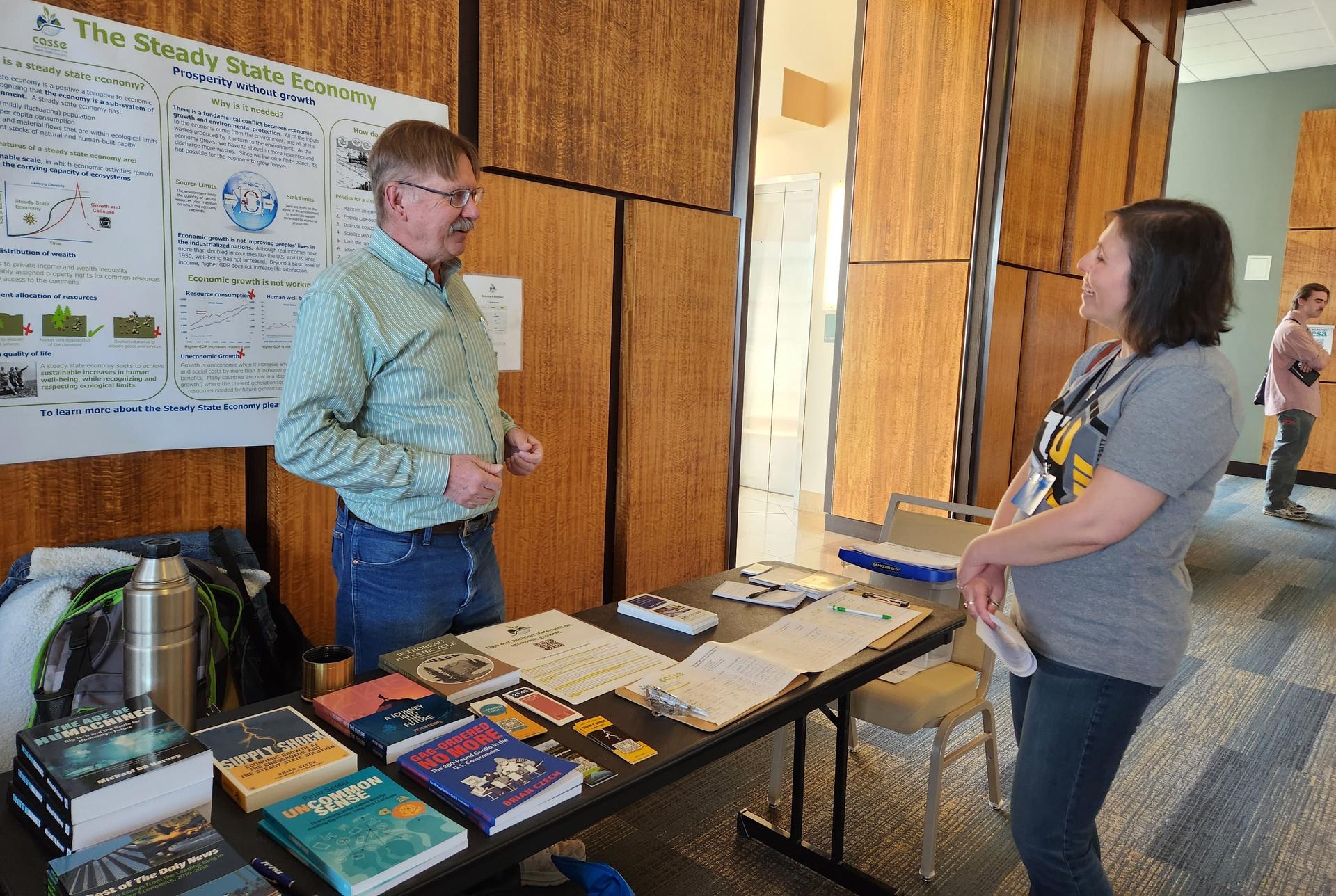
Czech talks with Didem Ikis, Towson University faculty member. |
|
|
|
|
On February 4, Extinction Rebellion DC hosted Brian Czech and Managing Editor Alix Underwood for a webinar on "Degrowth to a Steady State Economy." The recording lives on at the CASSE YouTube channel. |
|
|
|
|
Rodrigo Palmer is launching a CASSE chapter in Cornwall, UK, where he's pursuing a Business and Environment (BSc) degree at the University of Exeter. Rodrigo served as a Member of the UK Youth Parliament from 2022-24, campaigning for more ambitious local climate action.
Check out Rodrigo's writings on the steady state economy. |
|
|
|
Source: Matthew Beck/Citrus County Chronicle |
|
|
Big-picture refuge managers—like Andrew Gude—tend to be CASSE signatories. After all, what is a refuge a refuge from? Answer: The growing economy. Gude won the 2025 Paul Kroegel Award for Refuge Manager of the Year for his work at Lower Suwannee and Cedar Keys National Wildlife Refuges. |
|
|
|
|
This quarter, we published two Keep Our Counties Great case studies. Dave Rollo explored the battle against sprawl in Rutherford County, Tennessee. And Tom Olivier provided a local perspective on the fall from (and potential return to) green leadership in Albemarle County, Virginia.
Also, CASSE member Andrew Faunce was elected in March to the city council in Lebanon, New Hampshire. He arrives in office just as the city's master plan is being revised. |
|
|
|
|
Clifton Ware wrote a glowing review of Michael DB Harvey's The Age of Humachines.
"...over a year later, [Humachines is] finally becoming widely acknowledged as a primary source in explaining humanity’s current predicament..." "I found myself underlining at least 10-15% of the book, a habit I cannot resist when reading such an incisive book..." |
|
|
|
| "Thank you; we should have transitioned to a sustainable steady state 50 years ago. Better late than even later." |
Robert Whitlock, Olympia, Washington |
"I support the steady state economy model as the most likely path toward a sustainable, even regenerative, future that raises all ships." |
Mariana Altrichter, Prescott, Arizona |
|
|
|
| LynnAnnRose donated in honor of Nancy Huntington. |
|
|
|
|
Paul Ehrlich passed away on March 13 at the age of 93. Ehrlich was a giant in the field of population biology. In his 1968 best-selling book, The Population Bomb, he predicted that, if trends continued, starvation would kill hundreds of millions of people. The fact that his prediction hasn’t come to pass is partly thanks to his influence, which spurred many efforts to stabilize the population and empower women. |
|
|
|
|
John (Jack) Fordyce Marshall died on February 18 at the age of 85. The founder of Advocates for a Sustainable Albemarle Population (Virginia), Jack was professor of anthropology and public health and director of research in family planning for the World Health Organization. A forceful advocate for population stabilization and a steady state economy, Jack will be missed by many friends and allies. |
|
|
|
1100 N Glebe Rd, Suite 1010, Arlington, VA 22201, USA |
|
|
|
|