The Strait of Hormuz: Trump’s Waterloo?
by Brian Czech
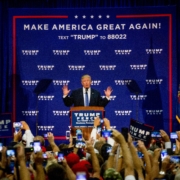
President Trump wants to be the King of GDP, but he might not make it through the Strait of Hormuz. (Quoteinspector.com, CC BY-ND 4.0)
Given his long-running obsession with GDP growth, an obsession punctuated with mid-terms in mind, President Trump has made some peculiar moves. Just this week, his stripping of immigrant truckers’ licenses took effect, as part of a broader crackdown on immigrant labor, a key source of economic growth. His hyperactive imposing of tariffs has undermined comparative advantage, a condition relied upon for global GDP growth. And now, with the war in Iran, the American economy is in for a heavy hit.
Only 20 days in, the war has already caused the biggest oil supply shock in history. We know what happened when that other iconic oil shock occurred, the OPEC oil embargo of 1973-1974. It turned a period of stubborn stagnation into the “Great Inflation,” the longest bout of inflation in U.S. history.
The Great Inflation was extended by the Iranian revolution in 1979, when again, oil supplies were sharply constrained. That ensured years of “stagflation” (inflation combined with recession) that no politician could fix.
Unless you’re an arms dealer or a war contractor, it’s hard for Americans to find a silver lining in Trump’s war. Young voters seem especially flummoxed. Even before he invaded Iran, they were “abandoning him in droves.” While it’s too early to tell for sure, war in Iran will probably exacerbate the abandonment and extend it to other age groups.
Strait of Hormuz: Achilles Heel of an Obese Economy
The global economy is roughly 82 percent fossil-fueled. The Big Three fuels are oil, natural gas, and coal. If agriculture feeds the economy (as it literally does), fossil fuels are the steroids that make it bigger and faster.
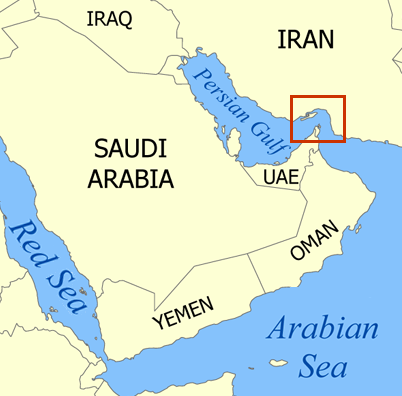
Strait of Hormuz: macroeconomic bottleneck. (Wikimedia Commons, CC BY-SA 3.0)
That makes the Strait of Hormuz the Achilles heel. Oil shipped through the Strait accounts for over 20 percent of global oil consumption. The oil comes primarily from Saudi Arabia, Iraq, the UAE, Kuwait, Iran, and Qatar. Nearly 20 percent of liquified natural gas (LNG) comes through the Strait as well, mostly from Qatar.
The King of GDP and his War Department are making a huge blunder by laying waste to Iran. Even with a bombed-out Tehran, Iran retains almost total control of passage in the Strait. Rather than the “unconditional surrender” Trump naively trolled them with, Iranian leaders have opted to choke off the Strait.
The Strait of Hormuz is now the torn Achilles tendon of global GDP. Perhaps the only silver lining is the environmental benefit of a smaller, slower economy (an entirely unintended consequence ). Unfortunately, not all else will be equal, as the oil shock will prompt Trump to “drill baby drill” even harder, domestically. And, exacerbating the war will itself take a heavy environmental toll.
Boots on the Ground and Boats in the Water?
Yes, the United States could invade Iran with boots on the ground and boats on the water, and eventually defeat the forces that control the Strait. However, those forces consist primarily of the Strait-smart Islamic Revolutionary Guard Corps (IRGC). American success is hardly surefire.
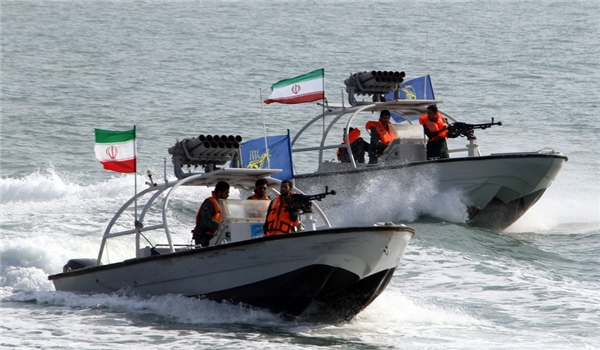
The Islamic Revolutionary Guard Corps Navy uses small, swift attack boats to converge upon commercial tankers. (Fars News Agency, CC BY 4.0)
Trump’s claim on Tuesday that the United States has decimated Iran’s military is misleading. No doubt Iran’s conventional navy has taken a beating, but the IRGC navy is another matter. They use small, dispersed attack boats to quickly converge on helpless tankers. They operate coastal batteries firing Qader missiles with a range of 120 miles. They possess huge stockpiles of naval mines. They have midget submarines and unmanned surface vessels, or “floating bombs.”
And suddenly, the IRGC has thousands of drones. They’ve learned to briskly manufacture inexpensive models, and for all we know, they may be receiving hundreds of drones per week from the 5,400 produced per month in Russia. These are the dreaded Shahed drones that have made life hell for Ukrainian troops and civilians. As a former U.S. Air Force pilot described, “It’s like having a sniper always following [you]. But unlike snipers, drones pursue you through open doorways and around corners. They chase you around obstacles and wait for you to emerge from a hiding place.”
The IRGC has an estimated 150,000 troops, 20,000 sailors, and can evidently mobilize a paramilitary force—the Basij—of 600,000 volunteers. It has allied, armed groups to call upon from Afghanistan, Iraq, Lebanon, and Yemen, among others. The Guards are accustomed to operating in a decentralized condition, in order to “overcome any vacuum in the absence of the supreme leader, the ultimate decision maker.”
Securing the Strait of Hormuz, then, won’t be the “little excursion” Trump has deluded himself with. It requires a bloody, uncertain, drawn-out war within a war that kills scores of U.S. troops while Trump’s popularity plummets in tandem with the rate of GDP growth. Trump will have only himself to blame, and not only for invading Iran. With GDP-obsessed leaders like him, U.S. citizens still don’t recognize the need for degrowth toward a steady state economy. They’re still not prepared to trade GDP growth for much of anything, much less an imbroglio in Iran.
The Other Barrel of the Economic Shotgun
Care to guess what else flows through the Strait of Hormuz, comprising nearly a third of another global supply? Hint: We’re not talking about saffron, dates, or Persian rugs.
It’s fertilizer, including urea, diammonium phosphate (DAP), and anhydrous ammonia.
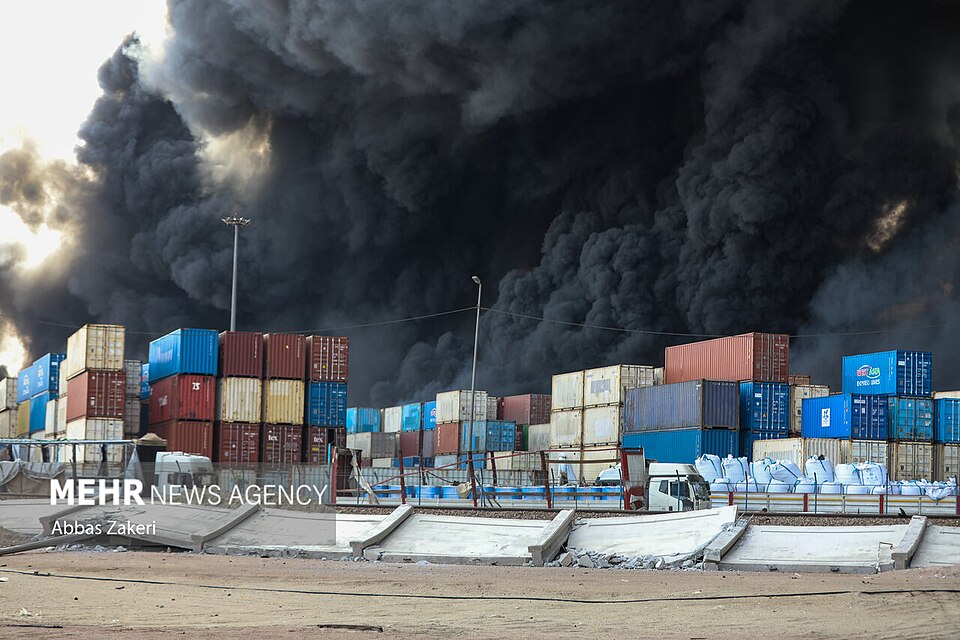
Cargo up in flames at the Shahid Rajaee Port in Bandar Abbas, Iran (April 26, 2025). One common fertilizer, ammonium nitrate, is highly explosive. (Abbas Zakeri, CC BY 4.0)
Urea is the most widely-used synthetic fertilizer in the world, applied to grain crops, root crops, and even leafy vegetables. These crops typically need a boost of nitrogen, and urea provides it. When phosphorus is limiting, DAP fills the bill. In alkaline soils, anhydrous ammonia is injected into the soil to help with nutrient uptake and to lower pH.
Fertilizer is a key ingredient in another revolution relevant to Iran, the United States, and global GDP: the Green Revolution. But as a result of Trump’s war, fertilizer prices are already spiking, according to Michael Werz, senior fellow at the Council on Foreign Relations. “In the Middle East,” he writes, “the price for urea rose by 19 percent within a week, creating new fiscal challenges for agriculture sectors across the globe.”
So far, American farmers have been partially buffered, because in many parts of the country, fertilizer supplies for spring planting were laid in before the war started. This is not the case, though, in northern growing areas, and the current choking of fertilizer flow may impact supplies for summer and fall applications as well. Again, this may not be a bad thing for the environment, but it portends human suffering in the form of hunger.
Backside of a Page in Putin’s Playbook
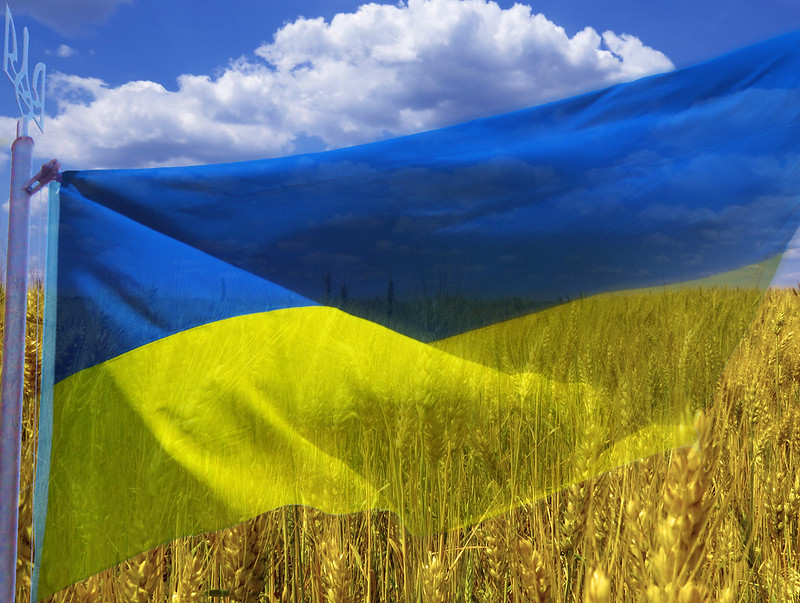
Putin wants Ukraine grain, and benefits from shortages elsewhere. (Valdemar Fishmen, CC BY 2.0)
One of Putin’s lesser-known motives for invading Ukraine was the rich black soils, or “chernozem,” that make Ukraine the bread basket of Europe. Russia already has a substantial chernozem belt of its own, bordering Ukraine. Commandeering the eastern half of Ukraine would connect these areas, providing Russia with perhaps the world’s greatest agricultural advantage.
An agricultural advantage in tandem with the vast natural gas reserves of western Siberia would provide Putin with a double-barreled shotgun of economic power to threaten foes and attract anti-West friends, far into the future.
In the case of Iran, similar logic is involved, but in reverse. Iran can punish the United States and much of the world by withholding petroleum and fertilizers—essentially energy and food— from the global markets. It is no coincidence that Russia and Iran have gravitated toward a strategic alliance.
For the United States, led by a football fan, it’s a bit like facing an offense (Putin) and a defense (Tehran), with special teams performed by the likes of North Korea and Belarus. On the twisted scoreboard would be U.S. and Russian GDP, or rather the rate of GDP growth. And with Iran blocking the Strait of Hormuz, the momentum has shifted toward the anti-West team.
Shortage at The Trophic Base: Essence of Inflation
Long-time Herald readers know that money originates—annually as well as evolutionarily—via the agricultural surplus that frees the hands for the division of labor and makes money a meaningful concept. That’s the trophic theory of money.
Pursuant to the trophic theory, a vast amount of agricultural surplus warrants a vast money supply to meet the vast demand stemming from a vast division of labor. Anything that lowers the amount of agricultural surplus likewise lowers the “warranted money supply,” the amount of money that mirrors real economic production. The pre-existing or “nominal” money supply is thereby inflated, with too much money chasing too few goods.
A corollary of the trophic theory is that, the closer a good is to the trophic base of the economy, the more influential it will be in determining rates of inflation. Agricultural production is at the very base. Close to the base, too, are extracted or harvested resources such as minerals, sawtimber, and fisheries.
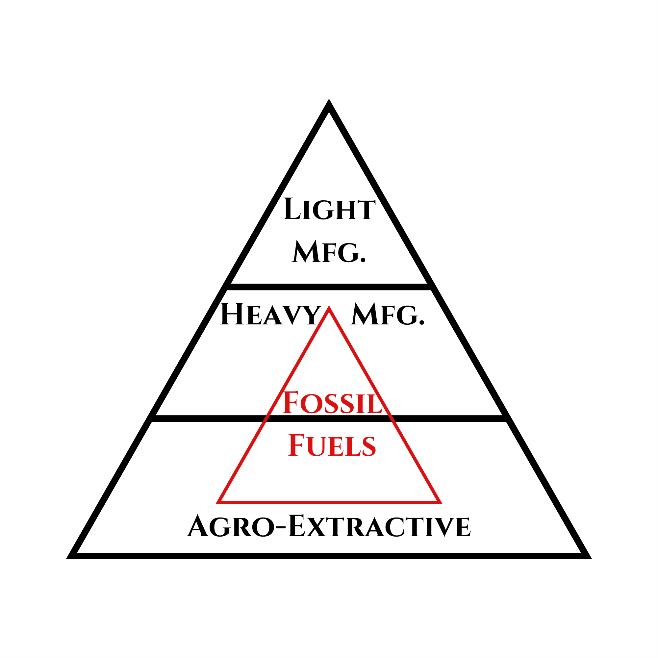
Commodity shortages at the trophic base of the economy—most notably shortages of grain crops and fossil fuels—are the most conducive to inflation.
Fossil fuels have a unique trophic niche. Similar to minerals, they are extracted directly from the earth (at the trophic base, in that sense) and, after refining, used just as directly in the production or operation of a vast swathe of economic sectors. A fossil-fuel shortage, then, is roughly as inflationary as an agricultural shortage, and in reality the two are tightly linked in the modern era of fossil-fueled farming.
Consider Putin’s war on Ukraine, for example. Especially in 2022 and 2023, it had a significant impact on Ukrainian grain production in the field. Grain exports were blocked, too, and large quantities of grain were destroyed in port. Ukrainian grain output is important enough that the war decreased the warranted money supply. Putin’s war, the covid pandemic, and aggressive fiscal stimulus coalesced into a perfect storm for inflation.
Putin’s war is still an inflationary strain on the global economy, and now it is accompanied by Trump’s war in Iran. Putin’s war hit grain harvests hard and indirectly impacted oil supplies, too, as European nations had little choice but to boycott Russian oil. Trump’s war hits oil supplies hard and indirectly impacts agriculture, as the shipping blockade in the Strait of Hormuz prevents the free flow of fertilizer.
What Can a President Do?
Citizens across the globe are being hurt by Putin and Trump. The bellicose ways of these autocratic politicians are causing inflation, unprecedented in scope. It’s a global cost-push inflation from the trophic base up; the type of inflation our monetary authorities have little recourse against.
The 2026 scenario of Trump’s war in Iran, Putin’s war in Ukraine, and other resource wars brewing across the globe corroborates what steady staters have long concluded: Peace is a steady state economy. And so is a stable dollar (and ruble and pound and yuan), as limits to growth are reached.
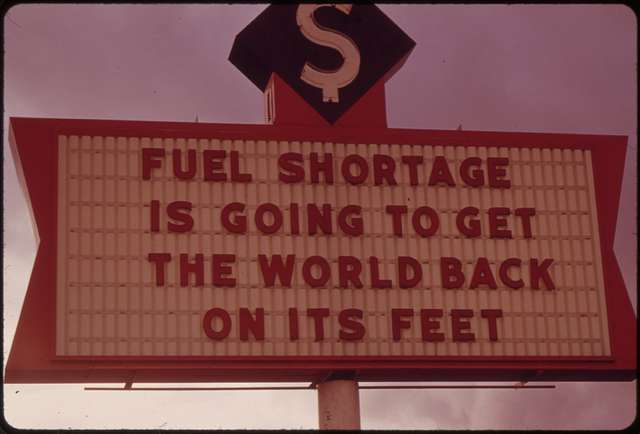
A clear-thinking, conscientious president would call for conservation at this point in history, connecting with hearts and minds in the process. (National Archives & Records Administration)
In response to 2026, a wise president would do what Jimmy Carter did on July 15, 1979. He would exhort Americans to conserve. Lowering the thermostat, shutting the lights off, and generally reducing consumption would go a long way toward mitigating the inflationary, recessionary effects of supply constraints.
And frankly such conservation would be good for the American soul. You couldn’t listen to Carter’s address without hearing that message between the lines. “All the traditions of our past, all the lessons of our heritage, all the promises of our future point to another path, the path of common purpose and the restoration of American values.”
But Carter was ahead of his time, and the “malaise speech” (as penned by detractors and shoddily adopted by the press) was eventually deemed a political gaffe. I’m not so sure it would be today. It depends a lot on the president’s personality, empathy, and sincerity. Treated like adults, concerned citizens can be woken up to limits to growth. Even AI gets it about limits to growth.
In some ways, Americans are now predisposed to support a steady state economy. They find exorbitant salaries and conspicuous consumption distasteful at best and increasingly unsustainable and unethical. They can connect the dots from greed to exceedingly risky wars.
Unfortunately, if there was ever an anti-Carter, it’s Trump. Carter was clear-minded and conscientious; Trump is confused and conniving. It’s a bad time for confusion because, approaching his 80th year on Earth, Trump faces a plethora of tough decisions. Many of these heavy choices—like what to do about the Strait of Hormuz—stem from his aggressive meddling in too many affairs.
Trump wants to be crowned King of GDP, but he badly wants a Nobel Peace Prize, too. Given that peace is a steady state economy, he’s not going to get both. It’s looking more and more like he won’t get either.
And the Strait of Hormuz? It may be more than an Achilles heel for the global economy. It may go down as the political Waterloo for Donald Trump.
 Brian Czech is CASSE’s Executive Director.




I have gotten some very ugly responses in my inbox—profanity included—by folks who evidently don’t want to reveal their positions here in Comments. Let me just clarify a few points:
1) I am not anti-American. I try to make my country a better place, and I have the opinion that Trump is a bona fide disaster for the environment, American culture, and international affairs. Being a critic of Trump’s War is logical (as spelled out in the article), and publicizing my rationale is more patriotic than not. I could be proven wrong about the extent and duration about the macroeconomic effects, and about the political consequences for Trump. Thus the question mark at the end of “Trump’s Waterloo?”
2) I am not pro-Iran; certainly not a supporter of the recent and current regime. I simply summarized the capability of the IRGC, and a country of 90 million, to turn Trump’s “little excursion” into a protracted quagmire with massive macroeconomic effects as well as senseless loss of blood and treasure. Readers should be well-aware of that capability before adopting an opinion on Trump’s War.
3) One blog article cannot cover every angle of a scenario. For example, I included nothing about Israel. My focus was very much about the macroeconomic effects of Trump’s War, the irony of these effects (for the King of GDP), and a mitigative, steady-state approach going forward, now that the damage is being done.
And for those who think I am over-reacting or hyper-critical of Trump…you should see for example: “Jeffrey Sachs: U.S. and Israel underestimated Iran” @ https://www.youtube.com/watch?v=NVMqYkvS98o . And Sachs is famously astute and measured!
A very good synthesis of events and consequences! Unfortunately for Israel, dominated by an autocratic aspiring leader (Netanyahu), they will get much of the blame for this. Partly it is their responsibility because of the present leadership penchant for hawkish policy but partly too, and this is what concerns me, because the Jew is always the scapegoat and trump will throw Israel under the proverbial bus faster than a jihadist can pull the pin on a grenade. Israel should never have bombed Iranian oil infrastructure. Sure its good for a steady state economy, but terrible for trying to stymie the growing outburst of anti semitism and totally out of character for Israel of the past 70+ years.
Much thanks for the well-explained and in-depth article. I was about to raise the question about why Israel was not mentioned, but you answered that sagely in the comments section. In addition, I echo your suggestion that we get Jeffrey Sachs’ analysis on this subject. He is a wise man. I would also suggest checking out what professor John Mearsheimer (West Point grad, U of Chicago) says about this war of choice. Finally, from a non-biased, non-nativist perspective, to understand (but not support) the Iran regime of today, we would need to understand the blowback that partially got us to where we are, from: 1953 BP-CIA coup against the democratically elected Mossadegh and covert USA support for the aggressor, Iraq/Saddam Hussein, against Iran, in the brutal 1980-88 Iraq-Iran war. Impossible to predict the nature and duration of blowback from this war of aggression.
Putin’s war slightly different.
It was after failed Bogus Minks agreements.
NATO had devious plan of dismembering Russia.
First, you have destroy Reserve Fiat curren(cies) which will end 500+ years of HEGEMONSTERISM.
You have build Economics on ENTROPIC CAPITAL & ENTROPIC FOOTPRINTS .
This an off-shot SSE.
That is, part of is to build Gold/ Silver (i.e. ENTROPIC CAPITAL) based currency
It’s a real slap in the face to US citizens, to talk about the economic-growth supplied by immigrant labor, while ignoring the greater economic potential of US citizens who are involuntarily unemployed or underemployed.
On a different point, the soil term chernozem should not be put in quotes. It’s a long-established term. I’m sorry the author and some readers may not have been familiar with it for as many decades as I have been.
Thanks for an informative and well researched article. Sorry you’ve been subject to hate mail. Other readers wonder why you omitted Israel. I wonder why you omitted China. Most of Persian crude goes to Chinese refineries, which sell the products globally but also retain for domestic industrial use. The Chump administration aims to withhold oil from China to get China to loosen trade policy to sell the US critical minerals (and products that use them) that China alone controls. The US wants to buy the minerals and their products from China for military build-up intended to further threaten and harass China. With no black inky stuff under its own land, China’s stored reserves can hold out just so long. Meanwhile, the US can keep extending the ceasefire, while making absurd demands on Iran, thus withholding oil from China indefinitely, while the *real* diplomacy with China goes unreported in the press. The ceasefire + blockade works in favor of the US, as they don’t have to keep firing their precious missiles that will take years or decades to restock. The US gov sees Iran as a twofer. It’s an opportunity to increase US control of Gulf oil, and a proxy economic war on China. What could go wrong? (smirk.)