The New Food Pyramid: Packing the Plate for GDP
by Brian Czech
Say what you will—pro or con—about the nutritional merits of the Trump Administration’s new food pyramid, but the thing is a masterclass in political artistry. It systematically serves vested interests, a political party, and an ever-competing president. And, I’ll argue, it’s subtly designed for a surge in GDP.
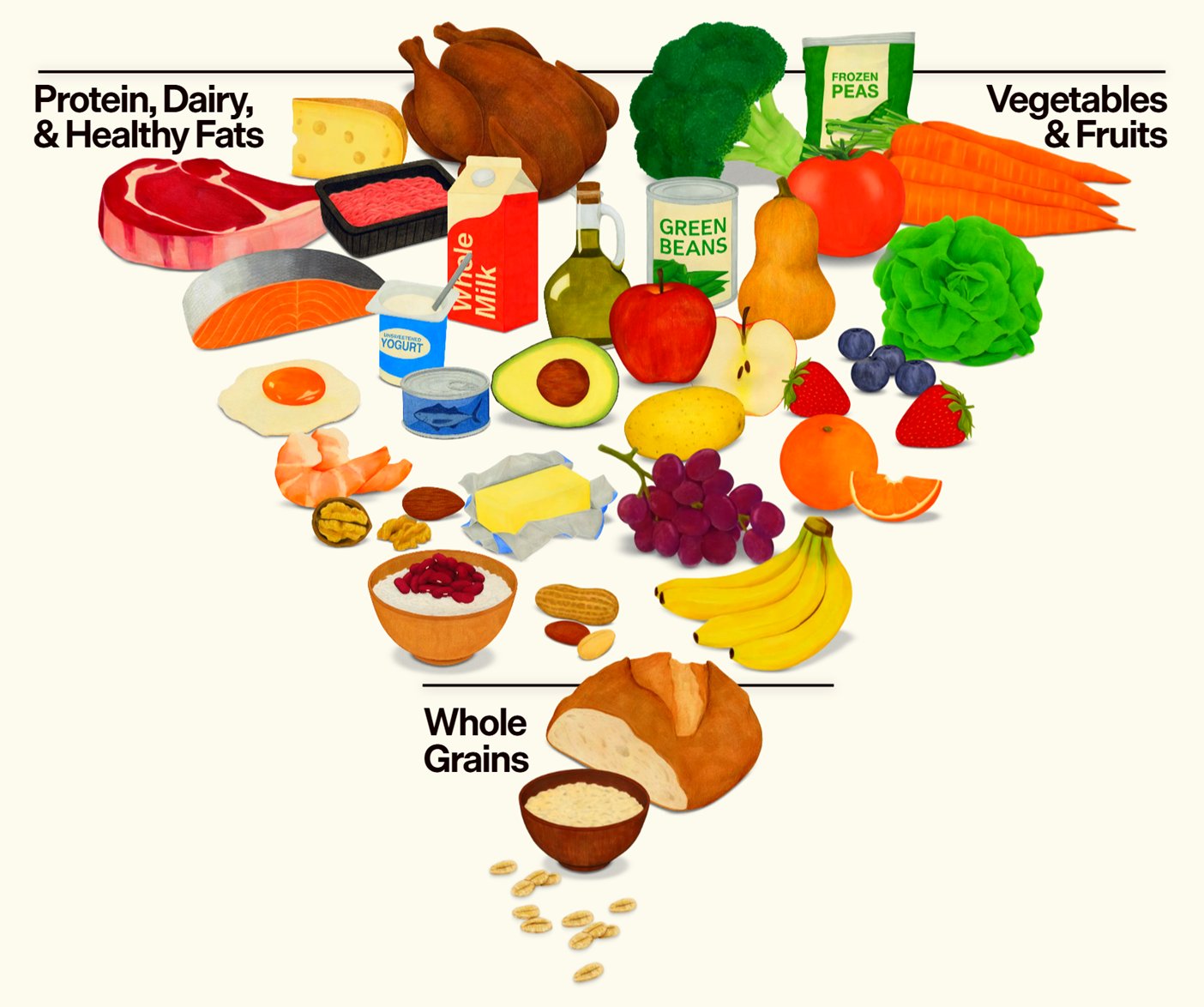
The Trump Administration’s new food pyramid: masterclass in political artistry. (RealFood.gov, Public Domain)
On its face, it certainly is an artistic endeavor, designed to grab you from several angles. The first thing to catch your eye is its surprising disposition. Why, this thing labeled a “pyramid” is not a pyramid at all! Not unless you consider an upside-down pyramid a pyramid nonetheless. Others, though, would view it as the opposite of a pyramid; a downright “nabla” in calculus terms.
So perhaps we have detected a subliminal message: President Trump has the power to turn all government programs upside down, as well as inside out or just straight off. And it’s a message he likes to rub into Democrats (aka “Others”).
Let’s have a closer look at this new concoction of comestibles and see what else we might find between the foodstuffs. Anyone else at the trough aside from the meat and dairy industries? Does it help us solve the “omnivore’s dilemma”? What are the implications for environmental and economic sustainability?
There’s the Beef!
With the new pyramid, no one’s going to be asking, “Where’s the beef?” There’s no way to miss that big, juicy rib-eye steak in the upper left, nor that ten-pound turkey tyrannizing the top tier. There’s also the pan of ground beef wedged in between, like a lasagna layer just waiting for the oven.

The new food pyramid is like free advertising—Big Advertising—for the meat industry, adding a new meaning to “pork-barrel politics.” (The Loomis Corporation, Public Domain)
The whole nabla evokes a colorful piece of pizza with all the toppings, but it’s the meaty top items that will especially catch your eye. Depending on your palate and political propensities, you’re likely to feel hungry, happy, hangry, or just plain angry.
If you’re a meat eater weary of the meat-wary literature, you’re a step closer to hog heaven. If you’re a vegetarian—especially for ethical reasons—your ire is hereby drawn. (Chalk up another “Trubbin,” a Trump rub-in combined with a drubbing.) Even if you’re neither, the mere size and placement of the meats will command your attention.
Now consider the fact that only four percent of Americans are vegetarians, while almost 90 percent eat red meat. No need to insult your intelligence by going further into the electoral properties of the pyramid. Whether it teaches anyone to eat better is up for debate, but it ought to be food for thought in Poli Sci 101.
And sure, there is also the standard special-interest steering. Four of the nine panelists behind the pyramid had financial ties to the meat and dairy industries. To wit:
- Thomas Brenna declared relationships with the National Cattlemen’s Beef Association, the Texas Beef Council, and the Global Dairy Platform.
- Donald Layman declared relationships with the National Cattlemen’s Beef Association and the National Dairy Council.
- Ameer Taha declared relationships with California Dairy and Dairy Management Inc.
- Heather Leidy declared relationships with the National Cattlemen’s Beef Association and the National Pork Board.
Gives a whole new meaning to “pork-barrel politics,” doesn’t it?
Mehmet Oz: Wizard of Growth?
Does anyone doubt that Trump has advisors recommending all the ways they can possibly think of to increase GDP? Kevin Hassett (National Economic Council), Scott Bessent (Secretary of the Treasury), and Howard Lutnick (Secretary of Commerce) make the Club of Growth look like an austerity measure. Beyond these high-level growthists, we should not be surprised if Trump has lower-level economists focused full-time on devising policies for GDP growth.
Remember, Trump claimed credit for “the greatest economy in the history of our country” during his first term, and must have been frustrated beyond reason as covid brought the economy to its knees. As with practically all presidential politicians, Trump still marches to the 20th century beat that hails GDP as the Holy Grail of Economics. “The greatest economy,” to him, means the biggest one with the fastest-growing GDP.
Now unfettered by covid, he wants to finish the job in his second term. Just this week he doubled down on the CBS Evening News, “Look, I’ve created the greatest economy maybe in history.” (Evidently the “maybe” was a bow to the pre-covid economy “he created.”) He wants to go down in the history books as the King of GDP, probably even more than he wants a Nobel Peace Prize.

Dr. Mehmet Oz, head of the Centers for Medicare and Medicaid Services, immediately after claiming that the new dietary guidelines will eventually increase American GDP by “trillions of dollars.” (The White House, Public Domain)
I suspect Trump has not only his cadre of economists keeping their eyes open for growth opportunities, but rather his entire collection of appointees. That would explain the lane-shifting of Dr. Mehmet Oz, the one-time TV surgeon recruited by TV-savvy Trump to run the Centers for Medicare and Medicaid Services. Oz was Trump-like with a wandering contribution to the rollout of the new guidelines, touching on Ozempic, schools, healthcare affordability, and Medicare taxes, among other things.
Toward the end of his part, Oz piqued the press, “But let me give you one last number.” He proceeded to describe how the new food pyramid could lead Americans—“so vital, so strong, so bullish about their future”—to retire not at the current average age of 61, but rather at 62. This, he argued, would “increase the overall GDP of our nation by trillions of dollars.”
Grubbing and Gorging for GDP
I doubt that President Trump is particularly interested in such long-term effects of dietary guidelines. He’s almost 80 years old with narcissistic tendencies, and his political concerns revolve around short-term electoral cycles. He wants GDP growth now. And he’ll get it from the new food pyramid.
While some lament its inversion (and some spoof it), the new pyramid might be more accurately described as tilted, especially in terms of ecological economics. Simply tilting it 60° to the right provides it a natural base of grains, fruits, and vegetables. In fact, tilted thusly, it becomes similar to the long-running food pyramid launched by the USDA in 1992, revised in 2005, and retained as the centerpiece of the Health and Human Services’ (HHS) dietary guidelines until the MyPlate approach commenced under President Obama in 2011. (Presumably the MyPlate website is short for this world, but hadn’t been taken down at the time of this writing.)
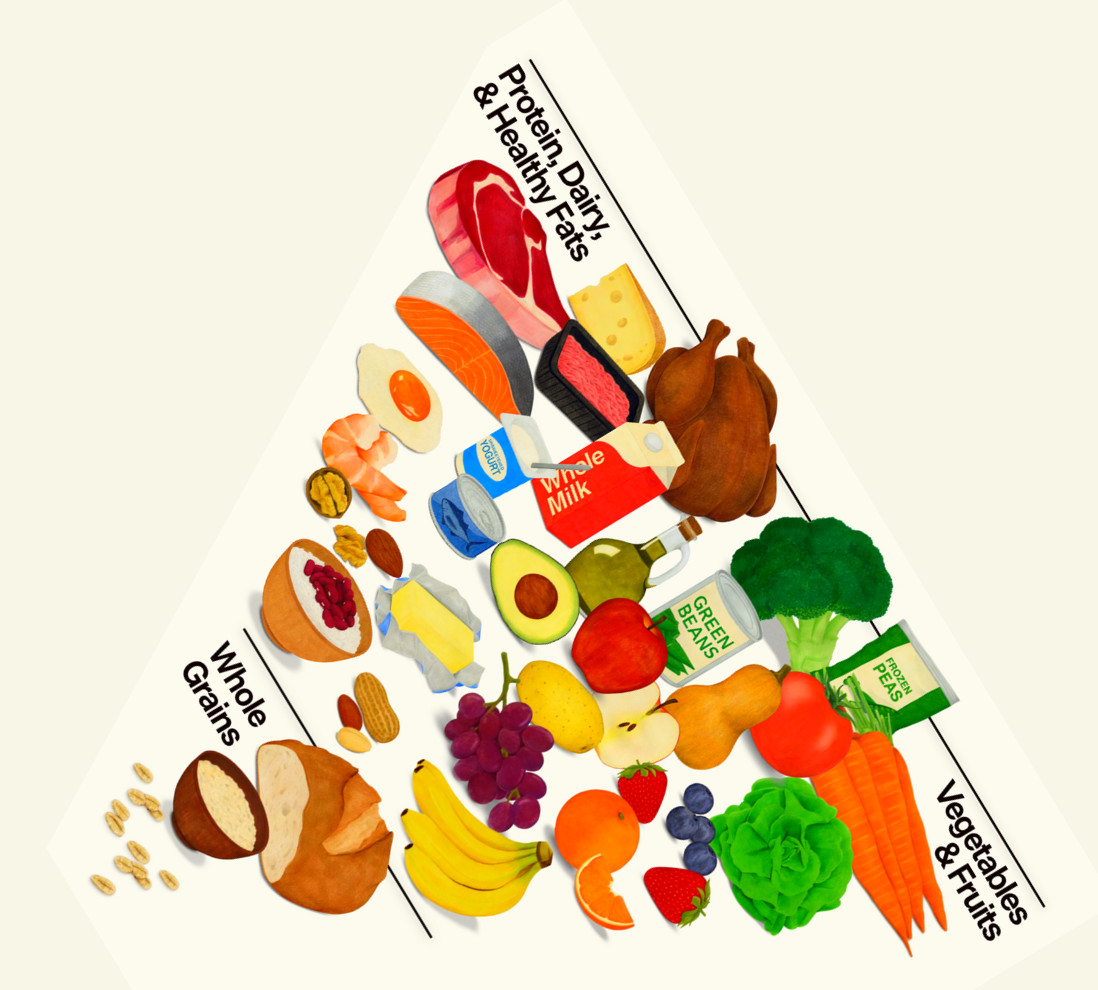
Tilted sixty degrees clockwise, the new food pyramid has a basic, ecological trophic structure comprising plants at the base and animal products above. Value is added—prices increase—moving up from the base. (modified by CASSE, Public Domain)
Tilting the new food pyramid also brings back its trophic structure, with plants at the base and animal products above. In the economy of nature, plants are the producers (via photosynthesis) and animals are the consumers. The old food pyramid with its natural trophic structure implied that we should be eating largely grains, primarily in the form of breads and cereal products, and plenty of fruits and vegetables. This implication was supplemented by detailed guidelines.
Animal products such as milk, cheese, and eggs were to be reasonably common in the diet. Animals themselves (beef, poultry, pork, and fish) would be consumed in lesser quantities.
Refined oils were included as healthy forms of fat, rounding out the macronutrients—proteins, carbohydrates, and fats—required for human health.
But the new food pyramid is not tilted thusly. It is indeed inverted, with profoundly different implications and guidelines. As Dr. Oz put it, the new pyramid “will dramatically change the natural history of how children are able to participate in life.” As an ecologist might add, our kids will be “eating up the world’s food web” and thereby increasing the trophic score of Homo sapiens.
I’m sure Oz wasn’t prompted to add, “By the way, friends, you’re going to be spending way more at the grocery store!” If anything, all involved would have been warned to keep this damnable devil in the details out of the rollout. But to the degree you adhere to the new pyramid, you’ll find yourself buying less of the cheaper items (grains, breads, cereals) and more of the expensive ones (meats, fish, and refined oils).
Big Deal at the Margin
Lest anyone think the new food pyramid is no big deal, or that few will heed it, think again. Dietary guidelines are not like government advice on bunk beds or magnets. The biggest difference of all is the level of relevance: Every single person on Earth must eat.
Next, consider that public schools are required by law to adhere to USDA guidelines. Adherence won’t take forever, either, because the National School Lunch Program is overseen by Brooke Rollins, the Secretary of Agriculture. She was the co-sponsor, with HHS Secretary Robert F. Kennedy, Jr., of the pyramid.
No, the new food pyramid will manifest in the schools faster than you can say “Medium rare.” And there is a long list of other federal and state food programs for seniors, low-income families, kids on summer break, and even prisoners. SNAP alone (Supplemental Nutrition Assistance Program) helped feed around 42 million Americans in 2024. That’s about twelve percent of the population! And SNAP, too, is overseen by Rollins.
Furthermore, Trump has considerable influence over those who vote for him. His base, especially, will passionately follow his lead, as they did with covid masking (or without it, to be more precise). This will especially be the case with something that many Republicans are already more inclined toward, like eating meat.
Democrats could hardly countervail the Make America Meaty Again movement by strategically lessening their own, already-lower meat consumption. In fact, they too could easily end up eating at a higher trophic level, if not with steak then with salmon or shrimp.
Perhaps vegetarians (regardless of party) would like to dietarily remonstrate, but they can hardly move any lower in their trophic selection. And they are few enough in number that their effects would be minimal.
Evidently, following the new guidelines will cost you about $175 per week for groceries. A bit of math gives us a current estimate closer to $100 per week ($1,000/month per household, with the average household comprising 2.5 people). Assuming a difference, then, of $75 per week, your monthly bill will go up about $300.
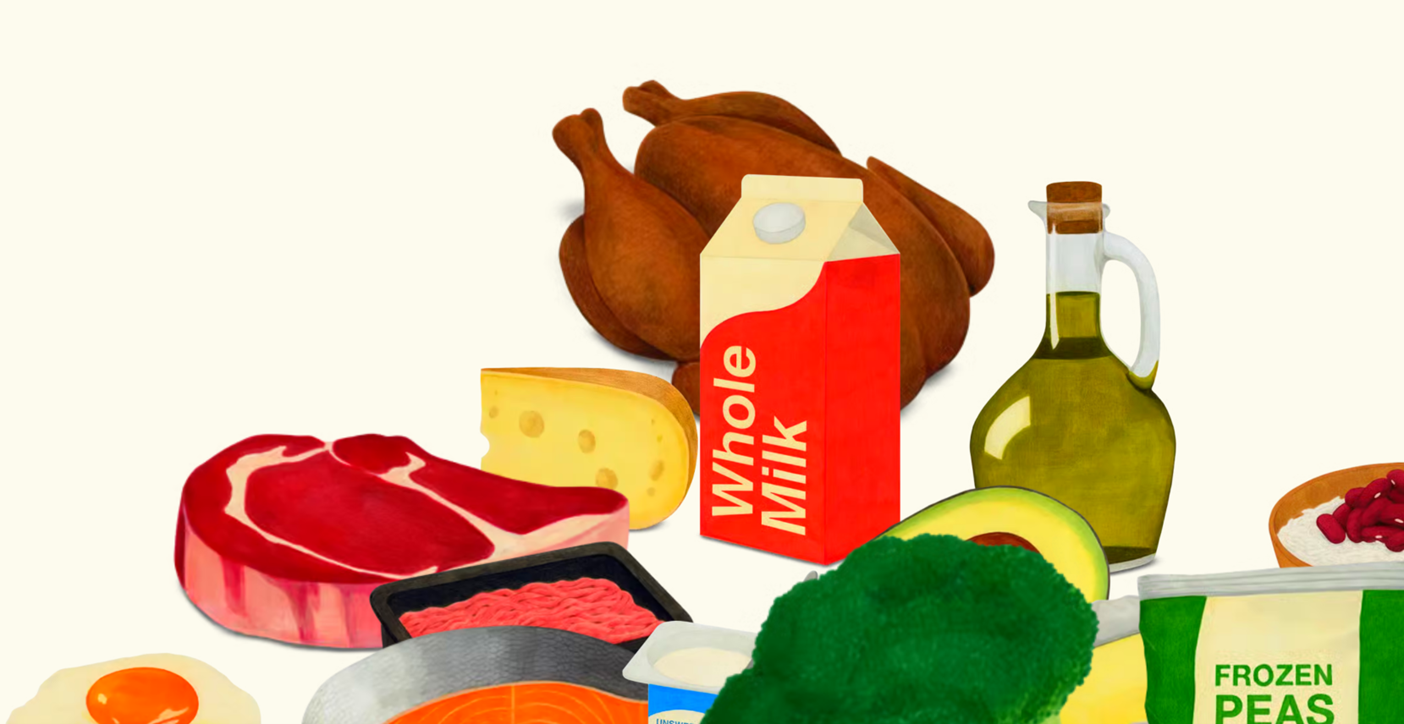
Prominent image from the realfood.gov presentation, 1/13/2026. “Every meal,” the guideline goes, “must prioritize high-quality, nutrient-dense protein from both animal and plant sources…” [italics added]. You’ll pay, and GDP will climb. (RealFood.gov, Public Domain)
Yes, the all-else-equal assumption (or “ceteris paribus” in econo-speak) is flawed. In order to follow the new guidelines, some will have to sacrifice other goods and services to afford their new grocery bill, moderating their contribution to GDP growth. But in a nation where disposable personal income is well over $20 trillion/year, “let them eat steak” is ready to rock the markets.
And the GDP pump is primed. For Trump, ever-hungry for the GDP crown, that’s the most appetizing item on the platter of public policy. But for a nation far into overshoot, it is systematically devastating, transcending today’s affordability issues and next year’s cholesterol levels. For years and potentially decades, the new food pyramid as GDP turbocharger will be undermining our environment, our economy, national security, and international stability.
 Brian Czech is CASSE’s Executive Director.





You’ve gotta be kidding me. “How dare they include ONE representation of a beef product in the food pyramid!” It’s OK to make the carrots look perfectly fantastic but not the beef??? And your admonishment that people should eat mostly grains “with plenty of vegetables” is way off. That’s not healthy. I’m speaking from personal experience. By eating fewer grains and lots of vegetables and fruits along with meat, fish, dairy, and eggs I control weight better. Americans are FAT because they eat too much grain along with excess fat.
This extreme resistance to healthy meat products is one reason that people like me have tuned out the self-styled environmentalists. (The other, larger, reason is of course the climate armageddon hoax and the dopey “solutions” like electric cars, carbon taxes, and windmills.)
Let’s not distract from the point of the article, which is that the new food pyramid was subtly and systematically designed for higher expenditure at the grocery store and therefore a surge of GDP (Trump’s obsession). That higher expenditure stems from eating higher in the trophic levels of the food system; a basic application of the trophic theory of money.
That’s the steady-state take, which is sadly lacking from the mainstream media.
And no, I didn’t “admonish” anyone for their diets. In fact, I positioned myself out of the nutritional science fray from the very first sentence, “Say what you will—pro or con—about the nutritional merits…” The part you quoted about eating plenty of grains and vegetables was a simple interpretation of the prior dietary guidelines, which I used to help demonstrate the natural trophic structure of the food system.
Brian wrote above that ” The old food pyramid with its natural trophic structure implied that we should be eating largely grains, primarily in the form of breads and cereal products,”…. while it placed cheaper corn flakes and sugar pops at the top of the pyramid and meats and other protein dense foods at THE BOTTOM.
Obviously shoppers will be influenced by the NEW PYRAMID as their wallets allow.. but to rant about NEW PYRAMID as an extension of the goal of expanding the GDP blindered is concentration on a STEADY STATER’s main message…. excluding the health aspects of attempting to nudge American eating habits in a healthy direction.
No, the old food pyramid did decidedly not put meats at the bottom. Have a quick look here: https://www.britannica.com/science/food-pyramid
Meats were (as I described in the article) near the top of the old pyramid. Now remember: It was a true pyramid (not an upside-down one) and implied that meats would comprise a substantially lesser portion of the diet, relative to grains and vegetables and fruits. In other words, it reflected the natural trophic structure of the food system.
The new, upside-down food pyramid also has meats at the top, but with an entirely contrary (upside-down) implication: that is, that you should eat a lot more meat. The least-expensive foods (inexpensiveness correlating with low trophic level) are deprioritized and lessened. Thus, the systematic rigging for GDP growth.
Climate hoax? Dopey solutions like electric vehicles that bring more jobs, cleaner air and water, and run on renewable resources? Wind turbines that produce electricity at much lower cost than coal or natural gas or oil together with the aforesaid cleaner air? Do you want our civilization to shoot itself in the foot and turn over a dying planet to our grandkids?
Whatever your views on diet are, anyone who claims that climate change is a hoax, even though it is scientifically and empirically supported, like most things you probably use (e.g., car) and people you consult (e.g., medical practitioner), is difficult to take seriously. Sounds like selection rejection of inconvenient truths to me. You are entitled to your views. I’m entitled to my views. Here’s one of mine, and it serves as advice to people – preaching by people who selectively reject inconvenient truths should be ignored.
We live in truly weird times. It seems as if the powers that be are not only not thinking about the future, they are pressing the accelerator to burn up our only habitable planet faster. It seems to be a psychological need of some kind.
I greatly respect and support RFKJ and his lifelong efforts to protect our environment and our health, including courageous efforts to lessen corporate capture of our government agencies, even as powerful corporate chemical and pharma interests have waged vicious campaigns against him. Meat is one component of the new guidelines’ recommended protein intake, along with eggs, seafood, beans, lentils, legumes, nuts, seeds, and soy. And the new guidelines emphasize fruits, vegetables, healthy fats, and whole grains as well. And, for the first time, government dietary guidelines are explicitly discouraging added sugar and processed foods. That’s amazing. It might be cheaper in the short term to eat refined carbohydrates and sugary foods, but it’s very costly over the long term. CASSE could have just as easily gone after the old dietary guidelines as a way to boost GDP through stimulating the pharmaceutical-industrial complex. (Why didn’t it? Please take care not to engage in bad faith, partisan politics). Our country has a chronic disease epidemic traced in part to diet and the new dietary guidelines are a good faith attempt to promote healthier eating, and this could arguably lower GDP. Thank you, RFKJ!
You wrote, “CASSE could have just as easily gone after the old dietary guidelines as a way to boost GDP through stimulating the pharmaceutical-industrial complex.” No, not nearly as easily. I don’t believe for one second that the old dietary guidelines were designed as a way to boost GDP through pharmaceutical spending. (Possibly a few nuts in prior administrations may have thought of such an effect as a bonus, but it wouldn’t have steered the guidelines or the outreach products like images and videos.)
The new food pyramid, on the other hand, would never have been released without the auspices of Trump, and it is more than conceivable that a surge in GDP was a succinct motive. No one is saying it was the primary motive. But it would be naïve to think it wasn’t one factor. It affected the writing of the guidelines and the artistry of the outreach products.
At CASSE, we do all we can to raise awareness of the ways and means with which a politician can pull out the stops for GDP growth, regardless of party. We know where to look. I for one was in federal service for over 20 years, including 17 in the DC beltway. I think I have a pretty good sense of how much GDP figures into the policy decisions of politicians. Trump is the most extreme case; probably in history.
With the pyramid, I found evidence to support my perception that Trump literally, explicitly has his appointees on the lookout for GDP-increasing policies and programs, as well as for touting the Administration’s GDP-growing effects. To wit: The quote from Dr. Oz. No way Oz says that without Cabinet-level growthmanship seeping into his public-service persona.
Finally, the article had nothing to do with RFKJ, or even the nutritional merits of the pyramid. Kennedy’s name came up only once in passing, whereas the very first sentence was, “Say what you will—pro or con—about the nutritional merits of the Trump Administration’s new food pyramid, but the thing is a masterclass in political artistry.”
No, I don’t think the previous food pyramid was designed to boost GDP, but it certainly helped- by encouraging processed foods as healthier (low fat, added vitamins, etc). OK this pyramid certainly has its benefactors but it is still a much better outcome in general. Many multi national food processors will not be happy. Laboratory meat will definitely be out!
The next step to really improving it is to swap grain fed animals for pasture raised, and replace chemical intensive horticulture with lower input methods.
Thankfully there is much less feedlot beef here in Australia but we still have to address the other issues.
Thank you for your measured insight regarding just one more manner of twist from this current disaster of an administration.
I can’t conceive of Drumpf advancing this except as being a bid to line his own pockets somehow (unless there’s a gold medal for GDP raising), as well as a way to curry favor with Ag industries. Kickbacks *and* awards? Time for a wa$teful parade!
That, pathetically, is his only focus in life: seeking recognition that daddy never gave, and appearing to be rich. Quite ironic, considering his record as a fantastic loser on a business level … and despised by all but cultists, and users of the same ilk.
All told, this pyramid, and the corresponding pricing involved, only serve to remind me to buy and eat a lot *less* meat.
As it is, I feel disgusted when strolling meat departments knowing how much ultimately goes to waste (regardless the pig fodder), the myriad resources used, and the resultant pollution.
Brian, there is a lot to say about the health implications of this, but I will stick to your main point, the GDP effect. Seen in isolation, it might be correct that higher food prices, regardless if you by more steak or premium whiskey, will increase the GDP, but in the end I don’t think that holds on a system level. Making food more expensive takes away consumption and production space in other sectors. If anything, I would say that higher food prices, just like higher energy prices are a drag on GDP. If the prices are higher because of overall inflation or because you choose foods higher in the trophic pyramid is probably irrelevant?
Thank you for addressing the main point! Alas, the article wasn’t a total waste LOL.
I did address, at the end, the compensatory nature of spending more on food and therefore less on other products — for some. The key phrase is “for some.” For those who are living paycheck to paycheck, the food pyramid won’t have much of an effect at all. However, as I also reported, U.S. disposable personal income is over $20 trillion/year.
Yes, a lot of that income is in the hands of Musk and the tech bros and other ridiculously remunerated CEOs and inheritors. But certainly there is enough elsewhere to make a significant difference.
All that helps explain why I used a relatively reasonable example of $300 more (spent on food) per YEAR instead of per month. If we went with per month, the annual GDP bump would be over a trillion dollars! But no, that is unreasonable for several reasons; primarily the compensatory spending and the (incomplete) degree to which the guidelines will be followed.
Your thought that the higher expenditures would actually be a drag on GDP would be correct if the higher prices were purely from inflation. But here the prices are stemming from eating higher in the trophic levels where more value is added, higher prices are warranted, and up-trophic profiteers re-invest.
If there was a drag, it would be longish-term (post-Trump).
Meanwhile, Trump gets the GDP bump he craves, with certainty and right now. And I do think, at some level (known to RFKJ or not), this effect was planned for and affected the artistry of the advertising (i.e., the pyramid and its website).
Thanks Brian, In Sweden the authorities estimate that around 5 percent of the population follows, or try hard to follow the nutritional guidelines. But obviously, when the guidelines are aligned to the actual consumption, the followers will be many.
In the US case it seems to me that the biggest difference between the new pyramid and the ACTUAL consumption pattern (thus not the previous guidelines) is about the rejection of highly processed foods, while the meat thing more or less reflect the status quo?
When I looked into recommendations for fruit and vegs some years ago, my conclusion was than almost all countries recommended a substantially higher consumption than the actual, but also that it is too expensive for many to eat them. https://gardenearth.substack.com/p/five-dollars-is-not-enough-for-five-day Fruit and vegs are actually more expensive than most animal product if you count calories and even more so on a protein basis. And poor people don’t go for vitamins, antioxidants and minerals, which are their strength.
Grains, potatoes and pulses are the cheap ones, but the consumption of roots and pulses fall when people get richer and grain is converted to various junk foods. https://journals.plos.org/plosone/article?id=10.1371/journal.pone.0062228
Well-put, Gunnar. And great question in your second paragraph.
I’ve lived all over this country: Midwest, Rockies, Northwest, Southwest, mid-Atlantic, and here’s my best guess: The U.S. will see a modest-at-best reduction in the highly processed foods consumption. Whereas, I predict a significant spike in red meat consumption. You’re kind of right that “the meat thing more or less reflect the status quo,” but “more or less” leaves room for a spike, and I’m sure it’s already commenced. Don’t forget those federal food programs I noted, for starters, but also households over vast cultural areas of the U.S.
The articles you linked to are outstanding—especially your Substack article. There’s a lot to unpack there, but it resonated with me as a small-scale (home-use) vegetable grower.
Your point about the high prices of fruits and vegetables per se (vs. the pulses) is congruent, too, with my argument about the GDP-serving artistry of the food pyramid. They’re not as high as the trophically higher meats—red meats especially—on a per-serving basis, but they’re far from cheap these days, especially if you go organic. You load a shopping cart with the items in that pyramid, roughly in the proportions they appear, and you’ll be in for sticker shock!
(And Trump will love the GDP effect.)
The assertion that the new food pyramid was subtly designed to increase grocery spending to drive GDP growth is backed by what appears as a partisan and incomplete argument. Consider that nutritional guidance has ALWAYS been shaped by industry, especially by lobbyists in the grain, dairy, and meat industries. The ecological role of cattle when managed regeneratively can build soil, improve water retention, increase biodiversity, and sequester carbon. Proven models of a health-ecology interconnection is found in Native foodways, and is being reflected outside of the US by professionals with titles that include Environmental Nutritionist and Agri-health Professional.
From a steady-state perspective, the most supportive dietary pattern appears to be a regenerative omnivorous diet rooted in Native and ancestral foodways, which simultaneously supports ecological and human health. Fixating on the image of a steak misses that it appears equally with vegetables, and with further guidance for nursing mothers and vegans, particularly in regards to B12, found in dark meat and necessary for red blood cell formation and nerve health on page 2. Mono-cropped grain systems promoted previously has driven farm consolidation. I cannot see how this was driven by GDP. RFK Jr’s friendship with Functional Medicine pioneer Dr. Mark Hyman likely informs his view that the systems of the human body are like that of the environment. An example would be that ultra-processed foods composed of wheat, sprayed with glyphosate preharvest. Recent and emerging research indicates that glyphosate disrupts beneficial gut bacteria such as Bifidobacteria and Lactobacillus, contributing to leaky gut and potentially to colon cancer, in addition to high consumption of processed grains leading to insulin resistance and type-2 diabetes. With this food guidance change I see human and ecological health are prioritized, with recognition of the importance of regenerative & small farms, and urban agriculture.
I can assure you the article wasn’t “backed” by “partisan” motives. Rather, it was backed by a “Trumpisan” reality. The fact that he happens to be in the Republican Party is incidental and almost completely irrelevant. His party is practically arbitrary; Trump is an in-it-for-Trump growthist who has changed parties five times.
For over three decades, I’ve been just as critical of Democratic growthists as Republican. I’ve noted many times the Clintonian propagation of the win-win rhetoric that “there is no conflict between growing the economy and protecting the environment.” Trump, though, is off the charts.
As for cattle… I’m a past wildlife manager, aware of the prospects for cattle management to “build soil, improve water retention, increase biodiversity, and sequester carbon.” Those prospects are real, but vastly overrated, in my opinion, by the likes of the Allan Savory, Holistic Resource Management fan club and network. The sane realization is that, sure, cattle grazing, especially in the West, is a relatively efficient mode of producing high-protein food in non-arable landscapes. But that’s not where the vast majority of U.S. market beef comes from. Rather, most of it comes from ecologically hideous CAFOs.
You can defend that food pyramid ’til the cows come home from the CAFOs, but it is naïve to think it wasn’t craftily drawn up with more than just RFKJ’s “functional medicine” awareness. Its artwork and the guidelines — “EVERY meal must prioritize… protein from BOTH animal and plant sources” — were clearly designed to serve the meat and dairy industry. And yes, you can bet a spike in GDP was part of the discussion.
I completely agree that the guidance to avoid ultra-processed foods is great. Frankly I see nothing new about it, either, except for the level of emphasis. The emphasis is great. But you must be able to read between the lines of the political ingredients that went into this food pyramid, in order to really understand the full intent.
Finally getting a chance to chime in here! Thanks Brian as always for your insights tying the growthist mandate into a major policy decision. Love the discussion of the trophic structure of a proper food pyramid, which would encourage us to eat low on the food chain. Such dietary choices use less energy, water, and land than animal products composed of other creatures who eat low on the food chain.
There is such a profound relationship between our dietary choices and ecological overshoot. Agriculture covers 40% of the planet’s ice-free land area, the vast majority of that for grazing or crops to feed livestock. That total would be dramatically reduced if we grew grains, vegetables, nuts, seeds and fruits to feed ourselves.
I must respectfully protest your claim that grazing in the arid west is an efficient means of producing protein! That conclusion only makes sense when you sweep under the cheat grass the host of externalities, like the invasive species introduced, the native wildlife killed to remove cattle predators and competitors, the water guzzled and land turned to monocrop deserts to grow supplemental feed to keep livestock from starving in semiarid landscapes.
Nutritionally, there is absolutely no basis for putting animal products at the top of an inverted food pyramid – the only possible rationale is enrichment of the industries that produce those things, which of course are major Trump donors. Not when the major causes of morbidity and mortality in the U.S., heart disease and cancer, are the result of excess meat and dairy consumption. Even if you do buy in to the meat industry propaganda that says we need dense protein, many vegetable foods contain loads of it.
I appreciate Kirsten Stade’s sane response, which shows that nutrition and ecology go hand in hand. Here in France, daily school menus are published each month. Once a week, the lunch is vegetarian. Organic items are included whenever possible. The menus and their chefs are monitored by non-sectarian nutritionists. The only “lobby” I see here is the parents, as these full course lunches look quite attractive to them (and to me when I had a kid in school). GDP is a non-factor here, and France is proof that you can have higher value eating with a lower value food GDP.