Why Is Simple Living So Complicated?
by Keith Akers
In industrially advanced countries, we have massively overshot the limits to economic growth. Climate change, peak oil, soil erosion, mass extinctions, and groundwater depletion are already biting into our well-being. Economic and social collapse seems to be the default.
We need “simple living”—the voluntary reduction of consumption—but on a massive scale. We need other things too, like social justice and cultural changes. But let’s focus on the economic logistics of simple living.
Simple living is actually not simple at all. In the United States, it’s complex, awkward, expensive, and sometimes downright dangerous.
For example, in terms of ecological impact and quality of life, bicycles are infinitely preferable to cars for most local transportation. But weaning off cars is just too much for the bulk of Americans.

It’s a car’s world. (Defense Visual Information Distribution Service, Public Domain)
Have you tried meeting all of your daily transportation needs on a bicycle or public transit? These modes of transportation are poorly supported in most industrially advanced countries. The occasional exceptions, like New York City, Toronto, and London, tend to prove the rule. You take your life into your hands if you go out into traffic on a bicycle. In the United Kingdom, for example, bicycle fatalities per mile are more than ten times the rate of fatalities in cars.
Such obstacles to lifestyle changes also exist in housing, medicine, and other areas of our lives, though in different forms. What makes simple living complicated is commoditization, the tendency of the economy to promote commodities to fill human needs.
What Is Commoditization?
“Commoditization” is not a well-understood term. My definition is based on Jack Manno’s overlooked and excellent Privileged Goods. The book may seem dated (published in 1999), but it has never been more relevant.
As used by Manno, commoditization is the process by which a commodity replaces a non-commodity, or by which a commodity with “high commodity potential” replaces a commodity with “low commodity potential.” It also refers to the tendency of the economy to gravitate towards increasing use of commodities and then to commodities with high commodity potential.
This is easier to visualize with examples, which Manno provides in abundance. For example, possible commodities in the field of health care, listed from low commodity potential to high commodity potential, include:
- Nutritional knowledge and lifestyle changes
- Doctor and nurse services
- Drugs, hospitals, and insurance
In this example, we’re not comparing effectiveness or appropriateness; we’re strictly looking at marketability and profitability, and these commodities are ranked in increasing order. The more marketable an item is, the more likely it is to attract the attention of businesses and be the focus of research.
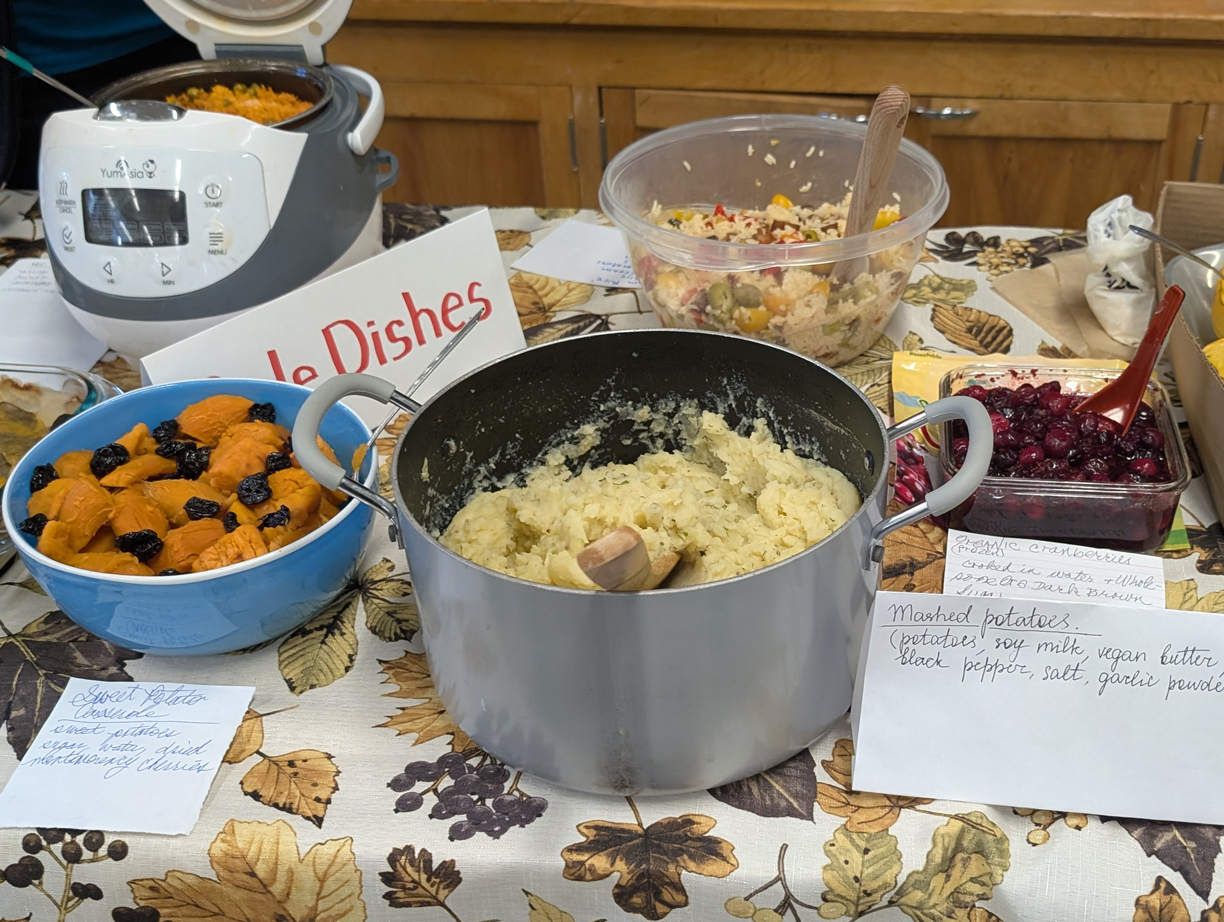
Healthy food, but not as profitable as drugs. (author’s photo)
Big business is going to be interested in hospitals, insurance, and drugs, because they are tangible goods that can be mass-produced. They are shelf-stable and predictable, and everyone understands what they are. Additionally, they are capital-intensive (buildings, manufacturing, banking) rather than labor-intensive (teachers, nurses, child care). Becoming a doctor or nurse is a good and well-paying individual career, but doctors can’t exactly be mass-produced.
Nutritional knowledge and lifestyle changes have even less commodity potential. The “products” aren’t tangible, and there’s little, if any, money in them. There’s no copyright on nutritional knowledge. If you’re willing to exert the effort, the information is available online and in public libraries. You can market it, and there are certainly nutritionists, health gurus, books on various diets, and the like. But it’s difficult. Nutritional knowledge can’t be mass-produced and sold in stores next to cold medicines.
Similarly, potential commodities in the field of children’s play, ranked roughly from low to high commodity potential, include:
- Group play (for example, with the neighbors’ kids)
- Childcare centers
- Barbie dolls
Possible commodities in the field of transportation include:
- Bicycle lanes and sidewalks
- Mass transit services
- Cars, roads, and airplanes
The same dynamics operate here. Our economy tends to reward commodities that are predictable, tangible, and resource-intensive over commodities that are variable, intangible, and labor-intensive. There’s a simple reason: They’re easier to market.
So What’s Wrong with This?
Commoditization isn’t necessarily a bad thing. Commoditization gave us widespread light bulbs and can openers. Issues tend to arise, though, when what best suits a human need diverges from what is most marketable.
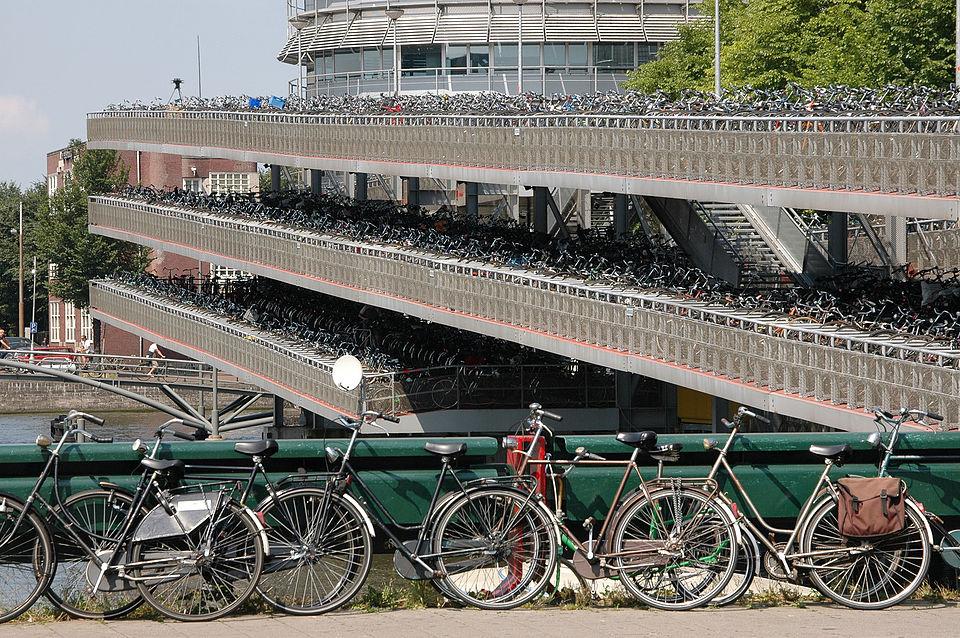
Convenient bike accommodations in Amsterdam. (AirBete, CC BY-SA 3.0)
When you consider the examples above, you can quickly see some possible problems. A key reason for our health-care crisis is that it’s easier to sell drugs and hospitals than nutrition education. So, drugs and hospitals get all the attention and research money.
Given the commoditization tendency of free-market economies, we need mixed economies, in which governments provide the infrastructure for simple living. If you want to enable people to use bicycles, you need bike paths. If you want them to take care of their health, you need to give them the necessary information (nutrition education in public schools).
The Problem of Cost
One key problem created by commoditization is that it tends to make goods with low commodity potential more expensive. We’ve seen this for years with health care, education, and the arts. Considering that we need many of these goods (or “gervices” as Brian Czech would call them) for healthy individuals and societies, we should be able to access them cheaply. Chalk up another market failure to modern capitalism.
This failure stems from a phenomenon known as “Baumol’s cost disease,” named after William Baumol, the late professor of economics from New York University. He suggested that the cost of labor-intensive, high-skill occupations such as hospital care, teaching, and the performing arts (concerts, plays, etc.) would become relatively more expensive over time because wages tend to rise about the same in all sectors, whether they are becoming more productive or not. “Productive” refers to how much an industry can produce with a given amount of input—in this case, labor input.
Baumol was talking about the same general phenomenon that Manno described, but from a different perspective. Baumol and his colleagues referred to health care, education, and the arts as “stagnant industries” or industries with low productivity growth. From Baumol’s perspective, when something is commoditized, automated, and mass-produced, it becomes less expensive. Manno’s high commodity potential becomes Baumol’s high productivity growth. Low commodity potential means, for Baumol, a stagnant industry.
People employed in stagnant industries tend to see about the same wage gains as everyone else in the economy. If wages in these sectors didn’t keep up with the rest of the economy, the people they employ would tend to quit. But we need them, so we pay what the market will bear (as with doctors and nurses) or reduce wages through political means (as with, all too often, unhappy public-school teachers).
At the heart of Baumol’s analysis is the notion that it’s intrinsically difficult to make labor-intensive industries more productive. It takes the same number of musicians to perform a Mozart piece today as it did in the 18th century. One doctor can only treat one patient at a time.

Can a conductor squeeze more profits out of his orchestra? (Steven Pisano, CC BY 2.0)
Yes, one teacher can teach multiple students at a time, and more with enough technology. But as classrooms (literal and virtual) get larger, students with special needs, special gifts, or idiosyncratic personalities are overlooked in the rush. This degrades education and demoralizes students.
Contrast all this with the productivity gains in information technology, which has seen astounding growth in the past fifty years. We can now hold in our hands a device that has orders of magnitude more computational power than what anyone had access to fifty years ago. If health care had undergone equivalent productivity gains, we’d all be living to 1,000 years old.
Government’s Role in Decommoditization
Although wage increases without corresponding productivity increases are a key factor, the reasons that costs rise for low-commodity goods are complex. They come down to the problem of relative cost, not absolute cost. College education isn’t intrinsically becoming more difficult to provide, nor are professors becoming lazy. It’s just that, proportionally, we tend to spend more and more on goods that can’t easily be commoditized. Regardless of the precise mechanism, we can’t doubt the outcome: Health care, a college education, and live music get pricier.
The solution to the cost problem, for Baumol, is to harness the immense productivity in some industries (mostly manufacturing) to finance ongoing government support of the so-called stagnant industries. In many societies, industries are already productive enough to achieve this. In other words, we don’t need more growth and could even afford degrowth. The key is to redistribute the wealth that is too often hoarded by owners, shareholders, and managers.
That’s where government comes in. Manno, alongside a host of other scholars, suggests increasing government intervention to support the sectors we need to flourish. Governments would provide or subsidize the infrastructure to support simple living: bike paths, restructured cities, health care, and education, for example.
Of course, infrastructure requires funding, whether it’s provided by the private or public sector. Therefore, increased government intervention should be coupled with tax reforms, such as those proposed in CASSE’s Sustainable Taxes Act. “Progressive taxation” would ensure the rich bear most of the inflated costs of stagnant sectors. Ideally, this would disincentivize excessive wealth accumulation and uneconomic growth. It should bring stagnant-sector costs back to a reasonable baseline.
Just as clearly, the funding can’t be unlimited. Sustainable fiscal policy includes not only sustainable taxes but a Sustainable Budgets Act. As with all matters economic, government faces hard choices in serving the democratic society that elects and supports it. But government is the main game in town for systematically and judiciously producing, providing, and protecting non-commodities.
Private enterprise is well-suited for producing commodities and many goods with high commodity potential. Governments get the leftovers: libraries, schools, and other goods with low commodity potential. Thus, private industry becomes productive and inexpensive, and government becomes “stagnant” and costly.

We shouldn’t let high-quality education fall victim to “productivity.” (Rawpixel, Public Domain)
The need for sustainable government spending doesn’t mean we should arbitrarily respond with indiscriminate budget slashing. This, unfortunately, is what we see today in public education, with declines in teacher salaries and educational achievement. There have been some attempts to increase the “efficiency” of teaching, such as learning videos, online courses, standardized tests, and recorded lecture series. But relying heavily on such methods tends to degrade the quality of the educational experience, compared to the old-fashioned way of doing things.
Ultimately, restricting education funds means teachers are unhappy and people have to pay for a decent education for their children. Private schools have been successful because of this, coupled with “culture wars” and the influence of the ultra-rich in politics.
Education is an example of a sector for which we should not shy away from a greater role for government. Government must also drive infrastructure changes and sometimes directly provide those goods that don’t make good commodities but are necessary for a simpler lifestyle. For example, government should be involved in putting nutrition education in public schools and in providing bicycle paths. These goods will result in less consumption of natural resources.
Simple living does require cultural changes, but it also requires government action to build out needed infrastructure and provide less marketable but resource-efficient alternatives to everyone. It is not enough to be individually frugal; we must work together to make simple living as attractive and available as possible.
 Keith Akers is an author and activist who blogs at CompassionateSpirit.com.



The best example of commoditization of a human right is access to fresh potable water. The efforts of Nestle and other corporations along with the importance of water to life make it a prime target for their greed.
Absolutely—you can make more money by putting it into a bottle and selling it to us!
They can only sell it to you if you buy it. It is a two way street. We tend to ignore our own role in creating the problem. Try finding a fridge or cupboard in a NA household that doesn’t have bottled water sitting in a fridge or cupboard within a few meters of sink that delivers clean drinking water at something approaching zero cost to the household. Until we look in the mirror and acknowledge that the problem is us and not some nefarious other we remain our own worst enemy. We react only in crisis. Long range (many generation) planning is, in general, beyond the reach of our collective intelligence. We are mostly an ignorant beast in the important ways relevant to long term survivability. Ignorance can be forgiven if not self inflicted. Unfortunately, we are also proving ourselves to be a stupid beast as we become less ignorant of such matters.
Yes, it is very much a two-way street.
Well, at our house we don’t use bottled water, but according to Vivreau, a company selling water dispensers, 34% of Americans use bottled water. That’s still a disturbing percentage considering that your kitchen sink provides essentially the same thing. In our heavily commoditized society, some people will find a way to make money selling people with what they already have.
But who sets up and benefits from this system in the first place? We cannot just blame consumers for everything. Companies seem to want to place the blame for environmental damage on consumers. They want to say (and often imply) that it is YOU who are putting plastic in the oceans, buying gas-guzzling cars, and so forth, deflecting criticism away from the companies or from our economic system. Changing the economic system won’t do the whole job, but it’s an essential part of environmental action.
True it’s not very easy to live simply and it’ll take both government and individuals to change that.
It helps a lot to have valuable relationships. Not just family and friends. Many people are isolated. In Australia, having a sense of belonging, loving my culture, history and country fills a gap that I do not need to fill with material stuff. It is enriching.
Living simply is not purely about logistics and economics.
Keith asks the question “Why is simple living so complicated?”
… and the answer is …. simple living is not complicated. Not at all.
The author mentions how terrible bicycling and public transit it. But never mentions walking for errands or doctor appointments or to the library or to good restaurants or to visit nearby friends or to the bank to, yikes, do banking in person! Walking is good for human health.
All three: bicycling, walking and public transit can be used as it appropriate to the task and the weather. Stop making excuses. Just do it.
As for healthful nutrition, fresh food is generally actually cheaper than overly processed food. And plant-based food (nuts, whole grains) provides more energy (as well as important fiber) … its energy dense that keeps one going a lot longer than sugary, processed empty calories. And apple costs 50 cents. A banana costs 20 cents. Plant-based protein for the body is healthful. Meat-based protein destroys the environment as well as human health.
Turning down the thermostat in the winter and dressing in layers saves energy and money. Buying extra clothing from thrift stores supports local businesses. Turning up the thermostat if one has to use air conditioning saves energy and money also.
Living a sufficient life is not a drudgery. People just refuse to think about how they consume … everything … because they think they have to buy new and more stuff all the time in order to be happy.
I repeat: simple living does not mean being poor. We live simply, that other species may simply live. We are rich, where richness is defined as contentment easily derived from simple pleasures.
We are elderly, low income residents of Santa Cruz, CA who do not “blame” consumers for buying stuff that makes money for the seller but who know that consumers, not sellers, are responsible for personal choices.
One final thought. I had difficulty with the word “commoditization” in regard to drinking water.
Commoditize is a verb that means a process in which a product is essentially deemed identical to the same class of offering presented by a rival company; whereas, commodify is a verb that means to turn something into or treat as a commodity.
Commoditization is about proprietary things becoming generic, whereas commodification is about nonsaleable things becoming saleable. Such as commodification of drinking water (bottled water)
Municipal drinking water systems do not sell drinking water as a saleable product to their residential customers. They tap a natural resource (rain water) and then they provide a service for which they are paid but on which they do not make a profit). Therefore, drinking water is commodified, not commoditized.
In general, Keith Akers presents theories to explain trends in mass culture. Jean Brocklebank presents ways to resist those trends. My mind is glad to have Keith’s explanations about a lot of what’s happening. My liver supports Jean’s lifestyle choices.
Keith provides an explanation about why the CASSE message is not more widely supported (aka, “what makes simple living complicated”), because of “the tendency of the economy to promote commodities to fill human needs.” An upshot of this analysis is that most people are expendable, because of their limited commodity potential. (Sorry people.)
Keith, you offer a solution, “Given the commoditization tendency of free-market economies, we need mixed economies, in which governments provide the infrastructure for simple living.” But how to encourage those trends, especially since, as you say, “unfortunately,” trends in the other direction are “what we see today.” Good goal, lots of evidence to show how it won’t work. Even the hope for progressive taxation to “ensure [that] the rich bear most of the inflated costs of stagnant sectors” is both an impressive goal and currently widely vilified.
Now what? Stay tuned….
Fortunately, there are more resources available beyond the “given … commoditization tendency of free-market economies.” For one, given the way people operate by habits, what are the possibilities for reaching people from within their habits, now with commodification normalized, to think that new possibilities with less commodification would be way cool? Or to express this more positively, many people (aka, commodified consumers) might like life with more playful children, more human-scale transportation, and more yummy food and funner socializing (on the way toward fewer doctor visits and less reliance on pharmaceutical drugs). Jean adds more support: “simple living is not complicated.” For example, “walking is good” and “fresh food is cheap.” Critiquing the bad is good; presenting the better for those habituated to the bad is a crucial next step.
Thank you, Keith Akers, for providing a good diagnosis of current negative trends and a hopeful portrait of ways to reverse them. The next challenge for CASSE supporters is to use the resources we have to encourage positive trends in the “beast,” to use Arthur’s word, in our fellow citizens, today habituated to commodities, but tomorrow? Let’s try to encourage the future we want to see.