Christ Didn’t Shop for Christmas Presents, Much Less Jets or Even Pets
Editor’s note: This annual essay originally appeared December 23, 2020 as “Christ Didn’t Shop…Much Less Jets or Guns.” The version herein is updated, and pets have replaced guns as one of the peeves.
by Brian Czech
With Christmas looming, folks are making tough decisions about last-minute Christmas presents. The public is rattled by inflation, credit card debt is through the roof, and gift-giving is a real strain for many. My advice for anyone stressing out over Christmas presents is simple: Take a break from the shopping!
It’s true that little kids galore are expecting presents from gramma, grampa, and Santa Claus. But is that a good thing to encourage? This year provides a chance for children to learn about the real meaning of Christmas. If you’re a Christian, the meaning should be simple enough to convey. Even if you’re not, Christmas 2025 is still an opportunity for teaching kids about material scarcity and the need to conserve. They’ll need such lessons for the rest of their lives.
Isn’t it high time for a re-set on the material expectations of Christmas? Christmas lights, reindeer ornaments, inflatable Santas, costumed geese, larger-than-life snowmen, Big Dots of Happiness…and that’s before we even step inside! Then in the house we have Christmas trees (chopped down or plastic), another set of lights, presents under the tree, and basically the whole set of lawn ornaments in miniaturized form, on and about the tree. Half of this junk is thrown out and replaced the following year.
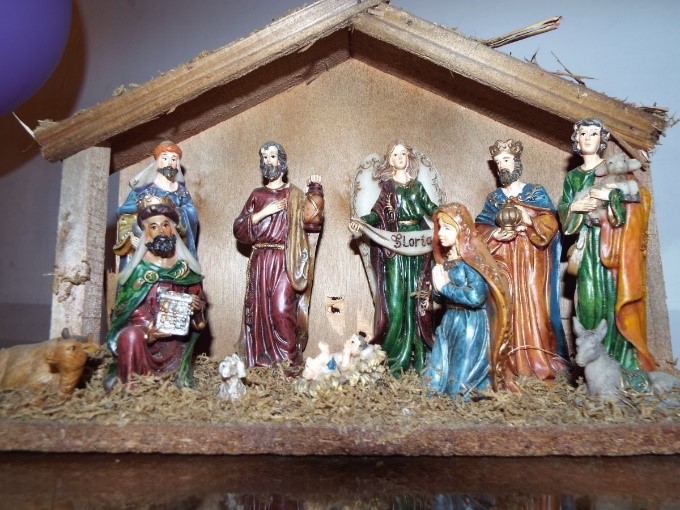
What happened to the little Nativity set, re-used for decades? It told the real story of Christmas. Made out of wood, no electricity needed, and possibly even hand-carved, it also told a story of sustainable consumption. I like to believe there’s no coincidence here. I believe, in other words, that Christianity and sustainable consumption are supposed to go hand in hand.
Christ Wasn’t Much of a Consumer
I’m no theologian, but I was born and raised a Catholic. I read the Bible and learned the Catechism. All that teaching left me with plenty of uncertainty that plagues me to this day. Yet there’s one thing I’d bet the entire farm on: Christ was no conspicuous consumer.
The New Testament—supplemented by biblical archeology—has a lot to say about Christ’s lifestyle, starting with food, clothing, and shelter. His diet was typically at the subsistence level, with plenty of fasting. He probably wore a mantle (a type of shawl), sandals, and a one-piece tunic; “extremely basic.”
It’s unclear whether Christ ever owned a home. As a child, he lived in a house with Mary and Joseph. A passage in the Book of Mark suggests he might have had a house as an adult. Yet he spent much of his life on the road—on foot—teaching whoever would listen, giving little thought to living quarters.
If Christ had a house at all, I’m guessing it lacked a swimming pool, wine cellar, and gold-plated bedroom.
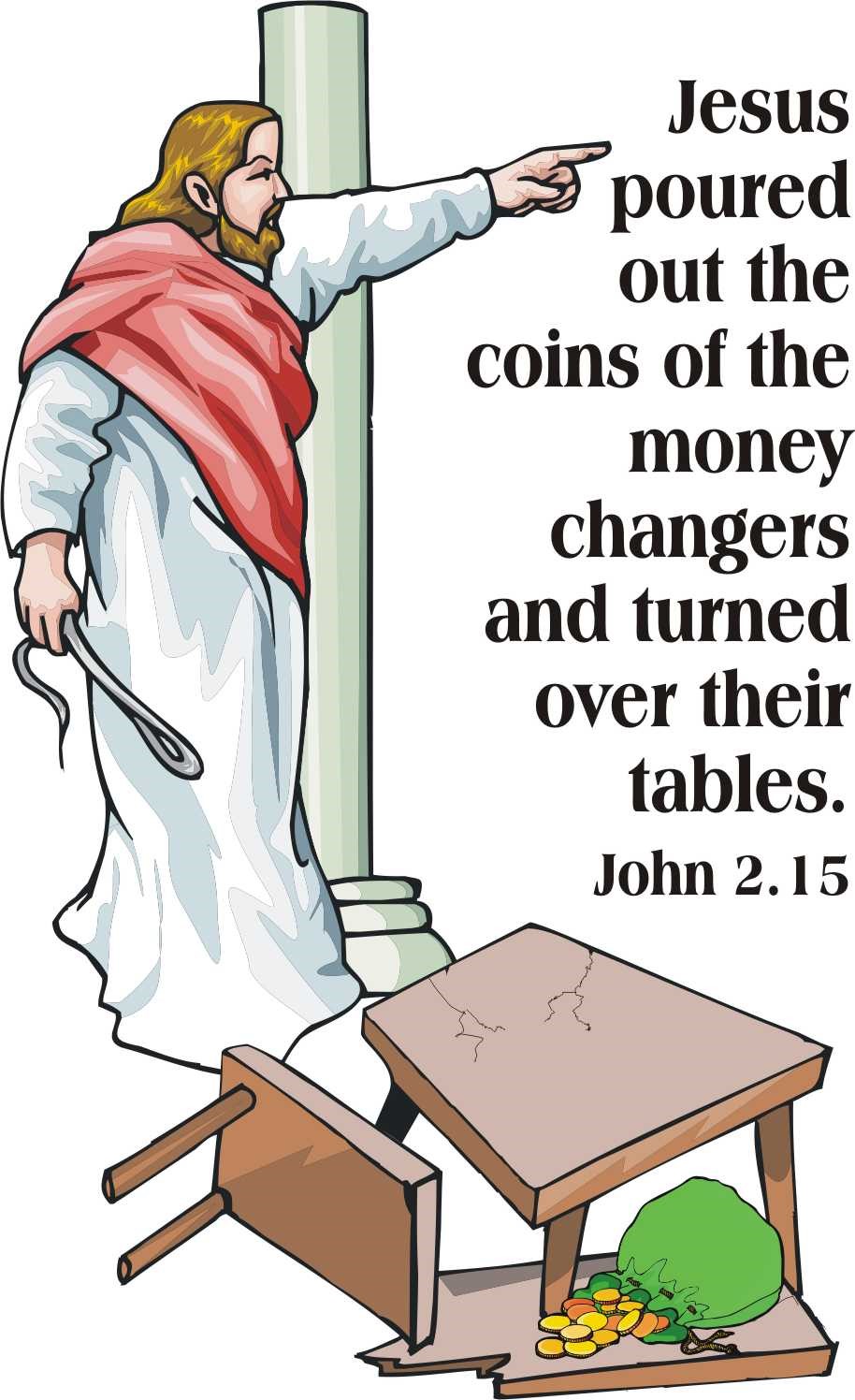
Let’s face it: Jesus wasn’t much of a shopper. The one time we find him interacting in the marketplace, he’s driving the moneylenders out! This we read in the Book of John:
“In the temple he found people selling cattle, sheep, and doves, and the money changers seated at their tables. Making a whip of cords, he drove all of them out of the temple, both the sheep and the cattle. He also poured out the coins of the money changers and overturned their tables. He told those who were selling the doves ‘Take these things out of here! Stop making my Father’s house a marketplace!’”
Of course, those were the days long before the study of “political economy” and debates over capitalism vs. socialism. It would be crazy to call Christ a capitalist, Keynesian, Georgist, or Marxist. But he sure didn’t find much redemption in the peddling of goods. His propensity to consume was off-the-charts low. That’s enough to know with regard to Christmas shopping.
“Prosperity Gospel”— A Theological Oxymoron?
Despite all we read in the Bible about Christ living frugally, we have (primarily in the United States) televangelist pastors who preach a so-called “prosperity gospel,” the notion that Christian faith will lead to material wealth. So, when you give to the church (such as for building a bigger church), it’s sort of a financial investment mixed in with your witnessing for Christ. Theoretically, then, you’d have more money for Christmas presents later.
This prosperity gospel goes back to the late Oral Roberts, and disciples today include the likes of Joel Osteen, Kenneth Copeland, and the unbelievably named Creflo Dollar. Dollar owns two Rolls-Royces, a jet, and multi-million dollar mansions.
Another prosperity preacher is Jesse Duplantis, known for inspiring his followers to buy him private jets. Evidently he’s had four of them. “Just burning them up for the Lord,” he says.
Whatever happened to the teaching of Christ, “It is easier for a camel to go through the eye of a needle than for a rich man to enter the kingdom of God” (Matthew 19:24)? Maybe with a jet, you can just blast your way on through there before anyone notices.
That reminds me of a little story. One time I was giving a talk to a small group of faith leaders in Washington, DC. They’d asked me to talk about limits to growth and provide a synopsis of the steady state economy. We then went around the group, maybe ten people in all, and discussed the issues. One minister stroked his chin for a moment and then, deep in thought, stated matter-of-factly, “The steady state economy; now that’s the Kingdom of God.”
As I recall, he was an Episcopalian pastor. While he didn’t elaborate with a theological argument, I think he was getting at the fact that Christians wouldn’t be conspicuous consumers. Instead, they would conserve, caring for creation and leaving room for future generations and non-human species.
Pet-Spending Peeves
In prior versions of this Christmasy concoction, after jettisoning jet culture, the focus turned to guns, starting with the particularly ridiculous notion of “God and Guns.” This culturally poisonous potion was a byproduct of a devolved Lynyrd Skynyrd, soaked up by gun nuts while Big Gun Money laughed all the way to the bank. Guns became a trendy Christmas present, touted by an ugly Santa Claus toting “America’s Rifle,” the mass-shooter’s AR-15.
Thankfully, that shameful episode in American culture has gone with the wind like a Lynyrd Skynyrd Tuesday. Not that guns have gone away—far from it—but the theologically asinine mix of “God and Guns” has been taken down by bona fide biblical scholars and common sense.
Too, Christ wouldn’t be concerned with only one cultural conundrum, especially on the sustainability front. At Christmas, then, neither should we. So, how about pets?

St. Francis of Assisi established a Catholic tradition of caring for creation, a tradition underpinning the theology and teachings of Pope Francis. (CC BY 2.0, Enrique López-Tamayo Biosca)
I for one have nothing against Fido, Bowser, or Bobo. But by God, with $157 billion going to pets in 2025, we’ve got another theologically thorny, unsustainable front to battle on (without the guns, of course).
“Jesus and Animals” is more edifying than “God and Guns” (to put it mildly), but I doubt that Christ would have ever considered cataract surgery for a canine, certainly not at $3,000 a clip.
Evidently American dog owners spend around $30,000 over the lifetime of the tail-wagger. Lifetime expenditures of cat owners are around $22,500 per kitty. Expenditures on the remaining pets pale on a per capita basis, but fish, rabbits, gerbils, hamsters, birds of various feathers, and reptiles of various scales all add up.
I refuse to put horses in the category of pets. That would open up an entire barnyard of animals and issues, including the proper theological treatment of sheep. Besides, my experiences across the States tell me that barnyard spending is not the culprit here. Agricultural animal husbandry is invariably a frugal endeavor, and the biblical roots are there for the finding.
In contrast, would Christ be paying $10,000 for hip replacement on a member of Canis lupus (familiaris or otherwise)? When, instead, $10K can provide tens of thousands of meals for starving children? When dozens of disadvantaged, indigenous kids can receive an education with $10K? When the Smile Train can fix 25 palates instead?
For those who are jaded on helping Homo sapiens, dollars can still be dedicated to wildlife conservation or environmental protection at large. In the process we protect the welfare of truly helpless, wild animals whose habitats (and whose selves) otherwise fall victim to the GDP bulldozer.
You don’t need to abandon ol’ Duke or little Luna to make the hard choices. If you’re a pet owner, you signed up for these choices. Sometimes the right way to go for an unhealthy pet is more rest, a little aspirin, or in the hardest of cases, putting an end to the days.
Of course, there is a long spectrum—as long as Madison Avenue—of potential pet expenditures ranging from doggie aspirin to tibial plateau leveling osteotomy. Along the way are sweaters for dogs, hats for cats, uncountable trinkets for fish tanks, plastic rabbit tunnels, super-silent hamster wheels, and custom aviaries with hand-crafted, thousand-dollar perches.
All of which brings us back to that $157 billion going to pets in 2025, with Christmas upon us. In fact, it brings us back to the broader theme of Christmas spending. If you’re pondering some last-minute Christmas shopping, perhaps a bit of reflection on what the holiday means will help. If Christ had the cash, where would it go?
Brian Czech is CASSE’s Executive Director.



 "General Audience with Pope Francis" by Catholic Church (England and Wales) is licensed under CC BY-NC-SA 2.0




“Leaving room for future generations” – five words that societies should live by.
Thanks, Brian, and Happy Holidays, steady staters! Adding to the conversation about the “pet economy,” it’s a crying shame–and a manifestation of the growth imperative–that, in the US, there are an estimated 10,000 puppy mills, 214K dogs kept solely for breeding purposes, 2.6M puppies originating from puppy mills sold EACH YEAR, and 1.5M dogs and cats euthanized by shelters (if this 2021 source is accurate: https://www.humaneworld.org/sites/default/files/docs/puppy-mills-facts-and-figures.pdf). What motivates people to spend (often) thousands on a dog bred in questionable conditions when there are so many existing furry friends in need of a home? In my quick search, I didn’t find puppy-industry profits, but they might have something to do with it…Big Puppy? hehe
That is pretty nuts. So basically in the US puppies are being bred on industrial scale, and then also being killed at an industrial scale because there are too many puppies.
Alas, there are just soooo many dynamics in the OECD countries, and the US in particular, that just make one shake one’s head in disbelief.
I am hoping that maybe in 100 to 200 years people will look back on GDP growth mania as another “what on earth were they thinking?” dynamic of our time.
Blasphemy so direct that literally nobody in this country wants to hear it.
Thank you!
Perhaps the so-self-denominated ‘Christian’ partisans in our allegedly ‘separate’ state apparatus will heed this clarion call.
Ha ha ha ha ha lol! That utterly free joke is my gift to you.
Thanks, Brian, and all the Commentators for these shoutouts on the meaning of Christmas beneath all the Tinsel-Angels-Consumption-Kitsch-andYarn—leaving most Americans caught in a very TACKY Christmas….
Your message, somewhere between your Episcopalian colleague’s endorsement of steady state living as the “Kingdom of God” and MLS’s labeling of your preaching as “Blasphemy so direct,” might suggest a new logo for CASSE’s masthead: Advocacy, Publications, Blasphemy, and a path to the Kingdom of God. How ‘bout it? Won’t that sell the product?
And for more ways to preach your, well, … sterling message, consider this inversion of the prosperity gospel, Reverend Billy and the Church of Stop Shopping, https://revbilly.com/, and their Christmas special, “What Would Jesus Buy?” https://www.imdb.com/title/tt0939681/.
Your send ups on hitching Christmas and guns and on extravagant pet spending are reminders of the power of what I call the Sentimental Industrial Complex. Hard parts of life, even including brutal choices, are often distracted from, smoothed over, or even warmly accepted if associated with enough sweetly sentimental stories or images. Pay no attention to that cruelty while looking into those puppy eyes….
A challenge for the new year: find ways to present limits on consumerist growth, while maintaining “room for future generations” as Cole puts it, and while enjoying delights in experiences and relationships not tied to material goods, more appealing to more people. Go for it, CASSE and friends, and Happy New Year!