Revisiting the Fight for the Final Forest
By Dave Rollo
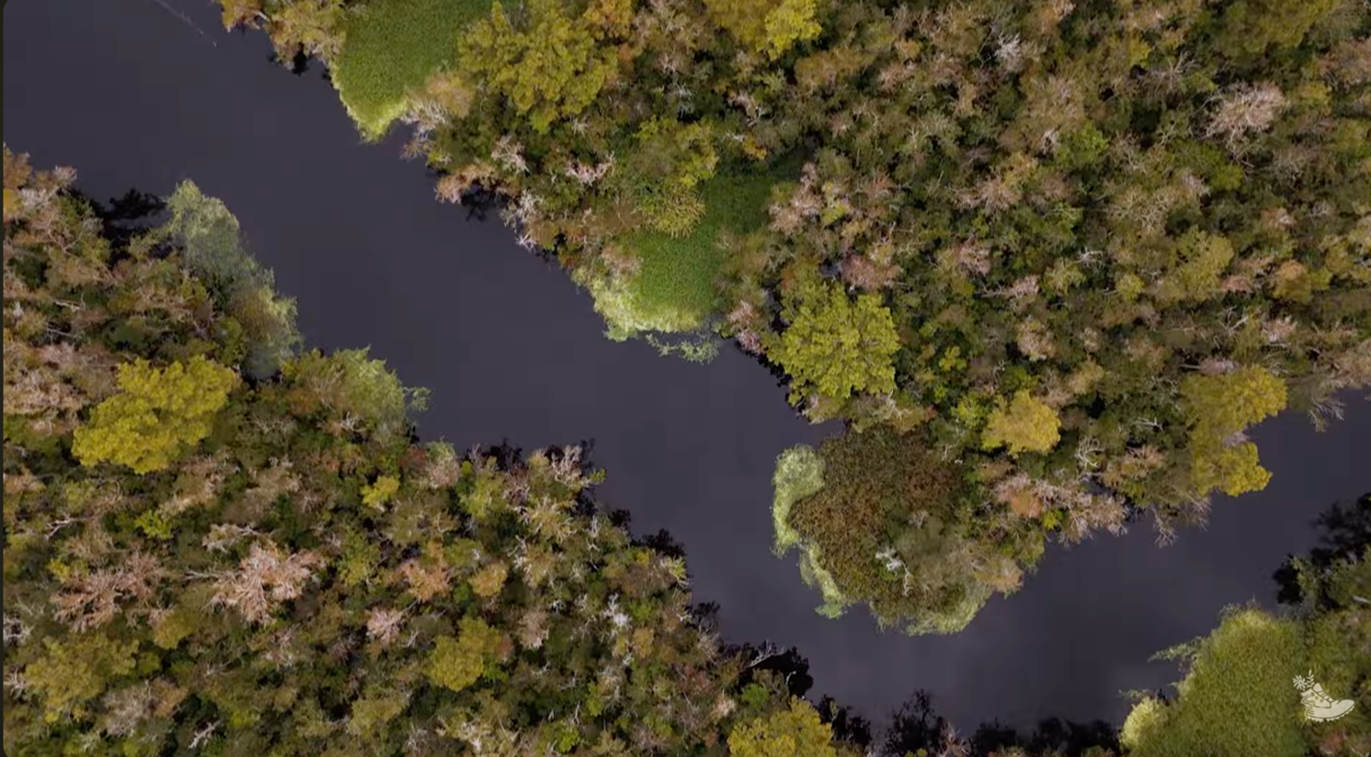
Aerial view of a Cape Fear River backwater in Sledge Forest. (Save Sledge Forest and Boot Scrap, The Last Forest: The Fight to Save Sledge Forest)
The fight to save Sledge Forest in New Hanover County, covered in the Steady State Herald this past spring, continues in earnest. As reported then, Hilton Bluffs—a massive, 4,000-unit development—pits county residents against Copper Builders, an outside developer. The proposal threatens what locals refer to as “The Last Forest.” The community’s resistance, spearheaded by the group Save Sledge Forest, has continued and grown, grabbing state and national attention.
One of the smallest counties in North Carolina, geographically, New Hanover is also one of the most densely populated in the state. The county has experienced approximately two percent population growth per year for decades. As a result of development pressures, Sledge Forest is the county’s last tract of ecologically rich, old-growth forest. To mitigate sprawl and protect rural areas, the county allows developers to concentrate housing units on smaller parcels. Defenders of Sledge Forest contend that Copper Builders misapplied density calculations to take advantage of this policy.
The owner of Copper Builders disagrees and claims he can carry out this massive project by right. The community is standing firm in their demand that the forest be preserved. Rallying in ever greater numbers, many thousands of residents are sending a message that the forest is too precious to lose. Activists hope that an entity with financial means will hear their message and step up to protect one of the most diverse and ecologically valuable wetlands in the American Southeast.
A Rare and Disappearing Ecosystem
Kayne Darrell, co-founder of Save Sledge Forest, describes the area as an ecological treasure. Encompassing several unique ecosystems, it is home to many rare and endangered plants and animals. In recognition of its value and vulnerability, the Old-Growth Forest Network added Sledge Forest to its national index of threatened forests in July 2025.
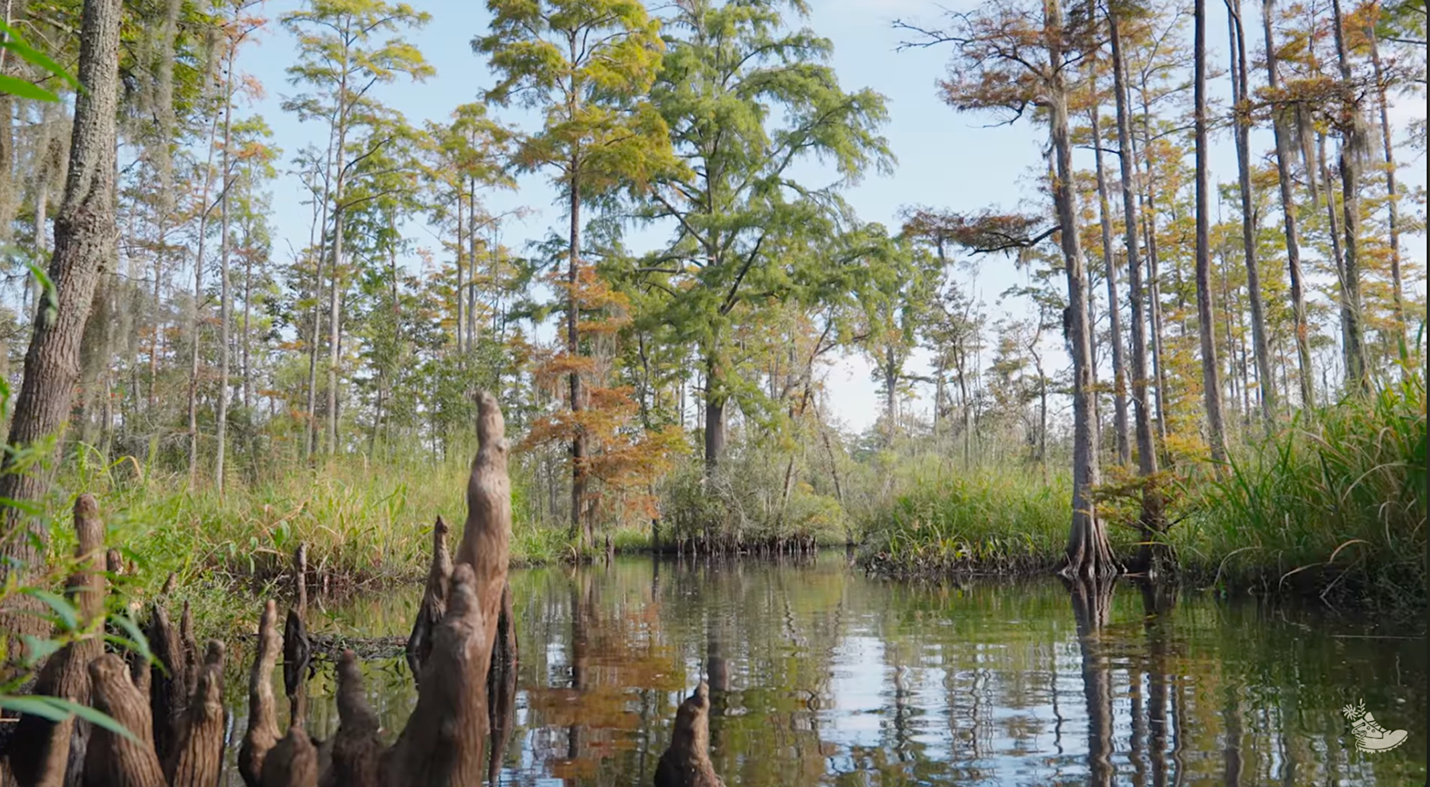
Sledge Forest contains several ecological communities, such as sandhill scrubs, wet pine flatwoods, and tidal swamps. (Save Sledge Forest and Boot Scrap, The Last Forest: The Fight to Save Sledge Forest)
The index notes the presence of 300-year-old pines and baldcypress trees over 500 years in age. Although it does not endow protection, the listing brings national attention to the value and plight of Sledge Forest.
Moreover, the North Carolina Natural Heritage Program now classifies Sledge Forest as a site of national significance, with thirteen imperiled plants and seven at-risk animals. The Alliance for Cape Fear Trees and the Cape Fear Sierra Club have also called for its protection. And on November 18, 2025, the Southern Environmental Law Center (SELC) issued an assessment of the forest’s ecological value.
SELC’s assessment stated that “[Sledge Forest] is the only part of the Natural Heritage Area with rare old-growth Nonriverine Swamp Forest.” SELC also noted that Sledge Forest “contains one of the largest occurrences of the Peatland Atlantic White Cedar Forest [a rare natural community type] in southeastern North Carolina.” SELC concluded that Copper Builders’ petition fails to comply with local code. They sent the assessment to New Hanover County’s Technical Review Committee, which met on November 19, 2025. Their decision is still pending.
A Loophole Exploited and a State Blow to Local Control
With the intention of protecting natural and agricultural space, New Hanover County government offers “density transfer credits.” This tool is meant to concentrate development by allowing the total number of units permitted on a given tract of land to be placed on a smaller portion of the tract. In other words, if I own 100 acres zoned for one housing unit per acre, I can use transfer credits to develop all 100 units on just 50 of my acres. This leaves the other 50 acres for preservation or, more commonly, agriculture.
Aerial photo of northwest New Hanover County with Sledge Forest, the last large forest in the county, outlined. (Save Sledge Forest)
Under debate, however, is whether areas unsuited to development, such as wetlands, should be subtracted from the total area when calculating unit allowance. In the case of Sledge Forest, Copper Builders did not subtract these sensitive areas in their density calculation. They maintain that a density of one unit per acre for Sledge Forest’s entire 4,000 acres can be concentrated in the forest’s 1,000-acre uplands portion. This loophole exploitation escaped notice until Copper Builders made their proposal for 4,000 homes.
Local activists don’t believe that any of Sledge Forest should be developed, uplands or not. Kayne Darrell asserts that, “[Sledge Forest] should not be developed on any level, because you can’t protect part of it without protecting all of it.”
The density debate has also taken center stage because Copper Builders’ use of the loophole has artificially increased the property’s value. At a lower unit density, Hilton Bluffs would be a less attractive investment. Consequently, it would be more feasible for a benevolent entity to purchase the property.
In theory, county government could address the intensive-development loophole by simply downzoning the area—reducing the units allowed per acre. However, this would likely be met with litigation. Furthermore, the state recently passed legislation to make downzoning illegal. North Carolina adopted relief bill S.B. 382 after Hurricane Helene struck the state. Slipped into the last page of the 103-page bill is a section placing widespread restrictions on downzoning. These included restrictions on “decreasing of density” and “reducing permitted uses” of any local zoning code.
S.B. 382 renders the use of zoning by County Commissioners to correct Copper Builders’ density calculations “invalid” and supposedly even “unconstitutional.” However, the developer’s petition will not be approved until the Technical Review Committee deems it adheres to county development ordinances. Key to their considerations is whether Castle Hayne— the rural community bordering Sledge Forest—has adequate infrastructure to support 10,000 new residents, or population growth of 833%! (The current population of Castle Hayne is 1,200.)
Violations Stoke Distrust
The debate over Sledge Forest’s fate is ongoing, but the developer has proceeded with what some say is callous disregard for local law. In April 2025, Copper Builders received a notice of violation from New Hanover County for illegal construction and land use at the Sledge Forest property. They had built a mobile structure without a building permit. The only penalty incurred was the cost of removal of the structure. Copper Builders states they are moving forward with their development plans undeterred.
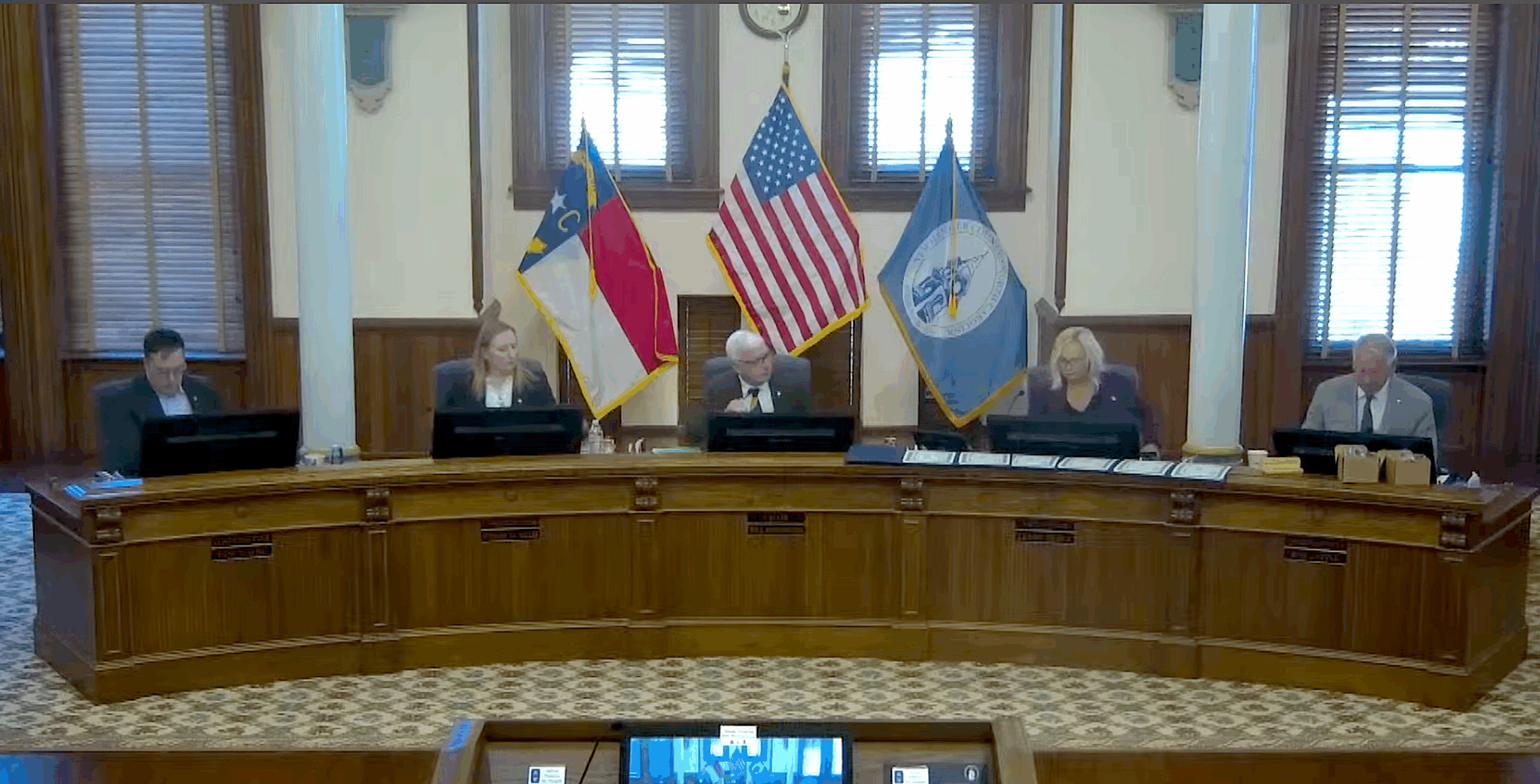
The New Hanover County Planning and Land Use Department issued several notices to Copper Builders for violating code in Sledge Forest in April. (New Hanover Planning Commission meeting in November, Public Domain)
Other infractions include zoning, floodplain, and Coastal Area Management Act (CAMA) violations. For example, the coastal community of Wrightsville Beach found that a Copper Builders luxury vessel was in violation of local ordinances. Copper Builders ignored the resulting fines until they were due to increase tenfold, then moved the vessel to Carolina Beach. Many locals see these violations as reasons to distrust the developer’s intentions. Activists warn that if the Hilton Bluffs development is allowed to proceed, Copper Builders will continue to blatantly disregard local rules.
Recently, Copper Builders created a look-alike website domain, savesledgeforest.com, to direct visitors from the Save Sledge Forest website (sledgeforest.org) to the Hilton Bluffs website. This further substantiated community distrust. In an interview for the Steady State Herald, Kayne Darrell said, “Attempts of cybersquatting to confound the public’s search for our organization indicate that our message is clearly resonating with the community.”
In a recent twist, the developer has submitted a plan for 1,800 homes, instead of the 4,000 originally proposed. The reduction of more than half the number of units was widely reported and was perhaps intended to portray a compromise. But, this proposal did not close the door on more future development. Thus, it has been interpreted as a phasing concept that softens the perception of the immense magnitude of the project.
The Added Risk of Toxics
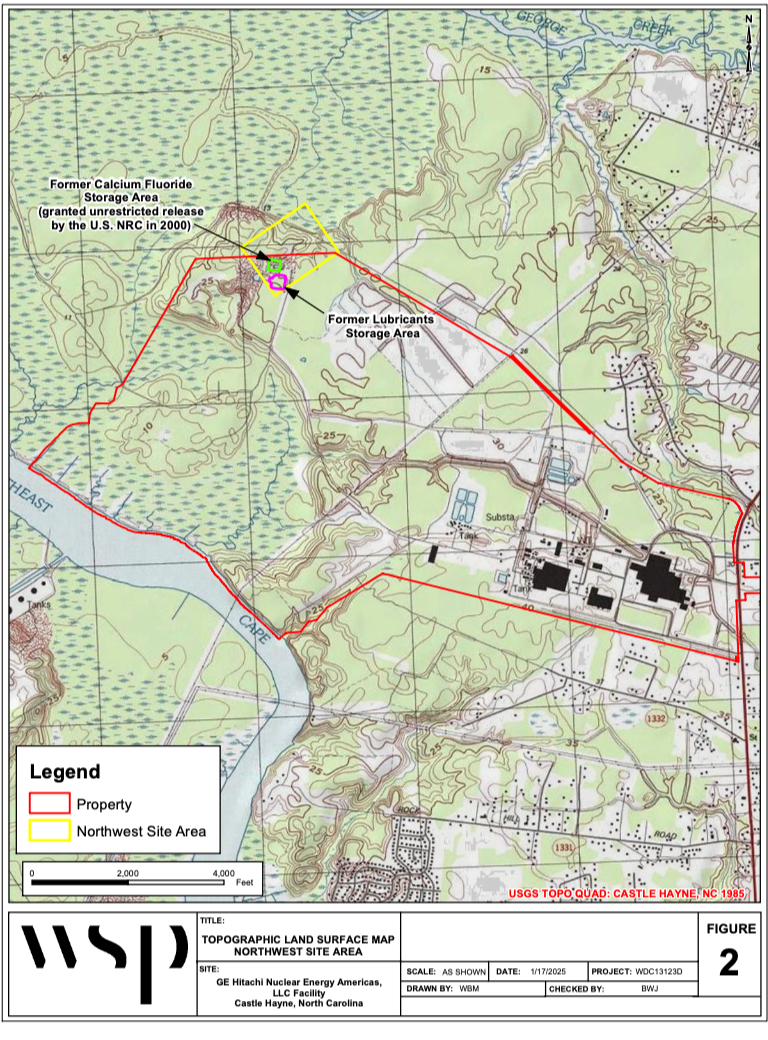
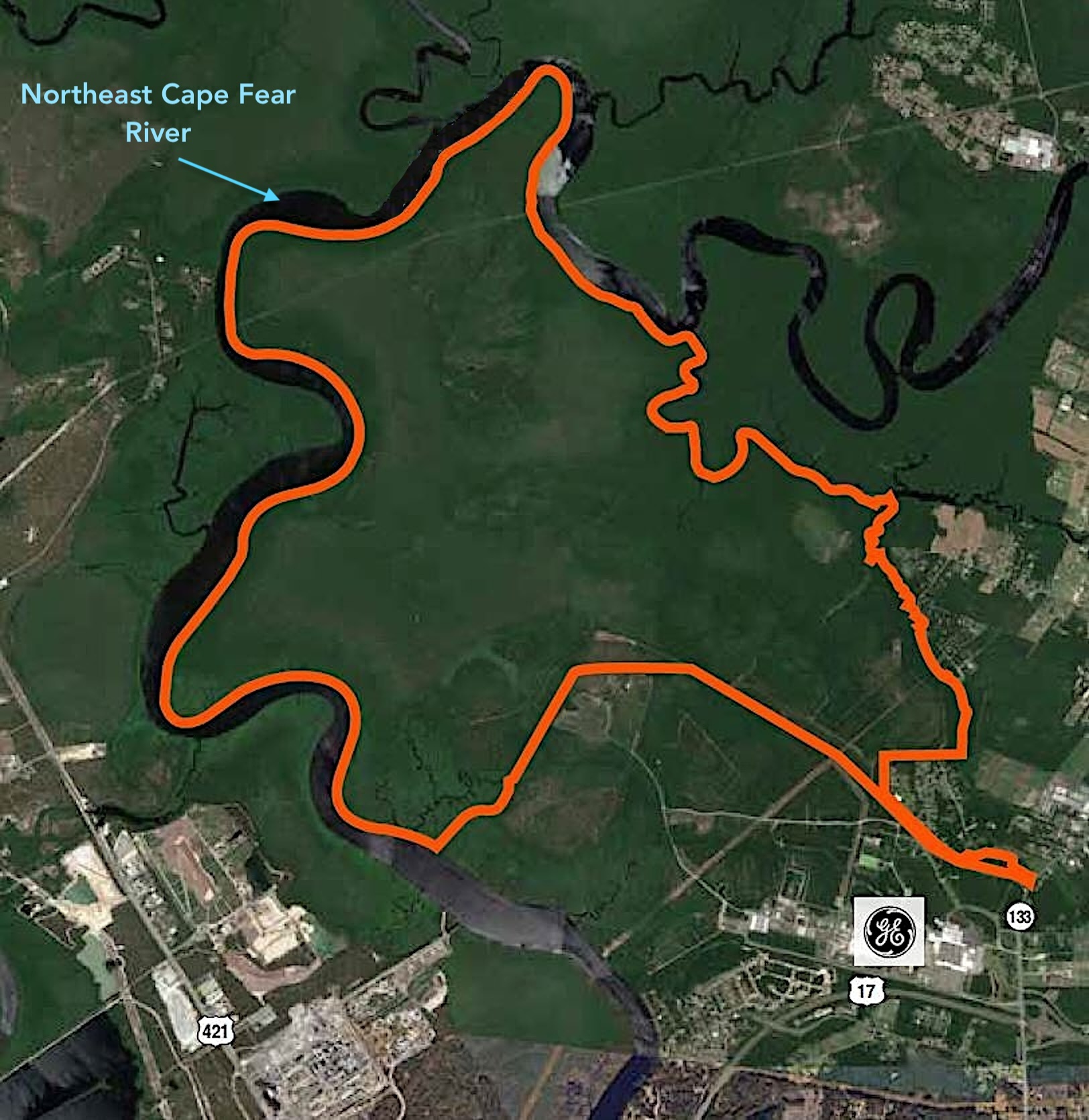
Development of the uplands tract could stir up contamination from GE Hitachi’s nuclear-energy facility, outlined in red. (NC Department of Environmental Quality, Public Domain)
Castle Hayne includes an area with known industrial waste adjacent to the proposed development. The waste includes chemical and radioactive materials from nuclear reactor fuel production at a GE Hitachi facility. Leachate from this waste is present in the groundwater. Residents are afraid that land grading for construction will disturb these contaminants, causing them to infiltrate residential drinking-water wells.
University of North Carolina-Wilmington geologist Roger Shew has raised concerns about the radioactive groundwater “plume.” Shew has made a plea for more testing to determine the risk of any land disturbances. Writing to the county commissioners, he notes that “there has been minimal or no testing on the Sledge Site,” and that more data is needed.
The potential to disrupt long-buried toxins has added to the unease of residents already facing the prospect of a nearly 10-fold increase in their rural community’s population. It has added urgency to efforts to protect the area from the pending 1,000-acre Hilton Bluffs proposal.
Building a Movement, Then Building Results.
Kayne Darrell describes the aim for 2025 as “Building a Movement” and for 2026 as “Building Results.” Raising awareness of the forest’s ecological significance and urging policymakers to intervene have been integral to this effort. The response to Save Sledge Forest’s message has been colossal, far exceeding the founders’ expectations.
According to Andy Wood, conservation biologist and co-founder of Save Sledge Forest, the movement tapped into existing sentiments. In an interview for the Herald, Wood said that overdevelopment has been degrading quality of life in the area for some time. “Traffic is worse, accidents are up, and infrastructure has not kept pace with growth. The consequences of growth have been ignored, and we’re now feeling the costs. Now, an outside developer has come to add more costs to the community, and people are fed up.”
Save Sledge Forest recently released a mini-documentary to inform the broader public of the threat to the vital ecosystem. Film for the documentary was shot from the vantage of a boat ride along the Cape Fear River. Andy Wood affirms in the video, “We’re speaking up. We’re speaking out. We’re not sitting down. It’s time for our policymakers to make note of that and do the same in defense of their constituents, not out-of-town developers.”
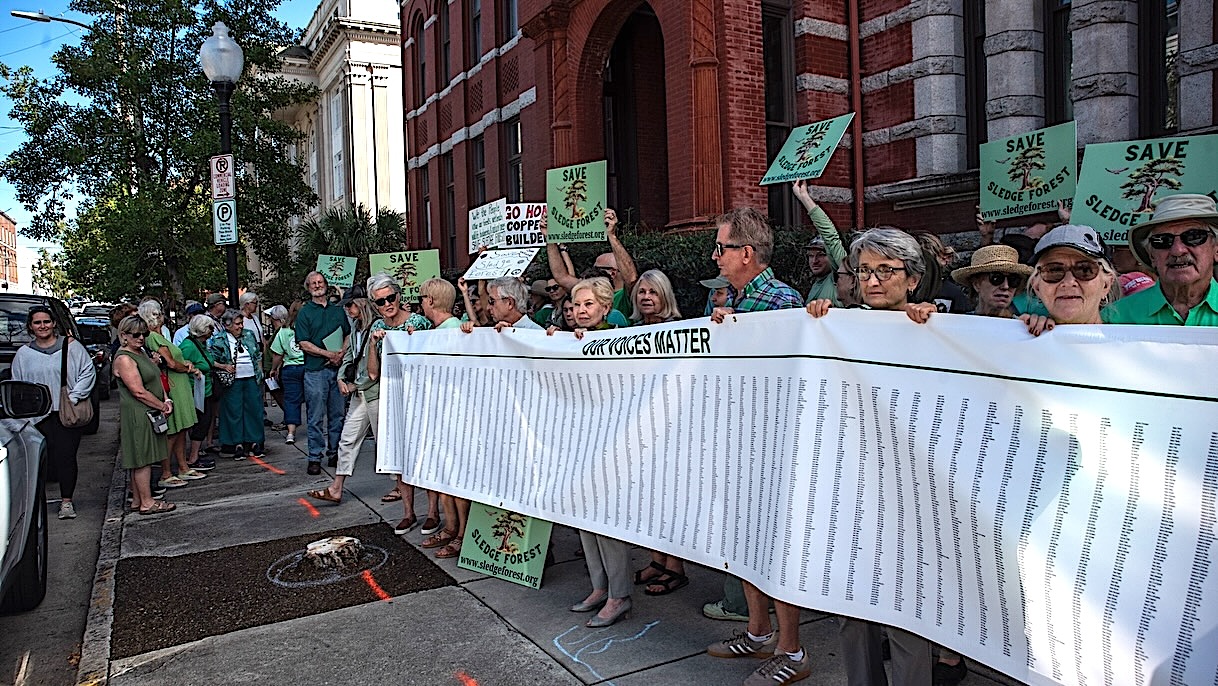
Community activists submit a petition with over 13,500 signatures to the New Hanover County Commissioners at their August meeting. (Save Sledge Forest)
Whether Sledge Forest’s wetlands should be part of the developer’s density calculations is a key consideration for policymakers. SELC’s findings suggest the answer is no, stating: “1. The Preliminary Plan relies on an improper calculation of the overall density of the Proposed Development,” and “2. The Proposed Development violates the density limit for clustered residential units in rural areas.” SELC maintains that a proper density calculation would reduce the development’s size by 80%, from 4,000 homes to 720.
SELC’s findings could give legal recourse for county officials to deny Copper Builders a permit for their proposed development. SELC’s interpretation of existing code would close the density-calculation loophole without violating state law by changing zoning. The profitability of the development would consequently be severely limited, and the real estate value of the forest would be much less than currently assumed.
This would align with Save Sledge Forest’s plan to find a philanthropic organization or individual to purchase the property for permanent protection of the old-growth forest. In a recent e-mail, Save Sledge Forest instructed its 13,000+ petition signers to share the mini-documentary with a few contacts. Spreading the message in this way may bring an interested buyer to the fore.
Battles such as the one being waged in New Hanover County are vital to curtail the continued degradation of the biosphere, one community at a time. Save Sledge Forest may prove that, working together at the local level, we can Keep Our Counties Great.
 Dave Rollo is a policy specialist and team leader of the Keep Our Counties Great campaign at CASSE.





Thanks, David Rollo, for this story—representative of many—showing some precious land facing prospects for development.
An outside developer, apparently with local government support and with the lure of profits, stand off against a rural community and some old-growth forest.
Listing with the Old-Growth Forest Network and Southern Environmental Law Center shows advantage Sledge Forest for protection. Debates over density suggest ways to reduce but not eliminate development, even as the loophole with the wetlands shows advantage Cooper Builders. Still, litigation over the company’s violations may slow its development plans as could exposure of the company’s look-alike website designed to distract from their impacts.
The company’s proposal for development with less than half the homes proposed seems a tactical retreat. But the “phasing,” as you put it, may bring enough destruction (of community and landscape), with future phases facing less resistance because of less to defend. Or in their defensiveness, are they turning or could they be persuaded to turn to building with more of nature left intact? How much is that possible?
Through all this, potential dangers from building on or near industrial waste sites should be reasons at least to pause. Then, will the cleanup needed be so costly that this in itself would make the company not want to continue?
Your essay shows the drama of a story still in play. Are there other supporting actions available? How about tours of landscape with Cooper or government people and/or with citizens (voters) to let the land persuade. Could there be a festival to celebrate the beauty of the place? The town of Eatonville, FL, was threatened with development. Rather than just fighting against that, they held a festival in honor of the town’s native daughter, Zora Neale Hurston. Prospects for development were simply ignored.
Thanks for keeping us posted on the story, with pointers from one county for the rest of the country.