The Youth Movement in a Post-Growth World
by Adel Ramdani
Bringing about alternatives to our capitalist growth system at the speed and scale needed is no easy task. The herculean work to develop transformative worldviews, including theories toward a steady state economy, is ongoing and increasingly cross-sectoral. At the core of this endeavor is the recognition that we cannot implement alternatives to growth capitalism without first addressing cultural and social dynamics deeply rooted in colonialism and cultural appropriation.
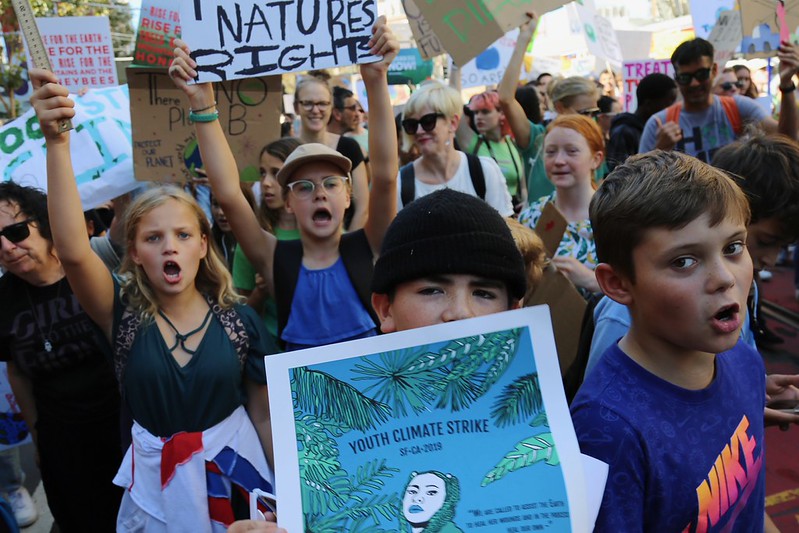
Young people have the most to lose from our accelerating ecological crises. (Fabrice Florin, CC BY-SA 2.0)
In this context, youth movements, particularly those focusing on environmental justice, have led the way for many. Youth activists often draw clear connections among the fossil-fueled economy, extractivism in general, colonialism, and a range of other systemic issues, such as racial justice.
The Young Feminist Fund (FRIDA), for example, has established the parallel nature of several struggles for justice. They have articulated the need to stand up to ecocide and genocide and move beyond capitalism, which they see (logically enough) as linked at the hip with growth. FRIDA’s recently published report states: “Neoliberal capitalism thrives in power-over structures that keep decision-making in the hands of those with privilege, access, and wealth.”
Let’s take a closer look at the Youth Movement and assess how it might help society move beyond the capitalist growth system.
Youth Aren’t Always Radical
The Youth Movement is not a unified voice that shares the same vision of the future. Nor do youth-led organizations employ the same methods to actualize their visions. Some take a more radical approach than others. The radicality of an organization is often assessed by its relationship to power, in terms of funding as well as access to decision-making spaces and representation.
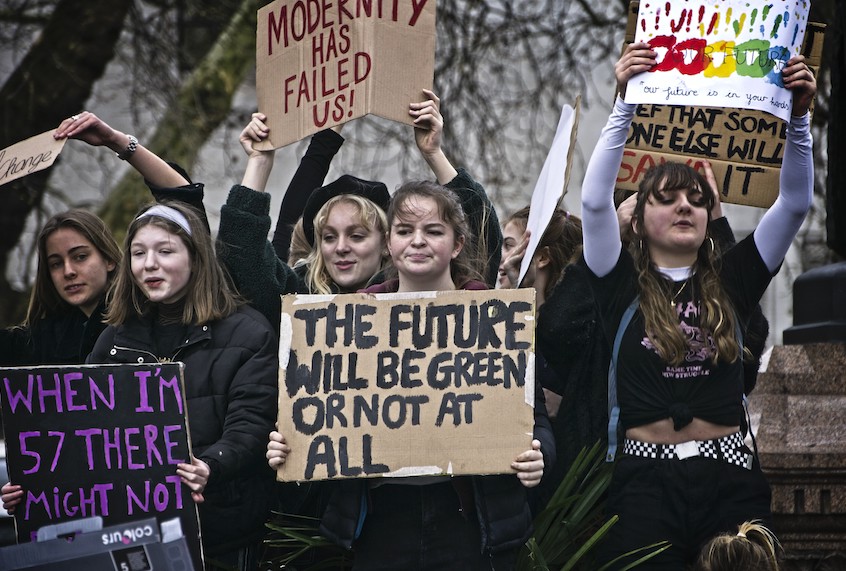
Is youth activism in danger of losing its radical edge? (Garry Knight, Flickr)
A large number of youth-led organizations take the “moderate” approach. The majority of environmental organizations are quite in line with this approach, as steady staters have long lamented. Moderate youth activists believe that, though the system is not great, it could be improved with the right champions in place or the right voices speaking on the right panels.
Youth organizations that take a moderate approach, explicitly or not, make the assumption that if enough funding flows through the right organizations, transformative change is possible. But it’s hard to imagine that reforming our economic system—based on interest-bearing debt and rooted in growth capitalism—is simply an issue of funding or access to decision-making spaces.
Vanessa Andreotti addresses the question of what it will take to transform our dying system (death being the ultimate outcome of unsustainability) in her book Hospicing Modernity. She writes about methodological, educational, and ontological (relating to being) interventions. Andreotti argues that only the latter can truly lead to systemic change.
Youth Activism and Professional-Class Liberalism
The Youth Movement has achieved a lot over the last few years. It has self-organized first at the local level, through volunteering, and grown into a global movement acting at the policy level. Throughout that time, youth activists have undergone a professionalization process, becoming highly trained.
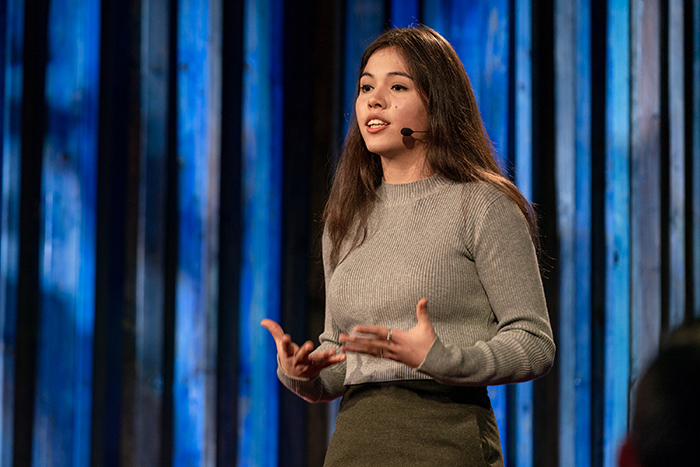
17-year-old Xiye Bastida, recipient of the Spirit of the UN award, speaks at New York’s TED World Theater. (Ryan Lash, TED)
In many ways, this is a positive development. There are more panels, workshops, and seminars with young activists (for instance at UN Climate Conferences) than ever. At these events, youth are making the case for more action to address the environmental emergency.
However, there are concerns about the Youth Movement joining the elite club of professional-class liberals. This club includes lawyers, economists, policy experts, and nonprofit executives. The global expansion of graduate and professional education has been a key driver of growth in this elite club.
The Youth Movement is organizing increasingly through the creation of non-profit organizations, sharing decision-making power with governing and advisory boards. They are also developing fundraising strategies and advocacy and communication plans. All of this makes them professional activists and members of the informal club of professional-class liberals. At what cost?
The Youth Movement is a diverse collection of individuals with different socio-economic backgrounds, lived realities, and opinions. However, only a handful of groups are made visible on the international stage. The level of visibility awarded to young activists often correlates with their willingness to adopt a “soft critique” of growth capitalism, far from the radical discourse they often come from. In other words, those in power are telling youth groups: We are willing to talk to you as long as you do not say anything to make us too uncomfortable. One gets the impression that some of the most visible youth organizations seek simply a piece of the cake, not to re-bake the cake.
Some youth-led organizations do recognize growth capitalism as the root cause of environmental breakdown. However, seldom are they equipped with a shared and coherent theory of change. They don’t have the tools to 1) recognize biases and the ways in which they might be part of the problem; 2) engage in decolonizing languages and narratives; and 3) mobilize funding to sustain radical work.
YOUNGO’s latest Strategic Policy Position is an example of how the Youth Movement is stuck at methodological and epistemological levels of analysis, not reaching the ontological level necessary for systemic change. One of the organization’s most important policy recommendations is to “incorporate the participation of children and youth as agents of change, as well as considerations of intergenerational equity throughout all decision-making.” However, this promotion of youth feels weak without an alternative theoretical framework. Which youth will they prioritize for participation, and to bring about what change?
Youth inclusion should not be a goal by itself; it should be a means to an end. The end we need is a comprehensive and radical change away from the capitalist growth system.
Embracing Radicality
A “radical” approach to youth-led activism targets growth capitalism as the root cause of ecological breakdown. It also targets the cultural and social components of the capitalist growth system. For the Youth Movement to embrace radicality further, activists must develop a sharp understanding of the fundamentals of this system. They must also unlearn many of the mental projections internalized over the years, at a collective and individual level. For instance, many youth have internalized consumerism, mass advertising, and “self-exploitation,” turning their activism into a spectacle and a competition.
At the end of the day, what determines an organization’s ability to embrace radicality—and contribute to a genuine alternative—is its relationship to all forms of power. To what extent is a group identifying, calling out, and challenging the status quo? Without an analysis of power dynamics, the risk is that youth environmental groups will limit their focus to reforms that those in power approve of. They may not dedicate enough time to sensibly think, dream, and feel about a future worth fighting for.
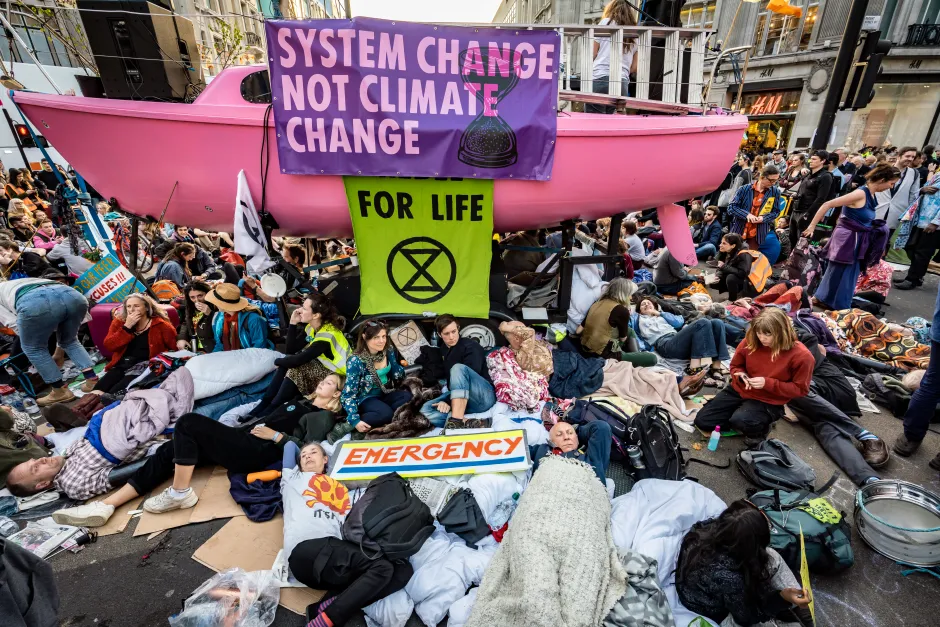
Will youth activists step up to the challenge of changing the capitalist growth system? (Vladimir Morozov, akxmedia)
The Youth Movement can be proud of what it has achieved. So many youth organizations focus on important issues: access to funding, decision-making spaces, and climate education, for example. But the Youth Movement must not stop here. Taking down cultural and social dynamics deeply rooted in pro-growth capitalism means asking some tough questions. What privileges am I willing to let go of? Do I actually want to change the system, or do I just feel bad about not being part of it?
We need all hands on deck to ideate new ways to equip the Youth Movement with a holistic, radical approach. To generate systemic change, young activists must be brave in their criticism of capitalism and growth.
Unfortunately, they must also get comfortable with doubt, not knowing exactly what tomorrow will look like.
 Adel Ramdani is the Director of CASSE’s European Chapter in Brussels and sits on the boards of Radical Ecology in the U.K. and the Youth Climate Collaborate (YCC).



Excellent article. Thanks. It took me 65 of my 68 years to figure out the scope of the wrong in our socio-economic system. I hope that today’s young people are quicker about it than I was.
I have felt this for most of my life. I remember watching Limits to Growth decades ago and wondering why almost no one saw the messages of that film. I am glad to see more and more people seeing this reality.