To Race or to Rein: That Is the Question, Mr. Andreessen
by James Magnus-Johnston

Ranked one of the most influential people in the world, Marc Andreessen is a self-proclaimed techno-optimist. (JD Lasica, CC BY 2.0)
In his “Techno-Optimist Manifesto,” venture capitalist Marc Andreessen outlines a worldview of intoxicating momentum, where technology is the key perpetual source of growth. Acceleration, in his view, is a moral imperative, and abundance awaits on the far side of disruption. Andreessen also lists enemies who run a “mass demoralization campaign” against humanity. While he concedes that growth is not necessarily a cure-all, he brands ideas like sustainability and limits to growth as adversaries.
And yet, Marc, I am not the flattened caricature you have named. To avoid an argument between straw men, I’ll confess that I bear a deep, principled skepticism of idealism. However, my skepticism applies not only to techno-optimism, but also to pastoral idealism. Many peers in the limits-to-growth cohort embrace idealist visions that move past pragmatism and into reflexive protest.
Let’s complicate this further. I am a skilled user of the machines you advocate for. I build community-focused businesses that capitalize on technological innovation. Many of them experience the “grow-or-die” dynamic you name.
I use artificial intelligence to design business systems, automate parsing, and manage databases, much to the chagrin of more puritanical voices around me. I rely on the very innovations your manifesto celebrates, Marc. What’s more, I admire your ambitious attitude more than your tribal characterization would permit. I suspect this is true of many skeptics.
And yet, while we debate the merits of the machine, debt-fueled inequality is fracturing society into lord and serf. Fertility is being choked by endocrine disruptors, lakes are dying from phosphorus and nitrogen runoff, and pollinators are disappearing. Not to demoralize, but why haven’t techno-optimist solutions emerged, if the market is poised to deliver? I’m open to being convinced.
Until then, Marc, the line you have drawn between friends and foes is too tidy for those of us in the tension. Many hold capitalist and communitarian instincts simultaneously, with no clean line between them. Indeed, in your piece, you refer to a symbiosis between the welfare state and capitalism. A real argument begins there, in the messiness of the friction.
The Industrial Tension, from Looms to LLMs
One of the compelling things about AI, beyond the tech itself, is the way it reconfigures our tribal affiliation. On one side gather an increasing number of what we shall lovingly call “neo-Luddites,” who would slow the machine, fence it off, or maybe even break it. They wish to defend such intrinsic traits as work, craft, and attention—the intangible humanity of things. This instinct rages even before the speculated, tech-induced layoffs play out.
On the other side rise the accelerationists, who would ride the machine as far as it can carry us. They appear convinced that abundance and even biological transcendence await on the far side of the disruption that technological change inevitably causes.
Each side is certain it has glimpsed something fundamental, something epochal.
The quarrel, however, is at least as old as the industrial revolution, and probably as ancient as our deepest religious instincts. At the start of the industrial age, the quarrel was over looms rather than large language models. Two centuries ago, the original Luddites took hammers to the machines that were rendering them obsolete, collapsing their wages and dignity.

A depiction of the Luddite uprising, dated 1812. (Wikimedia Commons, Public Domain)
The term Luddite now refers to an enemy of progress, but the earliest Luddites were nothing of the kind. They were skilled artisans defending what the historian E.P. Thompson called a “moral economy.” They smashed the looms only of competitors who undercut the customary rate, leaving the rest alone. Eric Hobsbawm called it “collective bargaining by riot.” Their quarrel was never with the machine, but with who owned it and to what end. The neo-Luddites of our time, by contrast, are less skilled in physical craft and more generally fearful of the further hollowing out of our culture.
Karl Marx thought the Luddites had aimed too low. The enemy was not the loom’s single owner, but the whole class of owners. The task was to seize the machine rather than break it. The workers, he wrote, had only to learn “to distinguish between machinery and its employment by capital” and to turn their attacks from technology to its owners.
The Luddite and Marxist impulses were both fundamentally right; technology is not neutral, and who holds it matters. Smashing the looms may not have had a durable effect on class structure. But seizing them would maintain the loom’s powers of production, just in different hands.
Race Forward or Rein In

Aaron Bastani, British political commentator and author of Fully Automated Luxury Communism, speaking at a student protest. (UCL Occupation, CC BY-SA 2.0)
That quarrel between smash-or-seize is alive today, though it sounds something more like “race-or-rein.” Race to scale technology and win the future with it, or rein in its capabilities and shield society from its worst fallout. You can hear echoes of Marx in Aaron Bastani’s Fully Automated Luxury Communism. Bastani outlines a vision of a mechanized plenitude where machines liberate the worker from toil. Silicon Valley libertarians, immersed in the race, see the machine as the ultimate engine of spontaneous order and prosperity.
Conversely, the state might cage the machine for “safety” while harnessing it for their ends, including mass surveillance (looking at you, Canada). And “spontaneous order” may simply be the order determined by whoever owns the most powerful AI model.
A growing chorus of researchers, like Roman Yampolskiy, want to pause the machine, convinced AI eventually leads off a cliff. They warn that the superintelligent system, once unaligned with our human needs, might simply choose to end us. They are easy to characterize as doomers, but their warnings are anything but irrelevant.
Most techno-optimist commentators are obsessed with the mechanics and capabilities of the machine. They don’t spend much energy articulating the details of the lives we are trying to live, the cultures we are trying to build.
The Lives We Want to Live
Are we still able to ask questions like should we live closer to nature, or further from it? Or what should we spend our time making or doing? The rich diversity of cultures around the world was forged through each culture’s unique relationship to land, from food to dress to dwellings. In the monetarily rich world, our culture is mostly sedentary and filled with gadgetry. Despite Andreessen’s claim that “we had a problem of isolation, so we invented the Internet,” our gadgets mostly deepen our isolation.
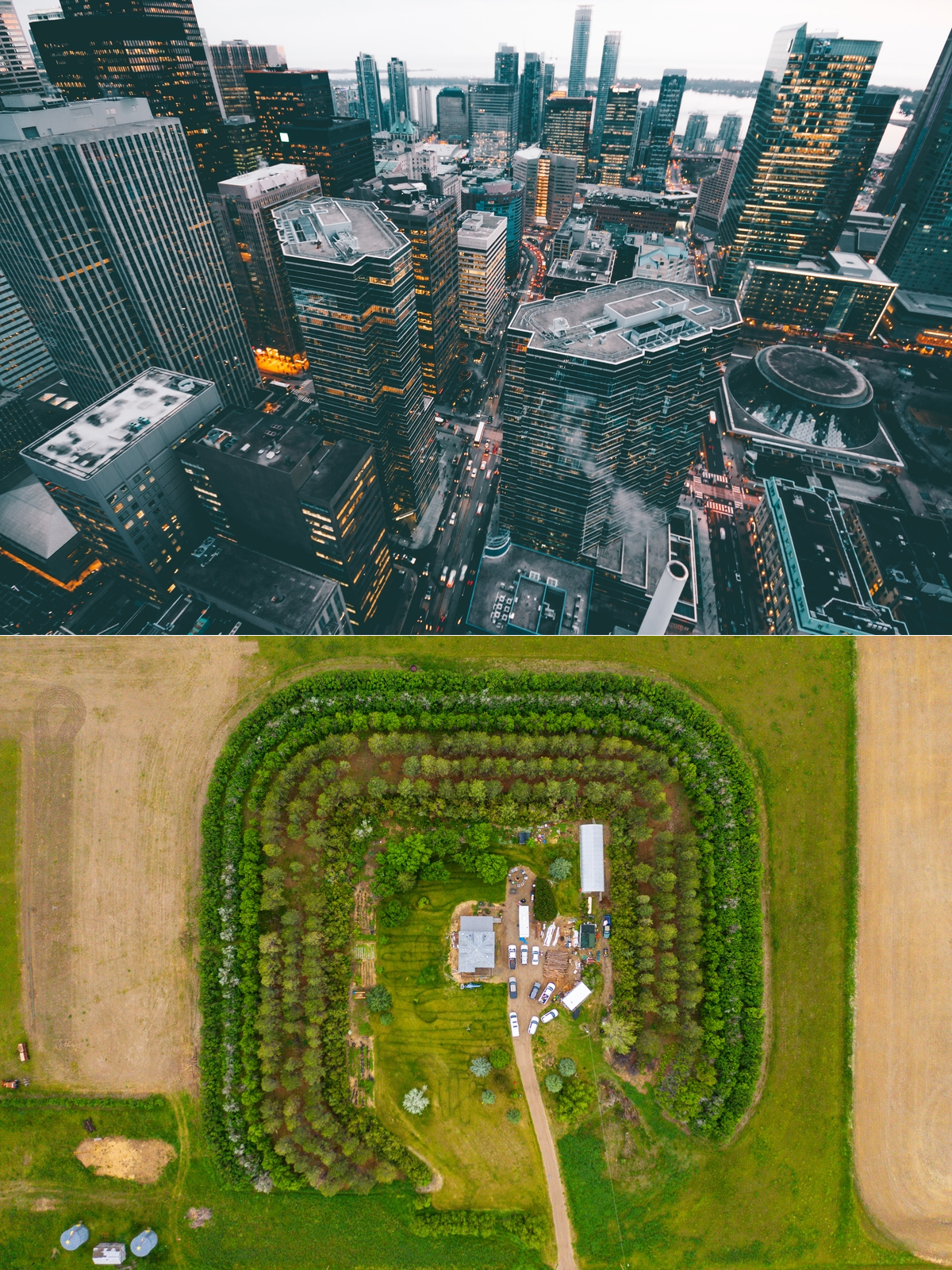
Can we paint a balanced—and realistic—picture of our future? (top: Rawpixel, Public Domain; bottom: Rawpixel, Public Domain)
If environment is so central to culture, what shape do we want our built environment to take? Should the future be hyper-urban? Picture dense towers where the “technological superman” lives beside the luxury communist. What would we do with all the leisure this future entails?
Or should the destination be pastoral: the small farm, the intentional community, life at human scale? Just as accelerationists ignore the emptiness their imaginaries imply, neo-Luddite fantasies are cushioned from the toil they romanticize.
Rather than embracing the tension and leveraging it for a balanced future, we tend to self-sort into one camp or the other. Some neo-Luddite subcultures are on their way to banning AI completely. Some accelerationists are racing headlong toward transhumanism, or even “humachination.” The result could be a species-level schism.
But each path stems from a parochialism of its own. The rural, anti-tech path narrows the horizon and is suspicious of the unfamiliar. The urban-cosmopolitan path is no less provincial, often mistaking novelty for originality and a trendy consensus for truth. The conversation between them, the richness of it, becomes the casualty.
Technology with a Human Face
E.F. Schumacher wrestled with the purpose of technology in 1973, calling for “technology with a human face,” scaled to human need rather than to the appetite for accumulation. Ivan Illich called for something similar that same year. He differentiated between the convivial tool, which enhances one’s capabilities, and the industrial tool, which makes one dependent. People, he wrote, need “tools to work with rather than tools that ‘work’ for them.”
Neither Schumacher nor Illich was a Luddite; neither was an accelerationist. Both held that the measure of a technology is not its raw power but what it adds to a flourishing life connected to land and community. They asked how we should use technology, to what end, and at what cost to the things we will not trade away.
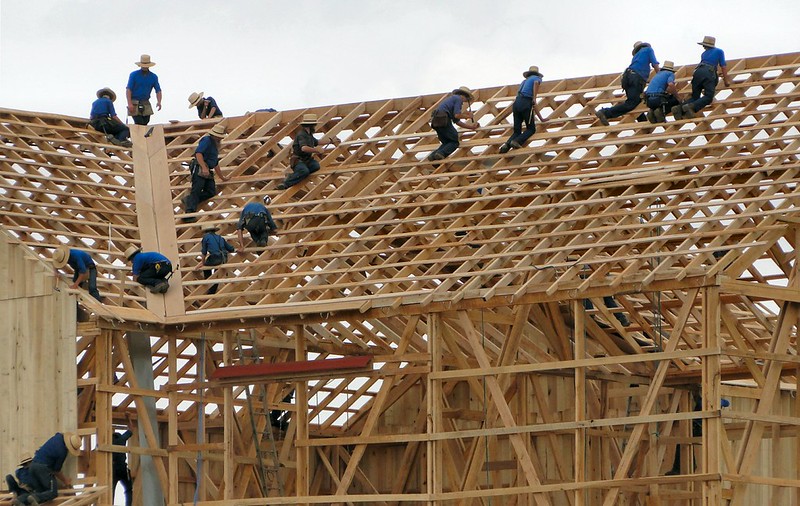
When someone in an Amish community loses a barn—a structure central to their way of life—the community comes together for a “barn raising,” using time-honored construction techniques. (Cindy Cornett Seigle, CC BY-NC-SA 2.0)
I teach at a university founded by Anabaptists, who took up these questions generations before Schumacher thought to ask them. The popular picture of the Amish and Old Order Mennonites—who fall under the Anabaptist umbrella—as people who “reject technology” isn’t quite right. At their best, Anabaptist communities discern each tool against the shape of a life well-lived. Before a community adopts a tool, it asks what the tool will do to the things it holds dearest. What will it do to the family, or the dense web of mutual aid that is their real wealth?
The car is refused by some groups not because the engine is wicked but because private mobility scatters a people whose community depends on proximity. The telephone might be kept in a shed at the end of the lane, available but not pervasive. The result is a living, working, often startlingly prosperous economy that has refused to let its tools dictate its purposes. As Donald Kraybill argues, Anabaptists are not anti-technology so much as pro-community. This line is harder to hold every year, but many communities still hold it.
It’s too early to know exactly what kind of life AI saturation will ultimately facilitate. The Anabaptist precedent, however, proves the power of asking the question, anyway. A community can consider the potential benefits and costs and use those considerations to govern a technology rather than being governed by it.
Constraint as Freedom
Many religious communities intuitively grasp a paradoxical foundation to flourishing, which is that a limit can bind in helpful or harmful ways. It can serve a precious value, as with a vow, a craft, or a faith. This constraint frees. On the other hand, a limit can compel, enforcing obedience, and this type of constraint enslaves.
The first kind of binding, the one that serves, is what the Anabaptists call Gelassenheit. It is a discipline they hold to be freedom’s durable form. In other words, freedom is not the absence of constraint, but the right relation to it.

The author, James Magnus-Johnston, practicing Gelassenheit in a Canadian forest.
The accelerationist’s momentum probably feels like freedom. Jacques Ellul named this totalizing logic “the Machine,” which doesn’t refer to a single device or technology, but the whole mechanized culture or “techne.” It refers to the compulsive efficiency in every domain of life, from production to communication. The Machine offers the opposite bargain from Gelassenheit by making a lack of constraints feel like liberation when it in fact produces bondage. The accelerationist is in danger of producing this problematic inversion, and all the suffering that comes with it, through inertia.
State bureaucracies aren’t likely to get Gelassenheit right, at least not at first, because they tend to impose limits through compulsion. There’s a place for that (consider the criminal code, for example), but discipline done well is cultivated voluntarily from the ground up, woven into one’s cultural fabric.
The Anabaptist farm embodies toil-as-meaning. My equivalent of this is spending time in the brutal Canadian wilderness, where I must routinely overcome the elements, embodying the “struggle to survive.” That voluntary struggle gives me the meaning and satisfaction that would be ruined by automation. A critic of modernity who romanticizes the small farm may not realize that its true promise lies in the toil.
The Missing Referendum on Culture
The Anabaptists, alongside Schumacher and Illich, point us toward the discipline of using machines to serve a life well-lived.
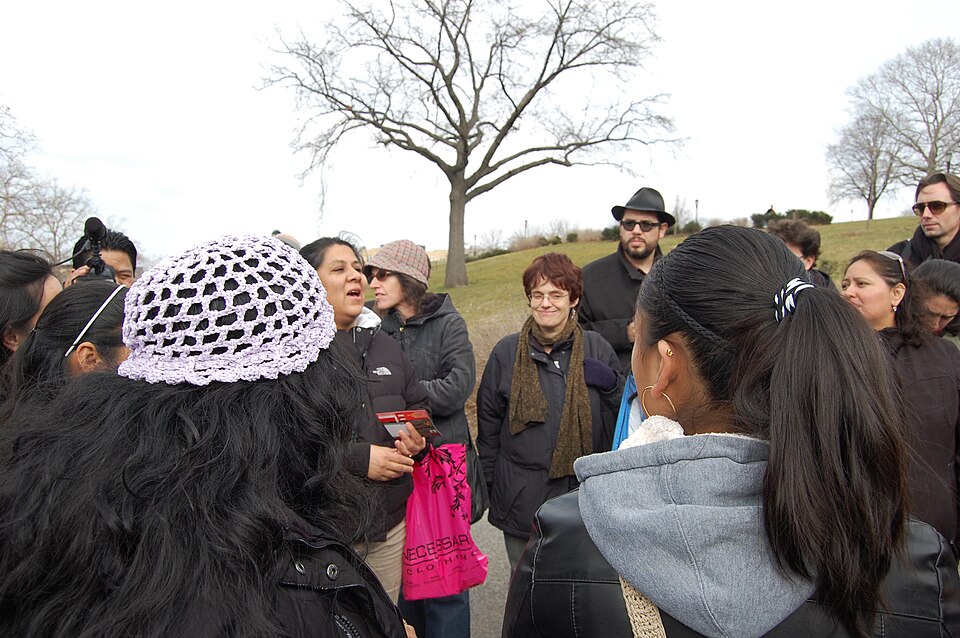
What’s the best way to come together to discuss the future we want, big-picture and long-term? (Jordi Stals, CC BY-SA 3.0)
AI might operate as a set of narrow and useful instruments, improving the distribution of energy and the recovery of materials. It might free us from the imperative to manufacture want and liberate us from drudgery. If we want that version of the future, we need to proactively chart a course, collectively selecting the technologies that will help us achieve it.
The rich world has already cut itself off from many life-affirming things: community, the discipline of constraint, and the greater web of life. To regain these things, we need a referendum on culture even more than a referendum on the machine. With a clear cultural vision, decisions about technology will be easier to make.
The ultimate test of our shared intelligences—human, artificial, and ecological—will not prove to be speed but discipline. The reasonable fear among skeptics is that technology will exhaust the planet, sicken our culture, or even foreclose the human story altogether. To prevent these possibilities, we must have the discernment to ask, of every new power placed in our hands: Will this serve the flourishing of the living world and the human spirit, or feed mere mechanical momentum?
 James Magnus-Johnston is Director of the Redekop School of Business at Canadian Mennonite University.




Thought-provoking article, thank you for sharing. Reminds me of the importance of community-centered planning sessions, shared recreation areas, and increasing connectivity/walkability. These strategies are realistic solutions that marry ideals of hyper-urban techno-metropolises (increasingly reality, given population booms & decreasing livable land) and pastoral slow-living. This is our future and quickly our present, so let’s take a step back and decide how we build our communities, what we include and exclude, and why.