Reading List
The CASSE reading list provides a useful list of articles, books, book reviews, and other publications about the steady state economy, limits to economic growth, ecological economics, and sustainability issues. Where available, these resources can be downloaded from the listings. Publications are sorted into the following categories:
- Must-Read Books
- College-Level Textbooks
- Foundational Essays
- Scholarly Journal Articles
- Articles in the Popular Press
CASSE also maintains a more extensive bibliography on these and related topics. Please contact us if you want more information about resources in our bibliography. In some cases, we may be able to email you a pdf version of a document.
Must-Read Books
Brown, Peter and Geoffrey Garver. 2009. Right Relationship: Building a Whole Earth Economy. Berrett-Koehler Publishers, San Francisco, California.
Cato, Molly Scott. Green Economics: An Introduction to Theory, Policy and Practice. Earthscan Publications Ltd.; 2009.
Czech, Brian. 2000. Shoveling Fuel for a Runaway Train: Errant Economists, Shameful Spenders, and a Plan to Stop Them All. University of California Press, Berkeley, California.
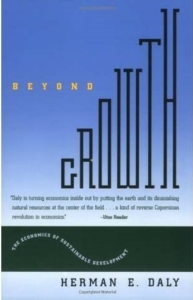
Daly, Herman. 1997. Beyond Growth: The Economics of Sustainable Development. Beacon Press, Boston, Massachusetts.
Daly, Herman and John Cobb, Jr. 1989. For the Common Good: Redirecting the Economy toward Community, the Environment, and a Sustainable Future. Beacon Press, Boston, Massachusetts.
Daly, Herman. 1991. Steady-State Economics, 2nd edition. Island Press, Washington, DC.
Farley, Joshua (ed.). 2009. Herman Daly Festschrift (e-book), in Encyclopedia of the Earth, National Council for Science and the Environment, Washington, DC.
Geisel, Theodor Seuss. 1971. The Lorax. Random House, Inc., New York, New York.
Hamilton, Clive. 2003. Growth Fetish. Allen & Unwin, Crows Nest, NSW, Australia.
Heinberg, Richard. 2007. Peak Everything: Waking Up to the Century of Declines. New Society Publishers.
Homer-Dixon, Thomas. The Upside of Down: Catastrophe, Creativity, and the Renewal of Civilization. Island Press.
Jackson, Tim. 2009. Prosperity Without Growth: Economics for a Finite Planet. Earthscan, London, UK.
Korten, David. Agenda for a New Economy: From Phantom Wealth to Real Wealth. Berrett-Koehler Publishers; 2009.
Magnuson, Joel. 2008. Mindful Economics. Seven Stories Press, New York, New York.
McKibben, Bill. 2007. Deep Economy: The Wealth of Communities and the Durable Future. Henry Holt and Company, New York, New York.
Meadows DH, Randers J, Meadows DL. 2004. Limits to Growth: The 30-Year Update. Chelsea Green.
Nickerson, Mike. 2009. LIfe, Money and Illusion: Living on Earth as if We Want to Stay. New Society Publishers.
Schumacher, E.F. 1973. Small Is Beautiful: Economics As If People Mattered. Harper and Row Publishers, Inc., New York, New York.
Speth, James Gustave. 2008. The Bridge at the Edge of the World: Capitalism, the Environment, and Crossing from Crisis to Sustainability. Yale University Press, New Haven, Connecticut.
Victor, Peter. 2008. Managing without Growth: Slower by Design, Not Disaster. Edward Elger Publishing Limited, Cheltenham, U.K.
College-Level Textbooks
Common, Michael and Sigrid Stagl. 2005. Ecological Economics: An Introduction. Cambridge University Press, Cambridge, U.K.
Daly, Herman and Joshua Farley. 2003. Ecological Economics: Principles and Applications. Island Press, Washington, DC.
Georgescu-Roegen, Nicholas. 1971. The Entropy Law and the Economic Process. Harvard University Press, Cambridge, Massachusetts.
Goodwin N, Nelson JA, Harris J. Macroeconomics in Context. M.E. Sharpe; 2008.
Foundational Essays
Boulding, Kenneth. 1966. “The Economics of the Coming Spaceship Earth” in H. Jarrett (ed.), Environmental Quality in a Growing Economy, pp. 3-14. Resources for the Future/Johns Hopkins University Press, Baltimore, Maryland.
Hardin, Garrett. 1968. “Tragedy of the Commons.” Science, volume 162, pages 1243-1248.
Mill, John Stuart. 1848. “Of the Stationary State,” Book IV, Chapter VI in Principles of Political Economy: With Some of Their Applications to Social Philosophy, J.W. Parker, London, England.
Schumacher, E.F. 1966. “Buddhist Economics” in Guy Wint (ed.), Asia: A Handbook, Anthony Blond Ltd., London, U.K.
Vitousek, Peter, Paul Ehrlich, Anne Ehrlich, and Pam Matson. 1986. Human Appropriation of the Products of Photosynthesis. Bioscience 36:368-373.
Scholarly Journal Articles and Reports
Clausen R. and R. York. 2008. Economic growth and marine biodiversity: influence of human social structure on decline of marine trophic levels. Conservation Biology 22(2):458-466.
Czech, B. 2006. Steady state economy. Encyclopedia of Earth. Eds. Tom Tietenberg et al., National Council for Science and the Environment, Washington, DC.
Czech, B. 2009. Ecological Economics, in Encyclopaedia of Life Support Systems. Developed under the auspices of UNESCO-EOLSS Publishers, Oxford, UK (copy compliments of UNESCO).
Czech, B. 2008. Prospects for reconciling the conflict between economic growth and biodiversity conservation with technological progress. Conservation Biology 22(6):1389-1398.
Czech, B. 2007. The foundation of a new conservation movement: professional society positions on economic growth. Bioscience 57(1):6-7.
Czech, B., D. L. Trauger, J. Farley, R. Costanza, H. E. Daly, C. A. S. Hall, R. F. Noss, L. Krall, and P. R. Krausman. 2005. Establishing indicators for biodiversity. Science 308:791-792. (Proposes GDP as an indicator of biodiversity decline.)
Czech, B., and H. Daly. 2004. The steady state economy: what it is, entails, and connotes. Wildlife Society Bulletin 32(2):598-605.
Czech, B., P. Angermeier, H. Daly, P. Pister, and R. Hughes. 2004. Fish conservation, sustainable fisheries, and economic growth: no more fish stories. Fisheries 29(8):36-37.
Czech, B. 2004. Taking on the economic triangle! Frontiers in Ecology and the Environment 2:227.
Czech, B. 2003. Technological progress and biodiversity conservation: a dollar spent a dollar burned. Conservation Biology 17(5):1455-1457.
Czech, B. 2002. The imperative of macroeconomics for ecologists. Bioscience 52(11):964-966.
Czech, B., P. R. Krausman, and P. K. Devers. 2000. Economic associations among causes of species endangerment in the United States. Bioscience 50(7):593-601.
Daly, Herman, 2008. “Towards a Steady-State Economy.” Paper presented to the U.K. Sustainable Development Commission.
Dietz, S., and W. N. Adger. 2003. Economic growth, biodiversity loss, and conservation effort. Journal of Environmental Management 68:23-35.
Dietz, T., E. A. Rosa, and R. York. 2007. Driving the human ecological footprint. Frontiers in Ecology and the Environment 5(1):13-18.
Feasta (The Foundation for the Economics of Sustainability). 2005. “Eliminating the Need for Economic Growth.” Dublin, Ireland.
Gowdy, John, and J. Erickson. 2005. The approach of ecological economics. Cambridge Journal of Economics 29:207-222.
Jackson, T. 2009. “Prosperity without growth? The transition to a sustainable economy.” UK Sustainable Development Commission.
Jackson, T. 2009. Beyond the growth economy. Journal of Industrial Ecology 13(4):487-490.
Liu, J., G. C. Daily, P. R. Ehrlich, and Gary W. Luck. 2003. Effects of household dynamics on resource consumption and biodiversity. Nature 42:530-533.
Mills J. and T. Waite. 2009. Economic prosperity, biodiversity conservation, and the environmental Kuznets curve. Ecological Economics 68(7):2087-2095.
Rees, W. 2002-2003. Is humanity fatally successful? Journal of Business and Public Administration 30-31:67-100.
Røpke, I. 2004. The early history of modern ecological economics. Ecological Economics 50(3-4):293-314.
Røpke, I. 2005. Trends in the development of ecological economics from the late 1980s to the early 2000s. Ecological Economics 55(2):262-290.
Rosales, J. 2006. Economic growth and biodiversity loss in an age of tradeable permits. Conservation Biology 20(4):1042-1050.
Stern, D. I. 2004. The rise and fall of the environmental Kuznets curve. World Development 32(8):1419–1439.
Trauger, D. L., B. Czech, J. D. Erickson, P. R. Garrettson, B. J. Kernohan, C. A. Miller. 2002. The relationship of economic growth to wildlife conservation. The Wildlife Society Technical Review 03-1. The Wildlife Society, Washington, D.C.
Victor, P. and Rosenbluth, G. 2007. Managing without growth. Ecological Economics 61:492-504.

Woodward, D., and A. Simms. 2006. Growth isn’t working: the unbalanced distribution of benefits and costs from economic growth. New Economics Foundation, London, U.K. 26pp.
Articles in the Popular Press
Daly, Herman. 2005. “Economics in a Full World.” Scientific American, September 2005, pages 100-107.
Daly, Herman. 2009. “The Crisis.” Adbusters, February 2009.
Dietz, Robert. 2009. “The Track to a Steady-State Economy.” Sustainable Industries, February 2009, issue 72, p. 38.
New Scientist Magazine Staff. 2008. “How We Kicked Our Addiction to Growth.” New Scientist, October 18, 2008, p. 52.
Simms, Andrew and Joe Smith. 2009. “The Good Life Doesn’t Have to Cost the Planet.” Yes! Magazine, Winter 2009.
Stoll, Steven. 2008. “Fear of Fallowing: the Specter of a No-Growth World.” Harper’s Magazine, March 2008.
Brown, Peter and Geoffrey Garver. 2009. Right Relationship: Building a Whole Earth Economy. Berrett-Koehler Publishers, San Francisco, California.
Czech, Brian. 2000. Shoveling Fuel for a Runaway Train: Errant Economists, Shameful Spenders, and a Plan to Stop Them All. University of California Press, Berkeley, California.
Daly, Herman. 1997. Beyond Growth: The Economics of Sustainable Development. Beacon Press, Boston, Massachusetts.
Daly, Herman and John Cobb, Jr. 1989. For the Common Good: Redirecting the Economy toward Community, the Environment, and a Sustainable Future. Beacon Press, Boston, Massachusetts.
Daly, Herman. 1991. Steady-State Economics, 2nd edition. Island Press, Washington, DC.
Geisel, Theodor Seuss. 1971. The Lorax. Random House, Inc., New York, New York.
Magnuson, Joel. 2008. Mindful Economics. Seven Stories Press, New York, New York.
McKibben, Bill. 2007. Deep Economy: The Wealth of Communities and the Durable Future. Henry Holt and Company, New York, New York.
Schumacher, E.F. 1973. Small Is Beautiful: Economics As If People Mattered. Harper and Row Publishers, Inc., New York, New York.
Speth, James Gustave. 2008. The Bridge at the Edge of the World: Capitalism, the Environment, and Crossing from Crisis to Sustainability. Yale University Press, New Haven, Connecticut.
Victor, Peter. 2008. Managing without Growth: Slower by Design, Not Disaster. Edward Elger Publishing Limited, Cheltenham, U.K.