Overlooked Steady Staters
by David Shreve
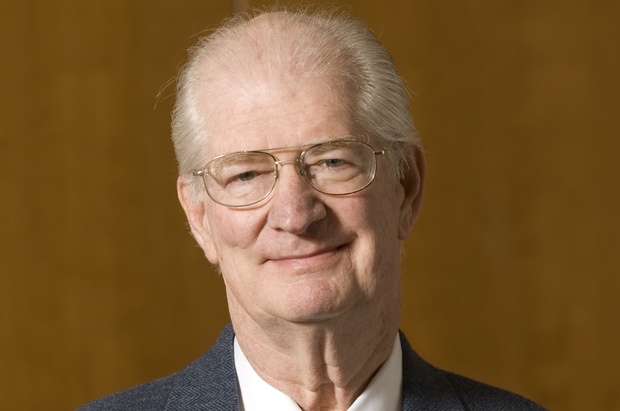
If you’ve heard of the steady state economy, you’ve probably heard of Herman Daly.
Herman Daly provided the key scaffolding for modern steady-state economic theory. But he built on the ideas of many before him, including Nicholas Georgescu-Roegen, Daly’s key advisor at Vanderbilt University. The term “steady state” is often used to describe an economy where capital stock is steady but growth may persist. But Daly was clear that his steady state was a homeostasis beyond growth, where economic output and material throughput stabilized at an ecologically sustainable scale.
As Daly persistently reminded us, this steady state could generate broad prosperity, and sustainably. This depended on population stabilization and more substantial sharing of resources and income. “We are addicted to growth,” Daly asserted, “because we are addicted to inequality.”
Daly’s steady state is a revolutionary concept, but also a creative combination of older systems and ideas. He assembled it with strands of political economics and proven practices much older than his own masterful synthesis. Some of these precursors are well-known, and some are obscure.
The Economists
Many of the world’s economic visionaries sought to understand natural resources, planetary limits, and the critical role of planned redistribution. Thomas Malthus was one such theorist. Writing at the turn of the 18th century, he focused on the “new worlds” coveted by European settlers and colonizers.
Malthus recognized that his fellow Europeans conceived of these places as “open lands.” As such, he feared, there would be a temptation to displace indigenous peoples, assume that resources were endlessly abundant, and encourage an ill-advised population boom. Resources were plentiful, but with his “population principle,” Malthus posited that a population boom would deplete them more rapidly than most imagined.
Only a few decades later, John Stuart Mill became the first to lay out an analysis of the stability of demand relative to price for certain goods and services. He also presaged Henry George’s late 19th-century thinking on unearned rents and how they ought to be taxed (quite fully).
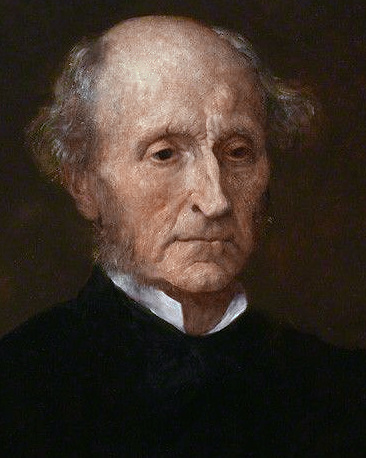
John Stuart Mill, the father of the “stationary state.” (George Frederic Watts, Public Domain).
For Mill, such concepts opened up the idea that societies and governments could control the distribution of income to the benefit of all. He envisioned this as a path to a “stationary state” without population growth or growth in aggregate economic activity. Mill had provided an answer to the Malthusian dilemma.
Closer to Daly’s era, Georgescu-Roegen and Kenneth Boulding blazed related pathways. They described principles crucial to the establishment of steady-state theory. Georgescu-Roegen touted the idea that the principle of entropy had to form the basis for any examination of economic systems. He perceived that earthly limits mattered a great deal. Population pressure was destined to bring resource scarcity to the fore, and existing resources were subject to constant degradation.
To Georgescu-Roegen, a pendulum was not the most telling metaphor for the global economy, despite the swings between boom and bust. Rather, he viewed the economy as more of an hourglass, processing limited resources pursuant to “time’s arrow.”
Boulding was president of the American Economic Association in 1968 and 1969 and a scientifically trained systems thinker. He popularized the notion of an “economics for Spaceship Earth.” Reflecting on the limits reckoned by Malthus, Mill, Georgescu-Roegen, and others, Boulding helped us see the economy as a subset of our finite planet. Early in his career, he also conceived of a homeostasis at the level of the firm. Unlike the more financialized creatures in the current corporate landscape, Boulding’s firm need not depend on perpetual growth.
An Overlooked Essay of John Maynard Keynes
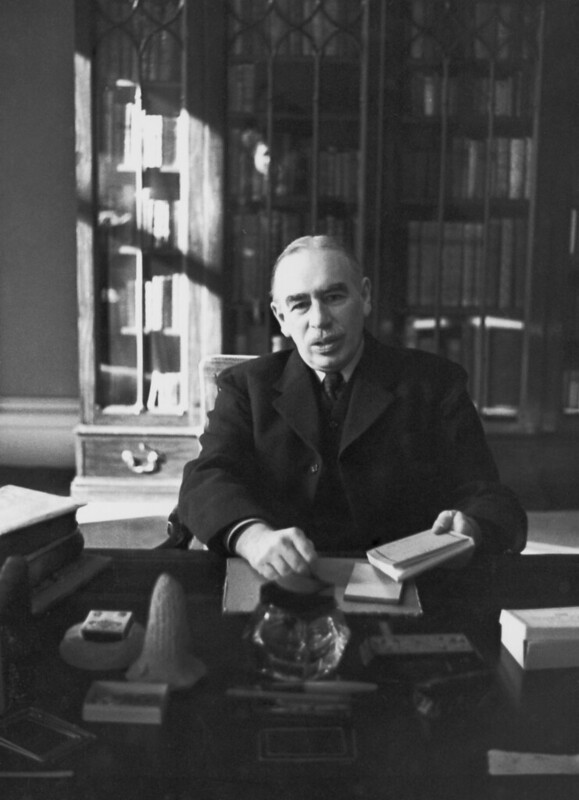
Writing in 1930, John Maynard Keynes saw the way to “economic bliss” with population stabilization and the broader sharing of our world’s immense productivity. (Patrick Chartrain, Public Domain)
John Maynard Keynes is best known for his revolutionary work, The General Theory of Employment, Interest, and Money. Six years before he published The General Theory, however, he speculated on “The Economic Possibilities for our Grandchildren.” Echoing Malthus and Mill, Keynes informed his readers of a simple way to banish the misery of the Great Depression. Productivity had become so capacious, he asserted, that even modest redistribution of its output could renew prosperity and full employment. This redistribution also lent itself to a shorter work week and increased leisure.
Keynes later wrote of a “consumption function” that revealed how government-engineered redistribution could focus demand on necessities and induce enough investment for full employment. It could do so, moreover, without banking on endless growth, in population or economic activity. These ideas made Keynes—perhaps the world’s most highly regarded economist—a nascent steady stater.
Along with his monetary theory that illustrated the futility of hoarding, Keynes’s principles of wealth redistribution would form the backbone of his General Theory. Today, that General Theory is still the clearest expression of how modern economies succeed or fail. It also helps us envision how modern economies may end their reckless pursuit of growth.
The Political Progenitors
Much like these imaginative and worldly economic philosophers, numerous political leaders helped build the sturdy foundation for Daly’s steady-state edifice. Though less explicit than Mill’s stationary state, the ethos of limits and management of natural resources—coupled with attention to redistribution—infused their governing philosophies.
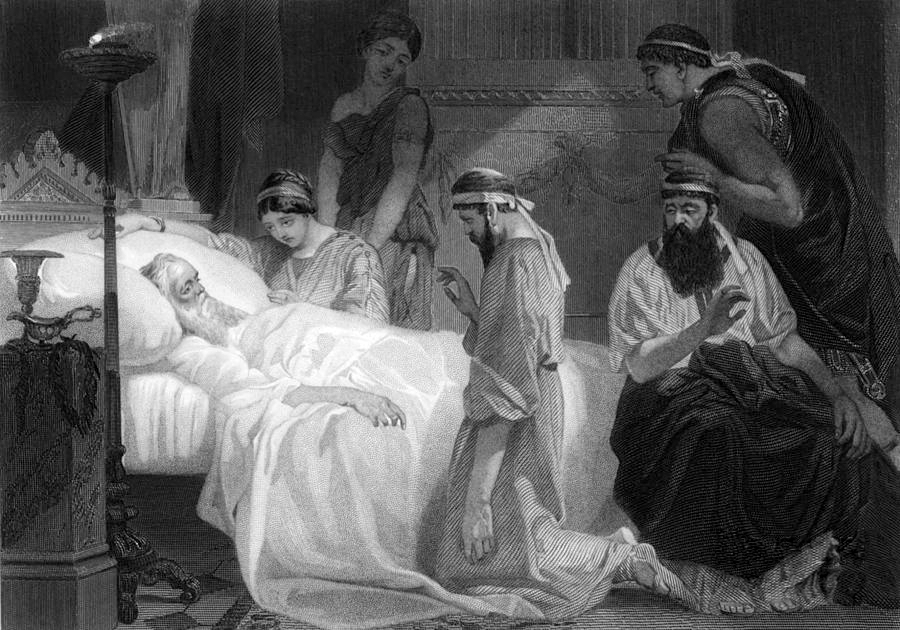
Thanks to Maureen Cavanaugh’s scholarship, the death of Pericles did not intern his progressive tax foundation. (Alonzo Chappel, Public Domain)
The golden age of Athens was built on a prototype of modern progressive (redistributive) tax systems, as thoroughly described by legal scholar Maureen B. Cavanaugh. Centuries down the road, German chancellor Otto von Bismarck and British parliamentarian William Beveridge illustrated how government planning and attention to social welfare could eliminate deprivation, with growth as an unnecessary afterthought.
The U.S. presidents Roosevelt—Theodore and Franklin—called attention to the limited and fragile natural resources upon which we all depend. TR established key parts of what became the U.S. Fish and Wildlife Service. He saw to the passage of the Antiquities Act, which allowed for the protection of “significant natural resources,” “national monuments,” and the wild lands that surrounded or composed these “monuments” (like the Grand Canyon). FDR established 140 national wildlife refuges, 29 national forests, and 29 national parks and monuments. He also created the Civilian Conservation Corps, which planted over two billion trees.
LBJ’s Great (Steady-State) Society
Most notable of all, but perhaps the least recognized as a steady stater, was Lyndon Johnson. Speaking at the University of Michigan in 1964, LBJ explained the essence of what he called the “Great Society.” He began his address with a challenge: “Your imagination, your initiative, and your indignation will determine whether we build a society where progress is the servant of our needs, or a society where old values and new visions are buried under unbridled growth.”
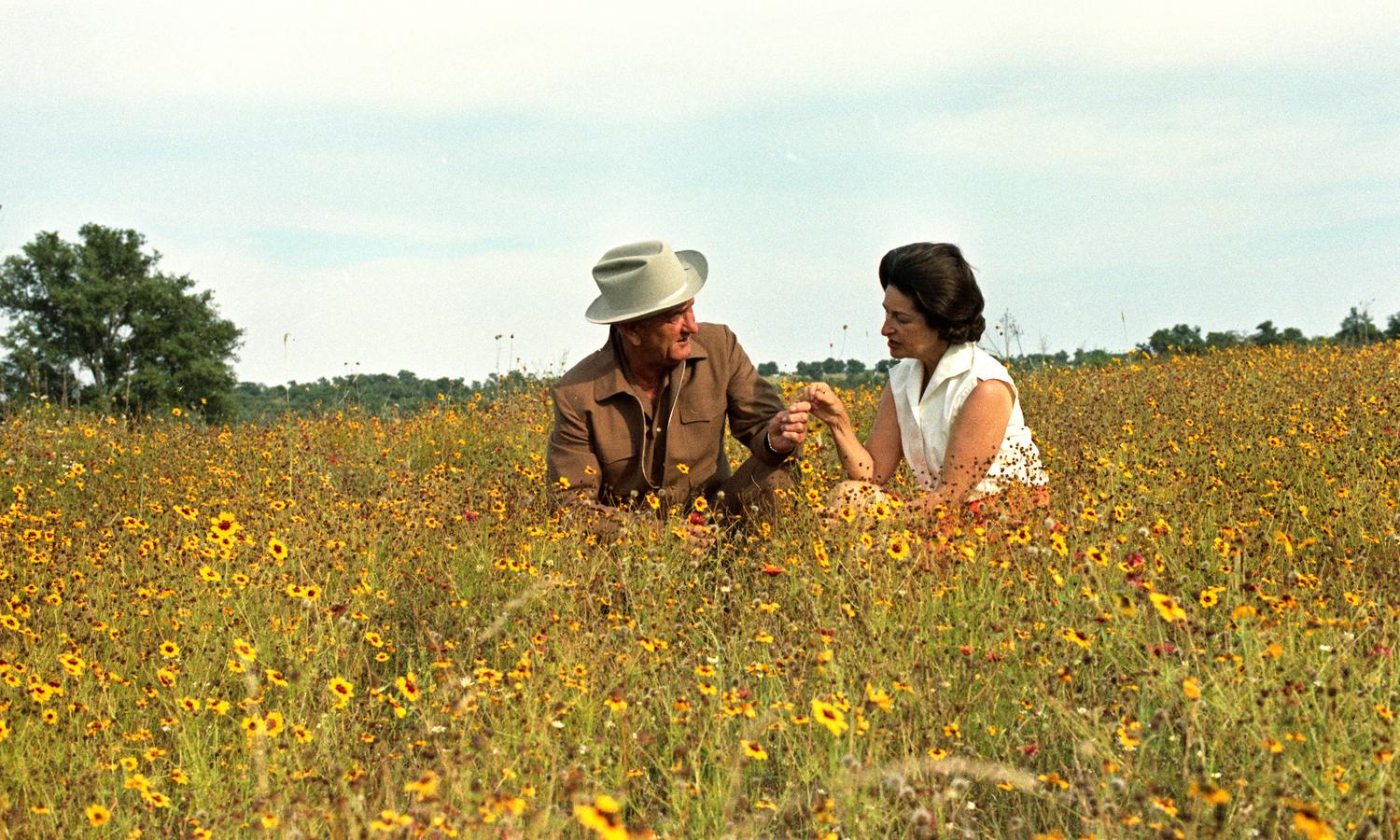
President Johnson and Lady Bird Johnson were known among friends and associates as “wilderness warriors.” (LBJ Library)
President Johnson added that leisure should be welcomed as a “chance to build and reflect, not a feared cause of boredom and restlessness.” He described the Great Society as “a place where the city of man serves not only the needs of the body and the demands of commerce but the desire for beauty and the hunger for community.”
LBJ called for a society “where men are more concerned with the quality of their goals than the quantity of their goods.” He lamented that “green fields and dense forests are disappearing.” “Once man can no longer walk with beauty or wonder at nature, he added, “his spirit will wither and his sustenance be wasted.”
Johnson was the most instinctive Keynesian of the modern U.S. presidents. He knew, therefore, inequality could be made small and poverty defeated. He also knew that, while an increment of growth would always accompany the eradication of unnecessary unemployment, continued economic growth in the aggregate wasn’t necessary. LBJ started building a prosperous economy that—for the first time since the nation started tracking GDP—didn’t rely on perpetual growth. Importantly, unlike many predecessors, he didn’t dismiss long-overdue civil rights in the process.
Like Keynes, Johnson also understood that population stabilization posed no threat to U.S. or global prosperity. He welcomed it as a key element of any successful modern economy. In his 1966 State of the Union address, he promoted U.S. assistance for international population programs. He pushed for these key aid programs throughout his tenure in office.
In the same address, Johnson called for an attack on “the wasteful and degrading poisoning of our rivers.” He promoted and signed the Wilderness Act and the Wild and Scenic Rivers Act and launched the Land and Water Conservation Fund. LBJ also helped pave the way for the key 1970s environmental laws. When the government passed the Wilderness Act, it brought 9 million acres of land under federal protection. In the sixty years since its inception, the Act has protected another 100 million acres of the nation’s wildest places.
And when President Nixon signed the Endangered Species Act in 1973, he did so in response to a years-long congressional push that began with President Johnson’s encouragement. This legislation can be regarded as a blueprint for the necessary containment of human economic activity. It is this, of course, on which a steady state economy rests.
In the (State) Laboratories of Democracy
U.S. state leaders have also established important steady-state footholds. Toiling often amid political pressures for growth and “development,” some U.S. governors have illustrated how to resist such pressures. Californians have been among them, and with an economy large enough to rank fourth among nations, their policies have global influence. But the surpassing environmental advocacy—and fragile ecosystems—in other states should also command attention.
Gifford Pinchot, a key ally of the Republican Theodore Roosevelt, demonstrated how governors could lead a conservation movement. As the chief executive in Pennsylvania from 1923–27, and then again from 1931–35, Pinchot promoted state-level scientific management of natural resources. The National Governors Association was formed in 1908 after President Roosevelt convened governors to discuss the future of the nation’s natural resources. It became an important vehicle for Pinchot’s conservation ethic and for the earliest sharing of state management “best practices.”
Pinchot followed on the heels of governors like Michigan’s Fred Warner. In 1909, in the wake of Michigan’s timber industry collapse, Warner established a commission with authority over all of Michigan’s reserves and public lands. Some of these state leaders clashed with preservationists such as John Muir. But their increasingly popular “conservationist” stands elevated Pinchot’s well-known maxim, championing “the greatest good of the greatest number in the long run.” It was the strict attention to the long run that tied this new class of governors to earthly limits and the possibilities for a steady state.
Less well known than the charismatic Gifford Pinchot or Wisconsin governor Gaylord Nelson were figures like Delaware’s Russell Peterson. Peterson was concerned about pollution, in particular, but also the preservation of Delaware’s treasured coastal wetlands.
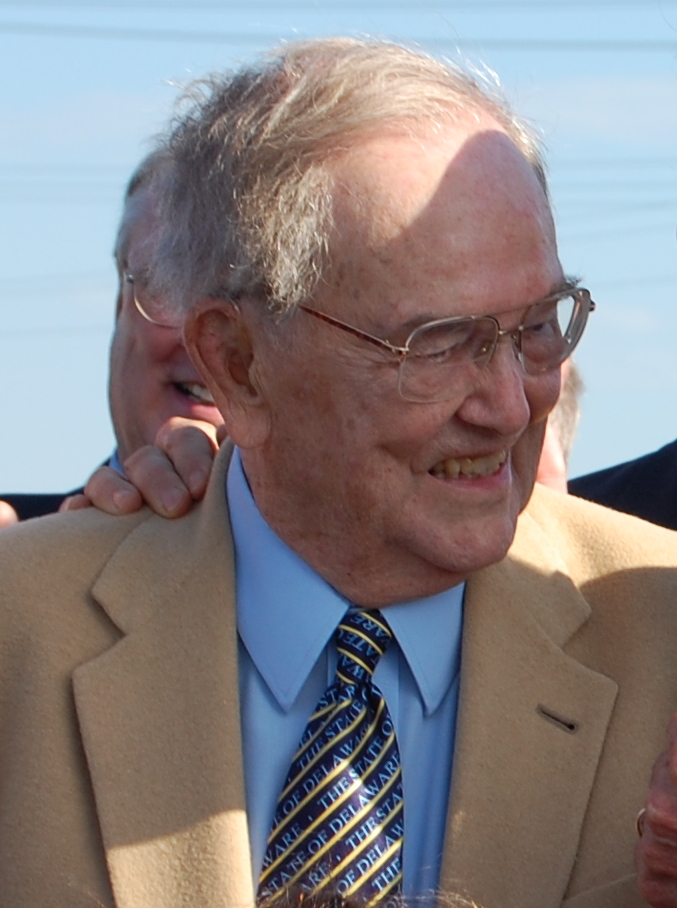
Russell Peterson was governor of Delaware (1969-1973), chair of the Council on Environmental Quality (1973-1976), and the president of the Audubon Society (1979-1985). (Office of Senator Thomas Carper)
He moved aggressively to protect the Diamond State’s lands, instituting a moratorium on all coastal development in 1970. Peterson then convinced his legislature to pass the Coastal Zone Act, which included zoning restrictions meant to stymie industrial “development.” He also blocked a Nixon administration plan to turn the Delaware Bay into a “superport” for an expanded petrochemical industry.
A Republican governing in a state dominated by the world’s largest chemical company (E.I. duPont de Nemours), Peterson stood firm. “Governors usually embrace whatever new enterprise will produce new taxes and new jobs,” he wrote in his autobiography, “yet here I was, the new governor, questioning whether this is what we wanted.” Peterson added in retrospect that what he sought was an economy that “meets the needs of the present generation without shortchanging the future.”
In the same era, Michigan’s William Milliken and Oregon’s Tom McCall were fellow GOP governors who also challenged the “economic development” status quo. They were just as keen as Peterson on the protection of their state’s environmental endowments. Moreover, all three served when recessions pushed states hard in the direction of compensatory “growth.” Their stewardship and courage, therefore, offer especially notable lessons. Their legacies live on in Delaware, Michigan, and Oregon.
Though few of these thinkers and political leaders secured a decisive transformation, all illustrated the possibility of a prosperous steady state economy. All were buffeted by reactionary opponents, with narrow vision and selfish concerns. These opponents fell back consistently on the easy but always compromised way out: growth.
But as Herman Daly reminded us repeatedly before his death in 2022, our reliance on growth has become more uneconomic with each passing year. To free ourselves from this wholly unnecessary reliance, we must revive our collective memory of a rich political and theoretical tradition, one in which sustainability and broad prosperity stood together.
 David Shreve is a Senior Economist at CASSE.
 Creative Commons





Thanks for connecting all these disparate personalities and eras. Daly is one of my heroes.
It occurred to me as I was reading this why the current pro-birther movement is very naturally allied with the oligarchs. In a steady state economy you must redistribute income and reduce inequality – and what oligarch wants that? Keep the party and the growth going!
Thanks, Mr. Davis, for this keen observation.
Indeed, if one limits the gaze to U.S. history, it’s hard not to notice this phenomenon (and several related variations) throughout our nation’s history. Despite invocations from Adam Smith, Thomas Jefferson, Alexander Hamilton, and others (especially Thomas Paine, who called for a 100 percent marginal tax rate on any income above 12,370 pounds sterling, approximately $27 million today) for broad redistribution through taxation, American commercial leaders and wealthy elites successfully stood in the way.
To hide the unvarnished greed (and anti-democratic spirit) of such resistance, however, they called on a series of “programs” by which to defuse the uncomfortable class antagonism. Genocide and theft of land from Native Americans, the latter of which they distributed in modest amount to poor western settlers, was the first. When the continent filled up in the 1890s, they turned to a revived “trickle-down” rhetorical strategy and to amplified racism and segregation, to convince poor whites that they could at least themselves exploit another large (and allegedly undeserving) class of American citizens. And when pressures against this compromised political economy built up around the middle of the 20th century, the growth of the bigger American economic pie became the favored device and deception.
Sadly, as we approached the rough 1970 tipping point (when environmental overshoot first set in), and LBJ warned that the time had come to relinquish all of these debilitating deceptions, we responded as a society by doubling down on growth instead.
Modern pro-natalists are only the most short-sighted, perhaps, among all of the many groups who still vainly and stupidly resist the egalitarian and democratic (and uniquely sustainable) alternative.
Mr. Shreve, Thanks for writing this,
While Hazel Henderson’s writings introduced many of these to me, I learned of quite a few steady-staters I hadn’t heard of through your work.
Brian
–
I agree with Daly that addictions to inequality and growth are linked. Which is partly why I’m increasingly incensed that my proposal to make True Full Employment happen ASAP in the USA is still being refused public sharing either online or in print. Even in this online forum, all I can get in is the URL to my petition based on my article – not the whole article. Maybe it’s because most Americans are still Social Darwinists and blame the victims with a knee-jerk?
I should also add that the Golden Age of Athens had a foundation of slavery – obviously the most extreme kind of inequality.