Spring: Ever More Silent
by Alix Underwood and Marwa Ebrahem
Humans have come to rely on chemicals not only to increase the fruits of our agricultural labor but also to stop other species from partaking in the feast. And the toll exacted by these “pest”-killing chemicals is immense.

Rachel Carson conducts marine biology research in the Atlantic in 1952. (U.S. Fish and Wildlife Service)
Over 60 years ago, in Silent Spring, Rachel Carson detailed the effects of DDT, the first widely used chemical pesticide, on ecosystems and human health.
Thanks to the environmental movement that stemmed largely from Carson’s book and courage, the U.S. government has since banned DDT. However, an ugly procession of thousands of herbicides, fungicides, insecticides, and rodenticides has followed.
In 2023, humans used 3.7 million metric tons of pesticides globally. That’s up almost 200 percent from 1990, when the UN Food and Agriculture Organization (FAO) started keeping track.
As pests build resistance, our pesticide use traps us in a vicious cycle—not dissimilar to the fertilizer-use cycle we’ve entered. And, as with fertilizers, the causes and effects of the pesticide cycle are not evenly distributed across the population. Pesticides are unique, however, in their devastating levels of inefficiency. Ninety-eight percent of sprayed insecticides miss their pest targets, affecting non-target organisms instead. The number for herbicides is 95 percent.
Let’s explore humanity’s history with pesticides, their impacts, and the reasons we cannot seriously curtail pesticide use while obsessed with growing the economy.
From the Glory Days to the Dirty Dozen
Historians believe Ancient Sumerians used sulfur compounds to kill insects in the 25th century BC. By the 17th century AD, the use of plants, such as tobacco and herbs, and chemical elements, such as arsenic, as pesticides was common. With mechanical innovations like sprayers, the industrial age, beginning in the late 18th century, facilitated increases in pesticide use.
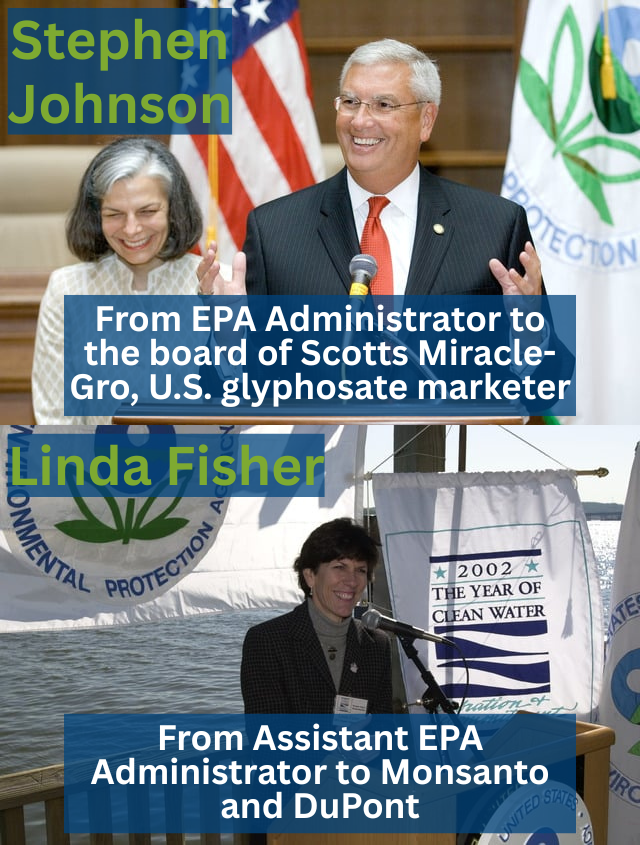
Of the U.S. Environmental Protection Agency’s (EPA) pesticide office directors since 1974, all seven who continued to work after leaving the EPA went on to make money from pesticide companies. (top: EPA, bottom: National Archives)
However, synthetic pesticides didn’t come on the scene until the 1930s. Historians attribute them with saving thousands of people from insect-borne diseases during World War II. The decades that followed were the pesticide glory days, with little awareness of their consequences or restraint in their application. But when Silent Spring hit the market in 1962, it launched a movement that resulted in landmark environmental laws.
The newly created U.S. Environmental Protection Agency (EPA) banned domestic use of the insecticide DDT in 1972. However, the new laws weren’t robust enough to effectively regulate the variety of pesticides flooding the market or the geographic extent of their use. The need for a global convention became evident, and the United Nations responded with the Stockholm Convention, which came into effect in 2004. Member states set an initial goal to eliminate twelve of the most dangerous “persistent organic pollutants,” nine of which were pesticides.
But governments can’t keep up. The United States permits the use of thousands of different pesticides with hundreds of different ingredients. And government collusion with pesticide companies—uncovered in Canada and the United States—calls into question the sincerity of their efforts to keep up.
Bringing a Bazooka to a Knife Fight

An engraving of a London rat-catcher from 1789; Europe has been controlling rodent populations far longer than the United States. (Welcome Collection, CC BY 4.0)
We’re in deep with pesticides, and our relationship with them is taking a sickening turn. Pests are becoming resistant. Scientists have known for some time that pests, many of which reproduce rapidly, develop resistance via natural selection. They have also known that chemical pesticides can negatively impact populations of pests’ natural predators. But these effects, together with climate change, which is working in favor of pest populations, have created levels of resistance so alarming that some are calling it a “pest revival.”
Bowie State University Biology Professor Steve Sheffield has studied pesticides for decades. In an interview for the Herald, Sheffield called the pest-resistance cycle an evolutionary arms race. “We escalate, and they escalate. And then we have to escalate, and they escalate, and back and forth.” Sheffield explained how we sometimes accelerate this arms race by “bringing a bazooka to a knife fight”:
“In places like London, where they’ve had settlements for thousands of years, they’ve also had rats for thousands of years. Their arms race has been escalating that entire time. And unfortunately, their second-generation anticoagulant rodenticides have made their way over to the United States, and we’ve started using them. It’s overkill, because our rodents are not as resistant as the ones in Europe. So, we end up with all sorts of ‘secondary poisoning.’ A mouse eats the stuff, then an owl eats the mouse, then the owl dies because it has ingested the rodenticide in the mouse.”
The Primary Outcome of Pesticide Use: Pollution
The vast majority of pesticide used doesn’t serve its intended purpose. Instead, it travels—often large distances—through the soil, water, and air. On 64 percent of global agricultural land, pesticide residues exceed “no-effect concentrations.” In high-biodiversity regions, pesticide residues exceed no-effect concentrations by at least three orders of magnitude on over four million km2. That’s larger than the surface area of India.
One could say that pollution is the primary outcome of pesticide use, rather than increased food production.
When it comes to humans, farmers and other pesticide handlers are at highest risk of health impacts. However, the general public is also exposed via the food they eat, the water they drink, and the air they breathe. Pesticide exposure is linked to acute symptoms ranging from skin rashes to death, as well as chronic diseases. According to the World Health Organization, the most widely used pesticide ingredient, glyphosate, is “probably carcinogenic to humans.” In the United States, over 13,000 lawsuits have been filed over glyphosate’s links to non-Hodgkin lymphoma.
The second most widely used ingredient, atrazine, is linked to tumors, breast and uterine cancer, and lymphoma. The third most widely used, metolachlor-S, is linked to anemia and diarrhea.
It’s worth noting that glyphosate, atrazine, and metolachlor-S are all herbicides. According to Sheffield, the most critical gap in public knowledge about pesticides is the tendency to think herbicides are safe because they target plants, not animals:
“Maybe they’re not killing mammals or birds outright, but they’re causing sub-lethal effects, which debilitate one or more body systems. People also thought that herbicides are not very persistent in the environment. Well, some of them are very persistent. You could apply them, and next year you could find huge levels of them in the soil and in other environmental media.”

This man’s mother was exposed to Agent Orange when he was in gestation. (Agent Orange Deformities, CC BY 2.0)
Sheffield pointed to the infamous Agent Orange, composed of TCDD and 2,4-D, as an example of the persistence and human health impacts herbicides can have. The United States used Agent Orange, alongside five other herbicide cocktails, to defoliate the Vietnam jungle in the ‘60s. The public associates Agent Orange with horrible human-health consequences. But this hasn’t fueled sufficient anti-herbicide sentiment for the overall reductions that we need. For example, farmers still use 2,4-D legally.
Non-human animals are not immune to herbicide impacts either, nor to the impacts of other types of pesticides. Controlling for other factors, there is a statistically significant relationship between pesticide use and the loss of imperiled species. And when we zoom in to the microscopic level, we find that pesticides negatively affect soil microbes and soil respiration, leading to soil fertility loss. In this way, the vicious pesticide cycle is bound to the vicious fertilizer cycle.
Pesticides and the Growth Economy
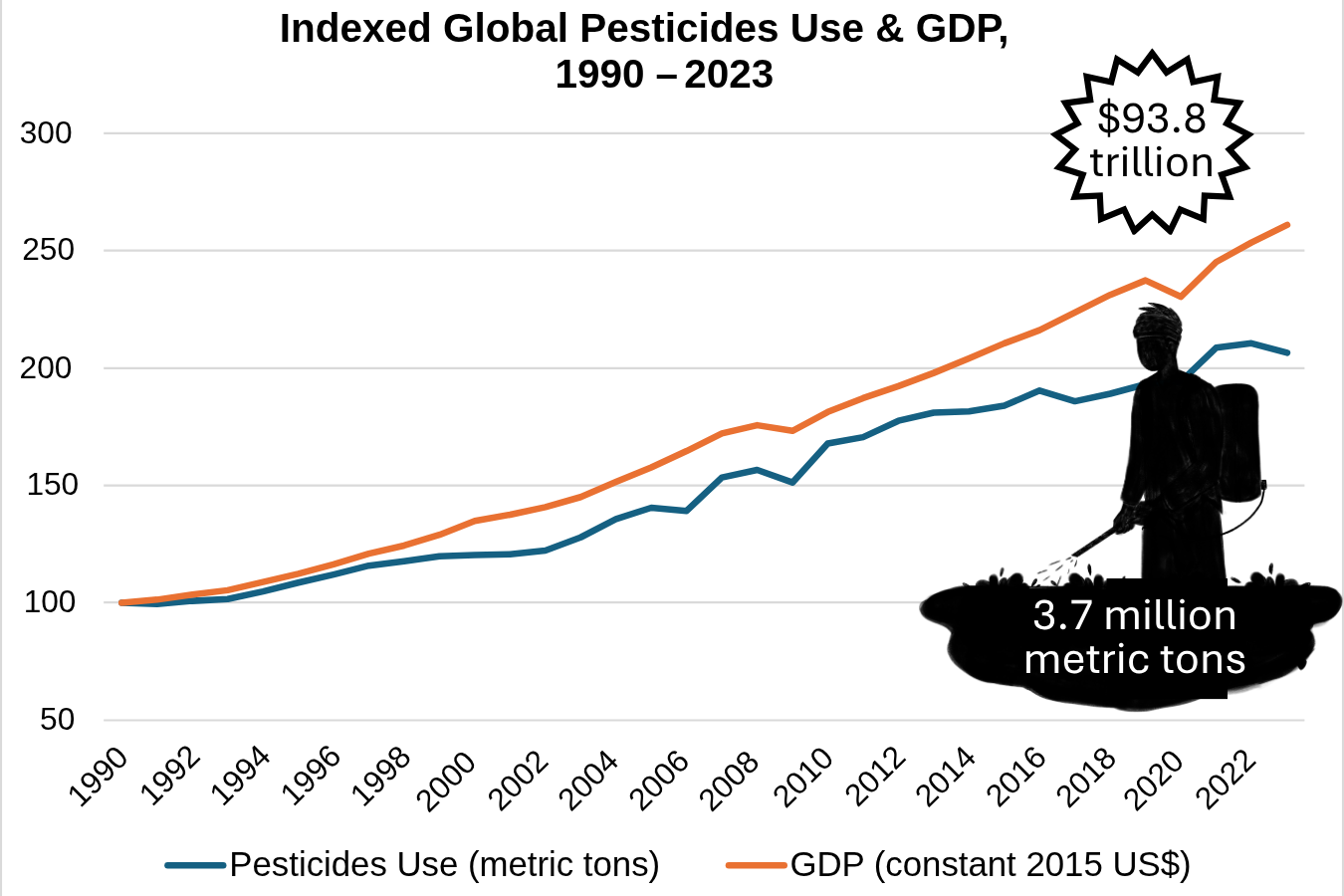
Pesticides use and GDP, indexed to 100 for comparability. (authors’ graph, data from FAOSTAT and the World Bank)
The theoretical underpinnings of our hypothesis that GDP growth causes growth in pesticide use (and vice versa) are much the same as the underpinnings of the hypothesis that GDP and fertilizer use are causally related. Pesticides are tightly linked to our dizzying levels of agricultural productivity. Productivity growth pushes labor from agriculture and other extractive sectors (the “trophic base” of the economy) to manufacturing and services. This facilitates growth of the overall economy.
As with fertilizers, experts hotly debate the extent to which we need pesticides to support the human population. In one study, researchers determined the United States would need to convert twelve million hectares of wildlife habitat to cropland to produce the same amount of corn with no pesticides. The UN tackled such assertions head-on in a 2017 report. They stated that “Reliance on hazardous pesticides is a short-term solution that undermines the rights to adequate food and health for present and future generations.”
However, it is undeniable that pesticides have played a role in us reaching a population of eight billion. And their role in individual consumption increases and shifts—to more resource-intensive goods—is even more undeniable.
In the United States, the quantity of herbicides and insecticides applied to feed crops (primarily corn and soy) for factory-farmed animals in 2018 was estimated at 235 million pounds. That’s nearly a quarter of the country’s total pesticide use that year. The production of livestock—99 percent of which comes from factory farms, in the United States—accounts for 40 percent of global agricultural GDP. More GDP, more pesticides.
Population size and consumption patterns are the indirect linkages between pesticides and the size of the economy. Let’s also consider pesticides’ direct contribution to GDP. The value of the global pesticide market in 2019 was $68.6 billion, with estimated growth to $87.5 billion by 2024.
Together, the European Union, China, and the United States control over 80 percent of the pesticides market. In many cases, pesticide corporations have their headquarters in countries that have banned domestic use of their products. Their primary buyers are low- and middle-income countries. The United States is an exception, allowing the use of 85 pesticides that are being phased out or have been banned in the European Union, China, or Brazil.
A Statistical Assessment
From 1990 to 2023, pesticide use and GDP had a positive relationship across the 168 countries in our regression analysis. We employed pesticide-use data from FAO and real-GDP data from the World Bank. We found that pesticide use increases by an average of 29 kilograms for every additional $1 million of GDP. The results are highly statistically significant (p < 0.001).
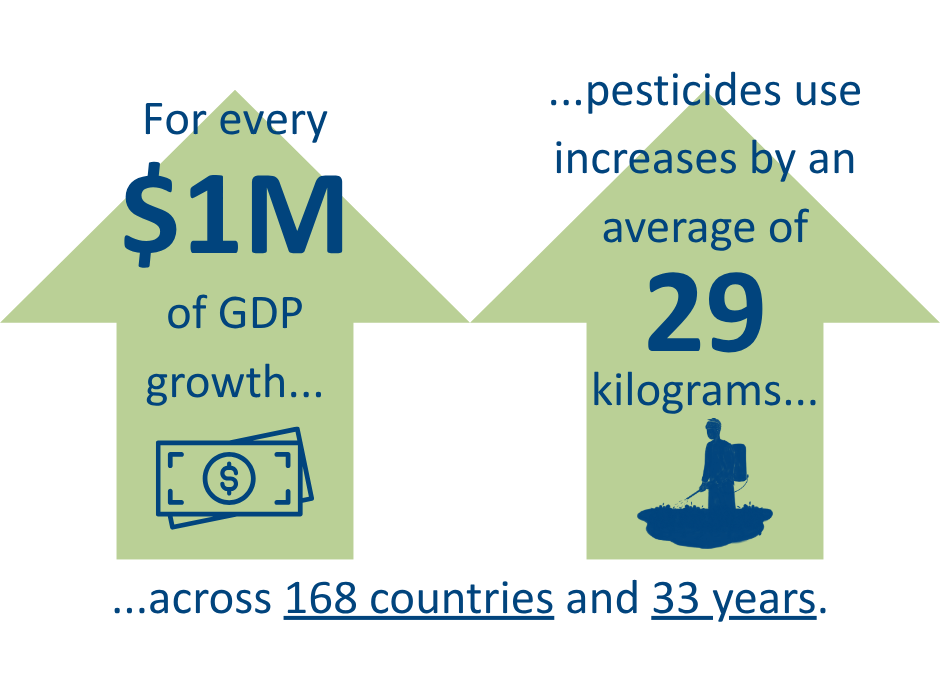
The results of a two-way fixed effects regression, with GDP as the independent variable and pesticides use as the dependent variable.
Importantly, FAO’s data reflects pesticides applied within national borders. When countries import food, they effectively outsource part of their pesticide footprint. Imports are subtracted in the GDP equation, but they affect the importing country’s GDP indirectly. Imports may be used as an intermediate input in higher-value activities, and food imports facilitate structural shifts toward non-agricultural sectors.
It is also worth noting that, though no global dataset is perfect, FAO’s pesticide-use data displays some particularly troubling imperfections. Multiple countries have long runs of identical annual values between 1990 and 2023. This suggests FAO replaced missing data with repeated values from previous years. Of the 168 countries in our analysis, 65 exhibited at least 5 consecutive years of identical values, with some cases extending over multiple decades.
To see whether this materially affected the results, we re-estimated the regression after excluding countries with long repeated-value runs. The estimated increase in pesticide use per additional $1 million in GDP increased to 32 kilograms. The results were still statistically significant.
Let’s reframe our regression results—from all 168 countries, for a conservative estimate—in terms that are easier to grasp. 29 kilograms per million dollars is equal to 2.9 kg, or over 6 pounds, per $100,000. Six pounds may not sound like a lot, but small amounts of these potent chemicals can wreak havoc on ecosystems. Just how much havoc depends on which pesticide.
Let’s consider glyphosate. According to the EPA, glyphosate is toxic to freshwater organisms at 11,900 micrograms per liter. So, 2.9 kg—2,900,000,000 micrograms—is enough to poison 243,698 liters of freshwater. These figures are likely much higher for glyphosate, in the United States, at least, where glyphosate use has been increasing more quickly than overall pesticide use.
And it’s about to increase even more quickly. President Trump is working to dismantle the country’s already-too-weak regulations, alienating his MAHA supporters in the process. The White House issued an executive order calling for more domestic production of glyphosate. Leveraging the Defense Production Act, the order frames production of the chemical as a defense issue. It reads, “With…U.S. needs far exceeding current output, the threat of reduced or ceased production gravely endangers national security and defense, which includes food-supply security.”
However, this pesticide promotion is undoubtedly linked to the administration’s obsession with GDP growth—an obsession shared with most governments. Pesticide alternatives exist, and organic farming holds abundant promise. However, we will not make a sufficient and permanent dent in pesticide use until we root out this growth obsession. Only then will we finally bring back a nice collection of spring-time song.
 Alix Underwood is managing editor at CASSE.
 Marwa Ebrahem is a quantitative analyst at CASSE.





I’m going to go about a half-inch out on a limb here and confidently assert that even the shocking percentage increase in use since 1990 cited herein is likely a severe underestimation.
Vast areas of the globe are completely unregulated.
At best, FAO knows something about some products that have been sold by public companies that will admit it.
Here in central Illinois, we are surrounded by industrial agriculture that gets big yields by use of herbicides, pesticides, fungicides, and fertilizer, especially N manufactured from natural gas. Half the world’s grain yield is from N so when CH4 runs out, a new way has to be found to make N. A few farmers are organic, more bio-friendly, but they have to cultivate a lot to control weeds, which is bad for soil micro-biota and organic matter. So the long term solution is to rest soils, to allow soil formation processes to restore fertility via living systems that capture energy and break down plant matter. My guess is that maybe 20% of land can be farmed while 80% is rested. I may be wrong about this, but it suggests far fewer people in a sustainable ecosystem. Current world populatin is 8.3 billion headed for 10 billion by 2060 (UN 2024 Medium projection). Das Gupta estimated 3 billion as sustainable population. Ehrlich, Daily, and Pimentel estimated 1 to 2 billion sustainable. Population will fall by lower fertility (happening in many countries as couples choose smaller families) or higher death rates, already happening in some high fertllity countries.
That’s pretty much how I see things as well. All in all, I can’t predict precisely how the next 80 to 100 years or so will play out – really no one can – but I expect it will be sort of a knuckle-biter (ie, watching things with great apprehension).
If I had to place a small bet (5 USD or 5 Euros), I would say we’ll probably see things get increasingly bad through 2050 or 2060 or so. After that there may be near consensus on the need to change civilization. Human civilization will probably survive, in the sense of continuity of record-keeping and written knowledge, but large areas of the planet may be basically depopulated, except for some outposts that are similar in spirit to research stations in Saudi Arabia’s “empty quarter” (the very interior).
I can’t resist trying to play this out in my mind, so I’ll wager:
2050: pretty bad all around
2080: epic struggles to salvage what can be salvaged
2100-2200: the crises have mostly stopped piling on as new problems, but the pain continues. There are some impressive developments in medicine and technology here and there.
2200 and beyond: A human population of 1 to 2 billion, centered closer to the poles, has a life that is preferable to what we experience in the developed nation-states today. Preferable in terms of meeting real human needs and desires, not consumption or display.
Thank you Alix and Marwa for this, it’s of course hard to read, but very necessary.
I can add an anecdote: a farmer here in California mentioned that it takes seven (7) times as much Round-Up (glyphosat) to get the same weed killing effect as it did 15 years ago. It’s not hard to see that humans in particular are on the losing end of an evolutionary arms race: weed species participate in a genetic lottery at least once a year, favoring the most pesticide resistant. Whereas we humans play that game maybe every 30 years.
Obviously it would be a lot better for all concerned if we humans could learn to live within our means over the long run in a steady state economy. One hopes the transition to that will be not entirely involuntary, but we’ll see :(