The Vicious Fertilizer Cycle and the Growth Economy
by Alix Underwood and Marwa Ebrahem
The size of our economy, measured by gross domestic product (GDP), is intimately linked to our use of artificial fertilizer. So is the ecological havoc we are wreaking on the planet and its inhabitants.
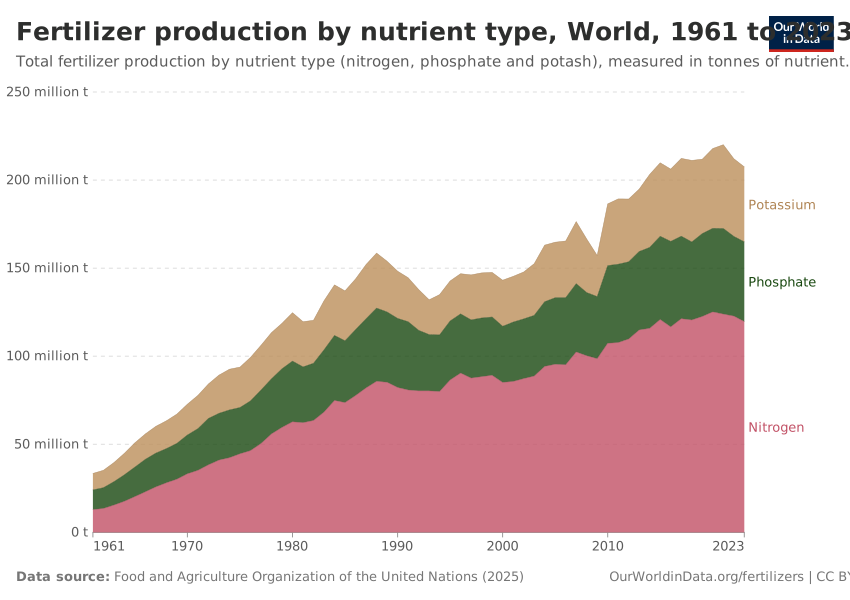
Fertilizer production has increased by 520 percent since 1961. (Our World in Data, CC BY 4.0)
Between 2002 and 2018, while the population increased by 22 percent, the per-hectare use of synthetic nitrogen, phosphorus, and potassium fertilizers—the three most common types—increased by about 23, 13, and 56 percent, respectively. However, the responsibility for—and benefits of—fertilizer use aren’t evenly distributed. Though estimates vary widely, some claim that industrial agriculture feeds only 30 percent of the population.
If so, we can add fertilizer to the list of ways high-income populations are disproportionately contributing to planetary breakdown. Artificial fertilizer is ecologically problematic out of the gate, as its production depends intimately on fossil fuels.
And as for fertilizer application, it is one of the world’s largest sources of water pollution. What’s more, in the long term, fertilizer degrades the very soil to which it is applied. This traps farmers in a vicious cycle, needing ever more external inputs to maintain high yields.
Agriculture and Fertilizer: Relationship Turned Toxic
Historians have found evidence of organic-fertilizer use from 8,000 years ago. Early farmers likely noticed that crops grew better where animals congregated, ingested, and defecated.
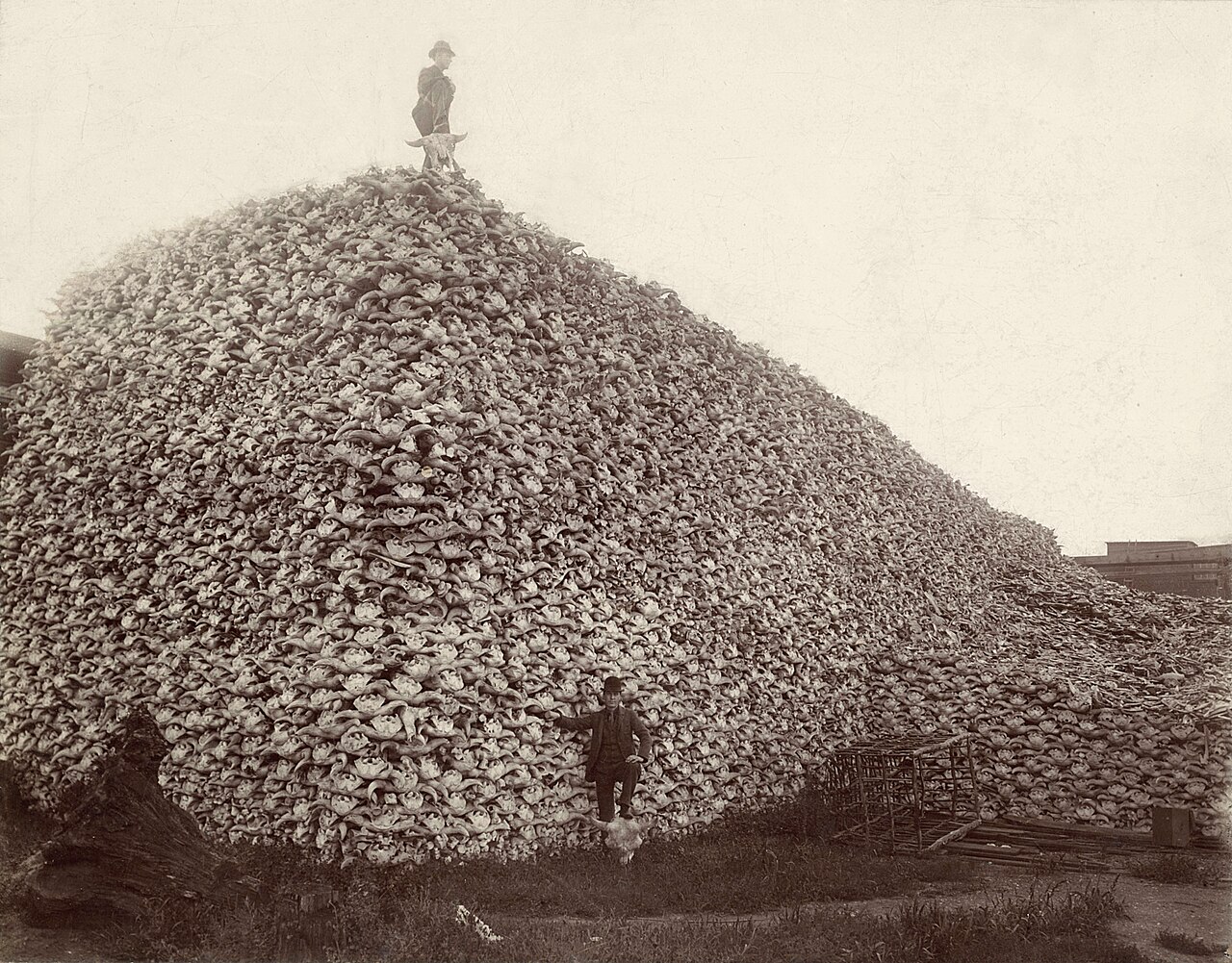
In the 18th century, it became common to use ground-up bones, such as these bison skulls, for fertilizer. (Soerfm, CC BY-SA 3.0)
However, it wasn’t until the 19th century that scientists made the leap from organic to inorganic, or synthetic, fertilizers (hereby referred to simply as fertilizers). Critical to this leap was the development of the Haber-Bosch process in the early 20th century. This process results in ammonia, the foundation of nitrogen fertilizers and a key ingredient in the most common phosphate fertilizers.
Fertilizer use accelerated in the 1940s. Ammonia, it so happens, is also a key ingredient in explosives. At the outset of World War II, the U.S. government constructed ten plants capable of producing 1.6 million tons of ammonia per year. After the war, priorities shifted from manufacturing munitions to restoring food supplies, and funding flowed to the agricultural sciences.
This funding was a catalyst for the Green Revolution, a 1960s movement that launched a productivity explosion in some parts of the world. High-yielding crop varieties are the poster children of the Green Revolution. However, the revolution would not have been possible without an accompanying boom in fertilizer use.
In recent decades, the ecological price of the agricultural model that spread with the Green Revolution has become painfully evident. Even the social benefits of this model, and their distribution, are hotly contested.
Making Fertilizer: Fossil-Fuel Feedstocks
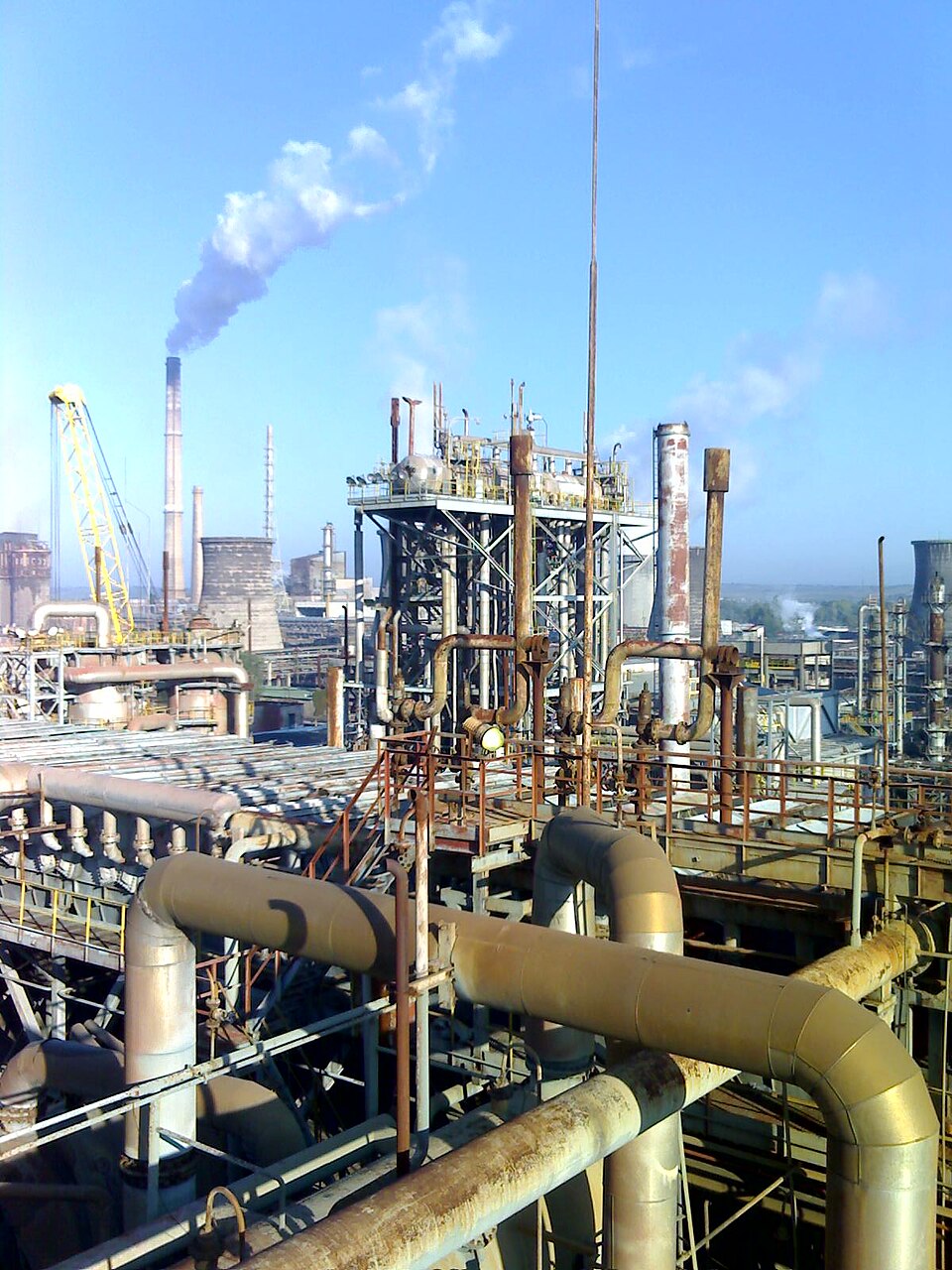
The trappings of ammonia production. (Tseno Tanev, CC BY-SA 3.0)
When most people think of the ecological impacts of fertilizer, they think of pollution from agricultural runoff. However, fertilizer’s assault on the environment starts at the factory. Like any manufacturing process, fertilizer production requires energy, overwhelmingly provided by fossil fuels. The production of ammonia accounts for about two percent of global energy consumption.
But ammonia production also relies on methane—aka, natural gas—as a feedstock for its chemical processes. The most common production method involves the following: Methane (CH4) is “reformed” with steam (H20), resulting in carbon monoxide (CO) and hydrogen (H2). H2 is the desirable output, reacting with nitrogen (N2) to produce ammonia (NH3).
But what happens with that “co-produced” CO? Water vapor is used to oxidize it, producing carbon dioxide (CO2). Because of this, greenhouse gas emissions are inherent to the ammonia production process, not just a byproduct of the energy used to power it, replaceable by renewables. In fact, over half the 450 million metric tonnes of CO2 emissions from ammonia production come from this chemical conversion of methane to hydrogen.
CO2 emissions aren’t the only ecological issue with fertilizer production. Phosphorus- and potassium-based fertilizers require inputs from mines, which are linked to ecological devastation. But now, let us turn to the arguably more frightening issues associated with fertilizer application.
Using Fertilizer: Polluted Waters and Lands
The agricultural sector is the leading cause of water pollution worldwide, releasing phosphate and nitrogen compounds that wreak havoc on the hydrosphere. In 2014, livestock produced upwards of 5.5 billion tons of manure—37 times more than the sewage that humans produced. Much of that is not actually (or effectively) used as fertilizer, but some of it was counted in the U.N. Food and Agriculture Organization’s estimate that the world consumed 183 million tons of fertilizer in 2020.
Much of the nitrogen in fertilizer doesn’t end up in crops. Instead, it leaks into our waterways, at devastating human and ecological costs. When the nitrate form of nitrogen accumulates in aquifers used for drinking, it can react with food in the body to make cancer-forming compounds.
Nitrogen and phosphate are key fertilizer ingredients because they stimulate plant growth. The wrong kind or too many plants can devastate ecosystems. When fertilizer runoff overloads water bodies—freshwater and marine—with nitrogen and phosphate, it catalyzes a process called eutrophication.
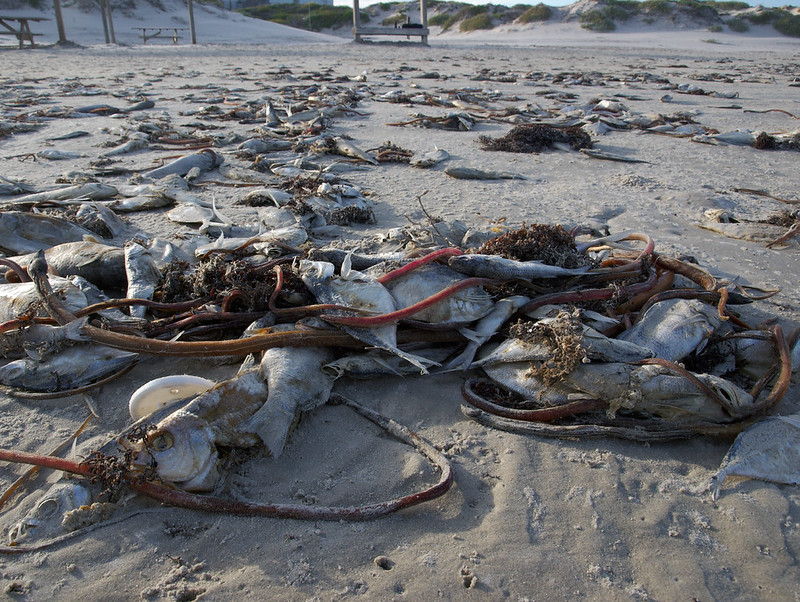
Fish kills are a common consequence of algal blooms caused by eutrophication. (Terry Ross, CC BY-SA 2.0)
Eutrophication can lead to algal blooms that are toxic to people and other organisms. It can also lead to hypoxia, otherwise known as dead zones, as the bacteria that decompose plant matter consume oxygen. Globally, dead zones increased tenfold from the 1950s to the 2000s.
In addition to its near-immediate polluting effects on water, in the long term, fertilizer also degrades the soil to which it is applied. It can deplete organic matter and harden and acidify the soil. Fertilizers can also contaminate soil with metals, endocrine disrupters, antibiotics, trace elements, and pathogens.
As if water and soil degradation weren’t enough, fertilizer application also leads to air pollution. Heavily fertilized fields release ammonia, which combines with other precursors to create particulate matter, the most dangerous form of air pollution. Additionally, soil microbes tend to misbehave when overloaded with nitrogen fertilizer, producing more of the potent greenhouse gas, nitrous oxide. They also consume more carbon and release more CO2, negating the soil’s vital carbon-sequestration abilities.
Fertilizer and the Growth Economy
Agriculture plays a special role in structuring (and growing) the economy. Fertilizer is a key component of the agricultural sector’s productivity increases. A 1 percent increase in fertilizer use is causally associated with a 4.5 percent increase in agricultural value per worker.
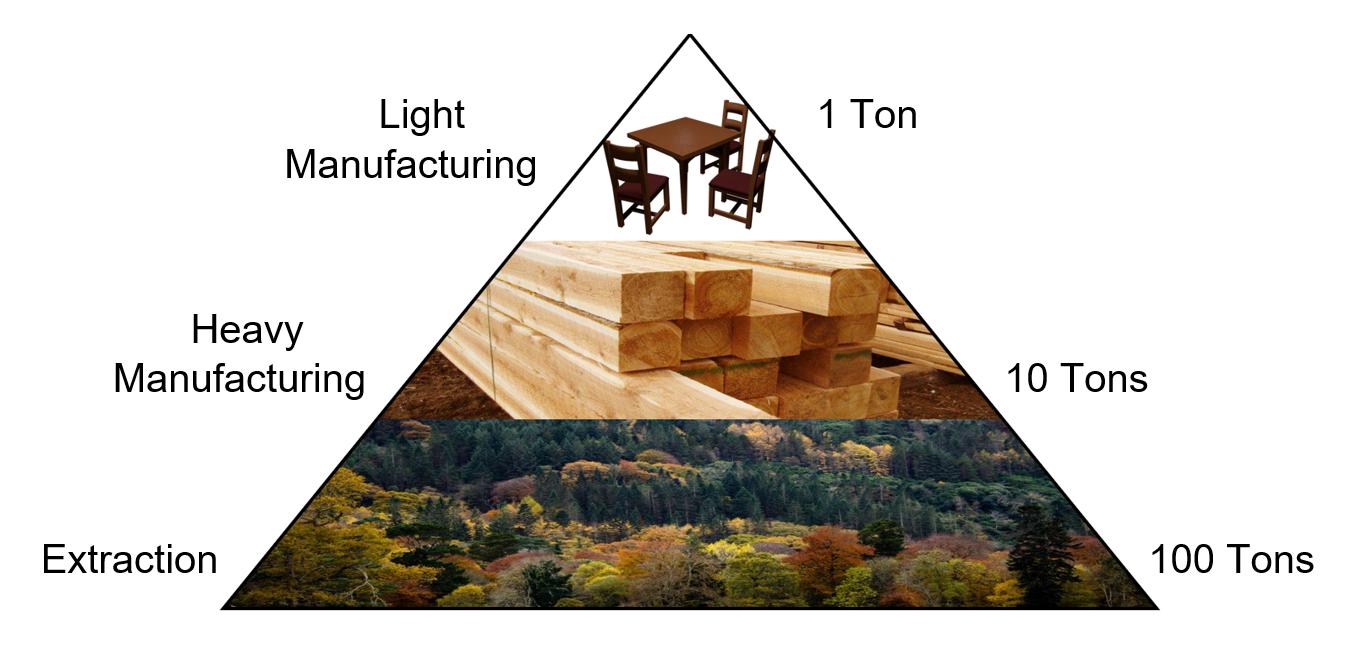
The less labor is needed to extract natural resources, including food, the more is available to turn them into higher-value economic products.
Productivity increases have enabled—or forced—countless people to migrate to other economic sectors. The result has been increases in economic output, aka growth, overall. We can represent this flow of labor, as well as energy and materials, from agricultural and extractive sectors, to heavy manufacturing, to light manufacturing, with a multi-level trophic pyramid.
And as labor moves up the pyramid, human diets require more inputs, including fertilizer, than ever before. In the United States, a third of the nitrogen and half of the phosphorus applied via fertilizer is used for corn and soybeans that feed animals, not humans. Alongside manure and other factors, fertilizer has given animal agriculture a reputation as the number one driver of global water pollution. All told, it is responsible for 43 percent of eutrophication.
It’s no coincidence that livestock production also contributes more than most other agricultural activities to economic growth. It accounts for 40 percent of agricultural GDP.
Subsidies Up the Growth Stakes
Fertilizer subsidies constitute one-tenth of subsidy spending in high-income countries and a whopping one-fourth in low-income countries. And yet the conventional government model for agricultural support—with fertilizer subsidies at its core—is relatively cost-ineffective. Public support for agriculture returns just 35 cents to farmers per dollar of support. This measure may not capture all the food-security benefits of this support, but clearly, governments could do better.
So, why do they stick to the fertilizer-subsidy status quo? According to the International Food Policy Research Institute’s Ruth Hill and Danielle Resnick, it’s because these subsidies have a unique combination of four qualities. They have immediate benefits, boosting short-term yields; they are readily visible, garnering support from voters; they can be selectively distributed according to political priorities; and they are simple to implement.
But the long-term costs of excessive fertilizer subsidies may extend beyond ecological degradation and inefficient use of public resources. Most governments finance their spending—including on fertilizer subsidies—partly via interest-bearing bonds or loans. Governments must pay off this interest with future public revenues. Particularly in low-income countries, this can pressure governments to divert much-needed income gains away from public well-being and toward debt servicing.
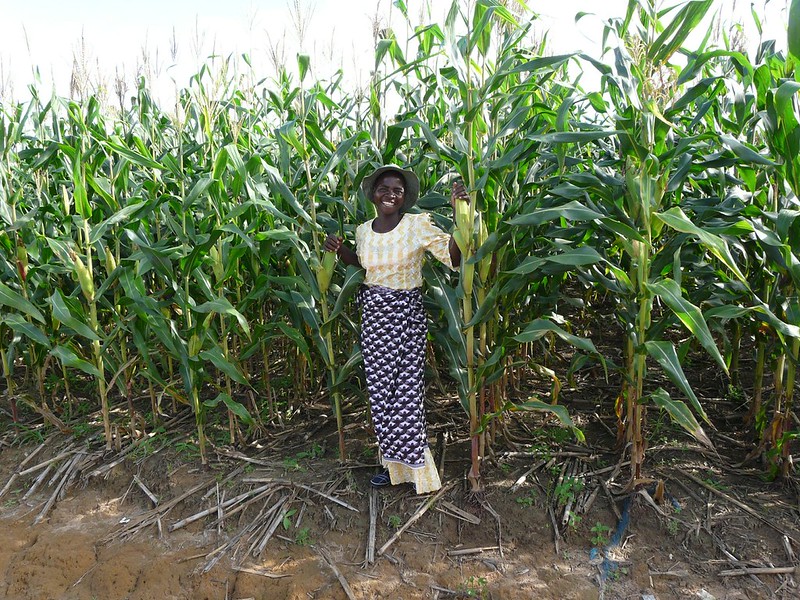
In Malawi, where almost half of public agrifood spending goes to input subsidies and public debt exceeds 90 percent of GDP, farmer Grace Malaitcha finds hope in conservation-agriculture practices. (CIMMYT, CC BY-NC-SA 2.0)
However, the relationship between fertilizer subsidies and international debt is complicated. In an interview for the Herald, Resnick, who specializes in the political economy of agricultural policy in Africa, said, “Prior to the 1980s, you had governments heavily subsidizing inputs [such as fertilizer] for farmers, who were usually very poor. Then, with the structural adjustments of the 1980s, these subsidies were seen as unnecessary expenditure. Many governments had to get rid of them as a condition of IMF or World Bank loans. And then, around the late ‘90s, early 2000s, they started to come back in vogue.”
According to Resnick, fertilizer subsidies generally benefit the poor more than other types of subsidies, such as fuel subsidies, in low-income countries. That said, they also benefit better-off farmers much of the time. However, it’s undeniable that many of the world’s most vulnerable people depend on yields that their land could not provide without fertilizer. Resnick said, “I don’t think we could get rid of fertilizer entirely, given the challenges with soil fertility that naturally exist in parts of the world.”
Suffice it to say, any attempt to reduce fertilizer use should simultaneously mitigate negative consequences for the poor. Resnick pointed to some promising developments, including “debt for climate swaps.” These entail debt forgiveness in exchange for the implementation of climate-friendly policies, which might include cutting back on fertilizer subsidies.
GDP and Fertilizer Use
Clearly, modern economies rely heavily on fertilizer. The question is: Does economic growth systematically drive fertilizer use and/or vice versa? To explore this relationship, we examined data from 173 countries between 1990 and 2023. We combined fertilizer-use data from the USDA Economic Research Service with real-GDP data from the World Bank.
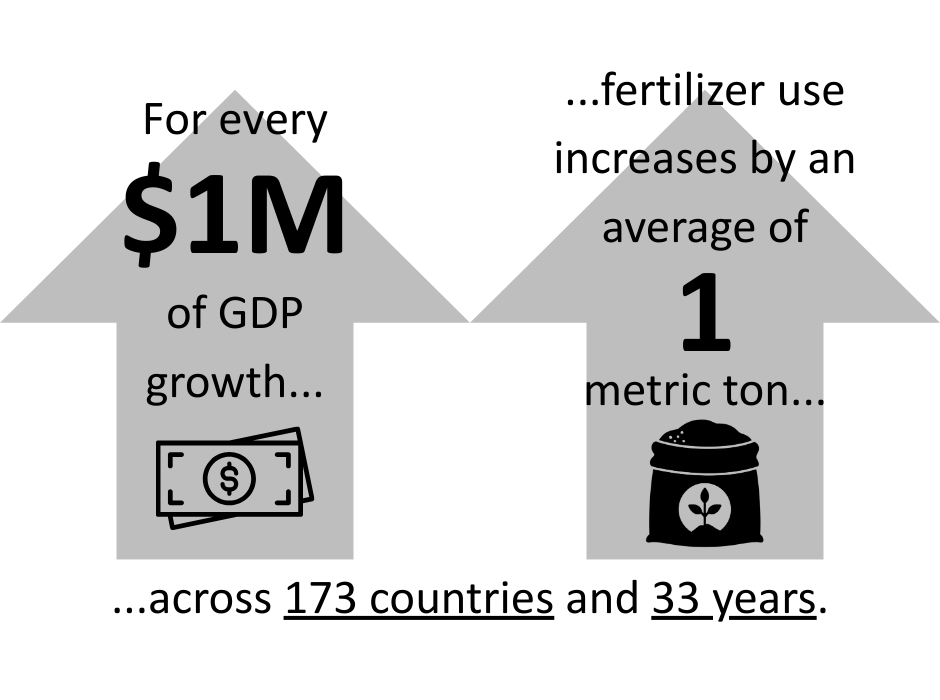
Fertilizer use is from the USDA Economic Research Service, and GDP is from the World Bank’s World Development Indicators.
We find that fertilizer use tends to rise as national economies expand. On average, within a given country, an additional one million dollars of GDP is associated with roughly one extra metric ton of fertilizer use. While the estimate is not statistically precise enough to eliminate uncertainty entirely, the relationship between fertilizer use and GDP remained positive when we ran alternative forms of the analysis model.
In plain terms, economic growth and fertilizer use move together. As the population grows and incomes rise, food demand increases and diets shift toward more fertilizer-intensive foods, particularly animal products.
Importantly, our measure reflects fertilizer applied within national borders. Some countries import much of their food, effectively outsourcing part of their fertilizer footprint. Although the value of imports is subtracted from GDP, the importing country may use that food as an intermediate input in higher-value activities, such as processing and food services. Food imports may also affect GDP indirectly insofar as they facilitate structural shifts toward non-agricultural, higher-value sectors (and more intensive diets).
Even so, the overall pattern suggests that under the current agricultural system, economic expansion remains tied to fertilizer-dependent production. If fertilizer degrades soil, pollutes water, and contributes to climate change, then growth in GDP implies more ecological pressure.
If we don’t reduce our fertilizer use proactively, it may be forced upon us to the detriment of food security. We are seeing a glimpse of this as the U.S.-Israel-Iran war chokes off the Strait of Hormuz, through which 20–30 percent of global fertilizer exports pass.
When asked whether this shock might catalyze a transition away from fertilizer dependence, Resnick said, “I don’t think so. If you look at all the shocks we’ve had recently, whether it’s the Russia-Ukraine war, COVID, or the food-price crisis in 2008, the reaction has often been to maintain or increase subsidies. Even international financial institutions will give low-income countries some breathing space on their debt to enable them to subsidize their farmers through the shock.”
This is a better outcome, of course, than widespread famine, but it begs the question: What will it take to catalyze the transition? If our response to shocks is to double down on fertilizer use, perhaps the key is to seize times of relative stability to implement change.
Organic alternatives to fertilizer are the surface-level solution, but their widespread adoption will only be possible if we intentionally degrow the industrial agriculture behemoth. Reducing fertilizer subsidies is a key first step, as is drastically cutting meat production. Both of these steps will shrink the profits of the fertilizer oligopoly, but, pursued carefully, they have the potential to improve human well-being, especially in the long term.
 Alix Underwood is managing editor at CASSE.
 Marwa Ebrahem is a master’s student in Applied Economics at The George Washington University and a Research & Insights Intern at CASSE.




It’s strange to read such a detailed analysis that ignores the role of overpopulation in “the fertilizer crisis.” What are we using all that fertilizer for, if not to feed ever more peope?
There is a brief mention of population growth two thirds of the way through, but no suggestion there or in the policy proposal at the end of the article that limiting or decreasing our numbers is an essential part of dealing successfully with this problem.
Thanks for pointing this out, Philip. I actually mentioned population in the 3rd sentence of the article. But I agree population is a blind (or at least undeveloped) spot here.
I chose to focus on consumption because people’s minds often go to population (as yours did) when it comes to agricultural limits, but the industrial model that’s causing most of the damage doesn’t feed as much of the population as we tend to think (though just how much is hotly contested, as I mentioned in the intro). What’s not contested is that the diets of high-income populations are disproportionately responsible. Those populations also tend to have lower birth rates.
But I agree that population is an important piece of the puzzle, as one of Resnick’s quotes illustrates well: Soil fertility is too low to support the population without fertilizer in many parts of the world (often with higher birth rates). [I’m using Resnick’s quote to make my own point here; I don’t know if she was implying population limits.]
I am glad that the authors mentioned “drastically cutting meat production”. Here is a link to a paper that quantifies the benefits on fertilizer requirements of reducing various animal food products in various countries and for various animal-food production systems: https://doi.org/10.1016/j.resconrec.2022.106820
Anyone, email me if you can’t access it (my email address is in the part that you can see even without access to the paper_
Synthetic fertilizer seems like another tragic example of humanity *increasing* reliance on a limited resource that is highly prone to disruption.
Sigh. That ain’t going to end well.
I would also recommend Lionel Shriver’s recent novel “A Better Life” that cleverly exposes many of the negative societal effects of mass immigration. One of the obvious other effects is that mass immigrations continues to increase the populations of developed country populations – that consume so many resources. Which in turn causes the use of polluting materials like fertilizers to increase. and the fertility of soils to decline and soils often to be washed away and lost forever.
Interesting, Winthrop. I’m not a fan of the “keep them out so they don’t consume as much as us” rhetoric. I think our priority should be to stop consuming more than our fair share of natural resources (I use “our” assuming you, like me, live in a high-income country and have an unsustainable ecological footprint). But I acknowledge that the issue you point out is indeed problematic under the consumption status quo.
Good article, thanks. As for the possibility to “feed the world” without N-fertilizers, it will be hard but I believe it is possible with a combination of:
Recycling of organic waste from all parts of the food system, including human excrements.
Reducing food waste.
Integration of livestock and crop production.
Considerable use of permanent, non-fertilized grasslands. This doesn’t necessarily mean expansion of grasslands, but rather better use.
Expanded use of biological nitrogen fixation through, among others, the cultivation of leguminous plants. This is not limited to peas and beans for direct human consumption but also clover and alfaalfa for forage, the growing of leguminous plants as cover crops or living mulches and leguminous trees in forest gardens, permaculture, silvopastoral or agroforesty systems.
Adaptation of diets to what works well in an organic production system. Notably an appropriate organic diet is not the same in all parts of the world. The notion that there is one good global diet with largely the same composition is socially, culturally and ecologically inappropriate. On the contrary, they diet should be adapted to what can readily be produced locally.
Instead of describing it as a set of technologies or practices it can better be seen as a change in the whole food system based on the integration of food production and consumption into the local ecological context.
https://gardenearth.substack.com/p/the-nitrogen-challenge-for-organic
Excellent article Alix. I note you mention that meat production is one of the highest users of fertilisers. I haven’t looked at the figures but I know feedlotting beef is very big in the US compared to Australia where I live (though feeding lambs appears to be gaining popularity here, unfortunately). Regardless, it is a terribly inefficient way to produce meat – it takes up to 6kg of feed to add 1kg of meat. We should be growing food for human consumption and letting cattle eat mostly grass – it tastes better, is much healthier for us, the animal and the planet. Cattle are not meant to eat large quantities of grains, so they are not healthy when they are slaughtered for human consumption. I don’t believe that methane from cattle is a big contributor to climate change, but feedlot animals would definately produce more of it due to their stomachs trying to process all the high energy feed.
We obviously didn’t learn anything from the pandemic regarding becoming more self-sufficient, either indivually or as nations, since we are now facing shortages of many things in many parts of the world due to over-reliance on world trade. Wake up everyone! fertiliser is a relatively easy ‘commodity’ to substitute – start utilising ‘waste’ products to make composts!
Thanks, everyone, for the discourse! Wow, L. D. Danny Harvey, I wish I’d seen your article before publishing this; we would’ve used the findings.
Lee, I’m sure you’re right that different livestock systems require drastically different amounts of fertilizer (perhaps Harvey’s article addresses this). But grazing cattle certainly doesn’t eliminate their ecological impacts and may have some unique impacts (e.g., land degradation/erosion). And my sense is that if we produced as much as we do now with grazing systems, the land footprint would be larger. But I’d love to see some research on that!
And to your point about methane, here are some quick stats from the first source Google fed me, from UC Davis: “Cattle are the No. 1 agricultural source of greenhouse gases worldwide…Livestock are responsible for 14.5 percent of global greenhouse gases…[Methane] is shorter lived than carbon dioxide but 28 times more potent.” (https://www.ucdavis.edu/food/news/making-cattle-more-sustainable#:~:text=Cattle%20are%20the%20No.,the%20Department%20of%20Animal%20Science.)
Cattle may have a place in some local diets where protein-rich produce isn’t available year-round, as Gunnar Rundgren suggests, but I don’t think we can get around the need to eat much less of it.